01In how many homes is one film shot?
The rise of Yeşilçam, the Turkish film industry, begins in 1948, when the ticket tax on domestic films was lowered. To understand its relationship with architecture, however, one first has to know about something that was missing: there were no studios. The films, which reached two hundred and even three hundred a year, were shot without sound stages on which sets could be built. The solution was real homes. The producer rented a mansion or a waterside house by the day; the crew arrived in the morning and packed up in the evening.
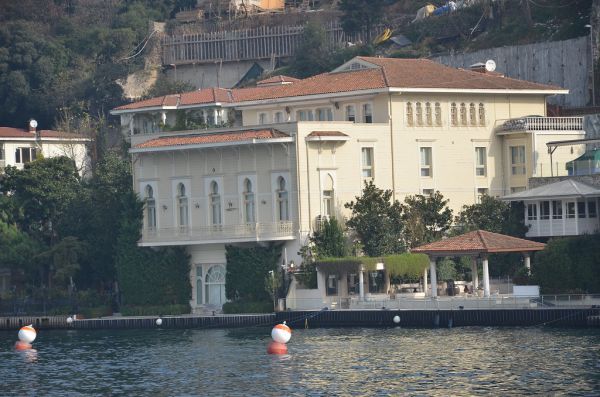
This method had two consequences. The first was that the same homes came to the screen again and again. Researchers write that the interiors and exteriors of the same five or six dwellings are found in almost all the films shot in Istanbul in the 1960s. A few waterside houses on the two shores of the Bosphorus, a few mansions in Beylerbeyi, Kanlıca and Yeşilköy, and the lobby of a single hotel for the hotel scenes. The audience came to know those homes without ever seeing them; and some owners of mansions made a living by renting out their homes.
The second consequence is less well known: the home we see on the screen was very often not a single home. The exterior was shot in one district, the salon in another, the kitchen in a third place. In one film the inside of the grocer’s shop is in Beykoz, its outside in Cankurtaran, the coffee house in Kemerburgaz and the apartment block in Yeşilköy. The home of Yeşilçam is a building put together in the editing; its plan cannot be drawn.
Why do all the homes of the rich in old films look alike? Because most of them are the same home. A wide entrance hall, a staircase curving upwards and, above, a gallery opening onto the rooms: this was one of the rare plans in which the camera could show, from a single angle, both the quarrel between father and daughter and the guest coming down the stairs. Directors liked that plan, and the audience came to identify the home of the rich with it.
02The three homes on the screen
Yeşilçam’s repertoire of dwellings is small, and the meaning of each home is clear from the start. Studies of space in these films reach the same conclusion: the dwelling used most often is the mansion, followed by the waterside house and the wooden house. The home tells us who the character is in the first frame, and very often it does no other job.
The mansion and the waterside house. It is the home of the factory owner, the shipowner, the “villainous” father. Inside it there are a Western suite of seating, a piano, a drinks cabinet, the portrait of a family elder on the wall, and a young people’s party in the salon. This home shows wealth, but in most films it is cold: love is not lived there; it is prevented there.
The neighbourhood house. A wooden house of two storeys, with a courtyard or with a door that opens onto the street. It is the home of the poor but warm family. The meal is laid on the floor or on a small table, the neighbour comes in without knocking, and the grocer sells on credit. This is the moral centre of the films.
The apartment flat. For a long time it stays in third place. After the mid-1970s it moves to the front; the back street, the apartment flat and the gecekondu, the informally built house, where the mass of people live, take the place of fairy-tale settings such as the mansion and the waterside house. When the apartment block comes to the screen, new types come with it: the caretaker, the building manager, the contractor.
If one looks carefully, there is a gap between these three homes. The ordinary apartment flat that was multiplying quickly in the cities in those years, where the civil servant, the teacher and the small shopkeeper lived, that is, the home of the real middle class, is almost never seen in the golden years of Yeşilçam. On the screen there are either the very rich or the very poor.
03Who was the audience?
Without knowing who watched these homes, it is hard to understand why they were shown in this way.
This means seven tickets a year per person, including infants and those living in villages. In those years the cinema was less a branch of art than the country’s shared evening entertainment.
As for the kind of country in which the audience lived: in 1950 three quarters of the population were in villages, and more than half could not read or write. In 1960 the literacy rate was still around 39%. By 1970, 28.8% of the population had completed primary school; those who had completed lower secondary school were 3.6%, those who had completed upper secondary school 2.6%, and those with higher education 1%.
These figures explain the language of Yeşilçam. For most of the audience, novels, newspapers and magazines were distant things; the way to hear a story was the screen. A film had to be understood at a glance even by someone who could not read subtitles, who had only just seen the city, who had perhaps come from the village that week. This is why the home was reduced to a sign: the mansion meant rich, the wooden house meant a good person. Architecture was a costume that left no need for words.
04Whose home was the mansion?
The wealth on the screen was not invented; it simply belonged to very few people. Income distribution in Türkiye was measured for the first time in 1963, and then in 1968 and 1973.
In other words, the gulf in the films was real. The unchanging subject of the melodrama, the rich girl and the poor boy, or the reverse, who cannot be united, was born less of imagination than of this table. What Yeşilçam did was to show the two ends of the gulf and leave its middle empty.
The other end of the gulf was also different from what was on the screen. The poor person in the films lives in the wooden house of an old neighbourhood, among neighbours known for generations. In reality the home of the poor person newly arrived in the city was the gecekondu.
The share of those living in gecekondus in the urban population was 4.7% in 1955; it rose to 16.4% in 1960 and to 22.9% in 1965. In the capital, three out of every five people were living in a home that had not been there ten years earlier and that its owner had built with his own hands. For a long time Yeşilçam did not see this home; and when it did, it usually showed it with the warmth of a neighbourhood. The films that brought the mud, the lack of water and the demolition crew to the screen remained a minority.
There is a choice here, and its reason is understandable. The person who bought the ticket was not coming to see his own home. What he wanted to see was either a salon that he would never be able to enter or a neighbourhood that he thought he had left behind. The cinema gave him both at once.
05The radio, the television and the corner of the salon
The two objects that changed the inside of the home most arrived in this period, and both appeared in the homes in films before they appeared in real ones.
On the screen the radio is a natural object in every home. In reality, in 1960, in a country of 27.8 million, there were 1.34 million licensed radios; roughly one set for every four or five households. The home that had a radio was the home where the neighbourhood gathered. It is no coincidence that it stood on the sideboard, on a lace cloth: it was one of the most expensive objects in the home, and it was shown to guests.
Television came later and more abruptly. The trial broadcasts of TRT, the state broadcaster, began in Ankara on 31 January 1968. In 1966 there were about two thousand sets in homes and workplaces in the whole country; in those years television was watched mostly in company, in hotels, patisseries and coffee houses. In 1974 broadcasting reached 55% of the population. In its tenth year the number of registered sets reached 2.25 million.
The effect of this on architecture is seen in two places. The first is the cinemas: the fall in Figure 1 is the fall of these years. The second is the salon of the home. The guest room, whose door had been kept closed, became the room used every evening once the television had come in. The armchairs stopped facing one another and turned to the same wall. The neighbour came again, as in the years of the radio; this time he came “for the television”. What opened the best room of the home to daily life was not an architectural decision but a device.
06The street: the car, the shared taxi, the bus
In Yeşilçam there is always a car at the door of the home of the rich; usually a long American car with tail fins. The young man collects his sweetheart by car and drives along the coast road. Someone looking at the screen might think that the car was an ordinary thing in those years.
At the beginning of the 1960s there were more lorries than cars on the roads. Imports were restricted; domestic production began in the second half of the 1960s, and the real increase came in the 1970s. The car we see in the films, like the mansion, was the daily life of a very small minority.
The real vehicle of the audience was a different one.
The dolmuş, the shared taxi, is an invention of this period that is particular to Türkiye, and it was born of the same logic as the gecekondu: the people’s own solution where the state could not keep up. The minibus went to the new neighbourhood where the municipal bus did not go; as the neighbourhood grew, the route grew longer. The share of these routes in the present form of the cities is no smaller than the share of the development plans that were drawn.
Yeşilçam liked the shared taxi and the minibus in comedies and did not see them in melodramas. The love story takes place in a car; a scene that takes place in a shared taxi is comic. This distinction shows which life the screen regarded as “real life”.
07When Ankara appears on the screen: Yeşiltepe
Yeşilçam is a cinema of Istanbul; Ankara is rarely seen on the screen. One of the places where it is seen is the Yeşiltepe Blocks, whose plan appears in our article on apartment plans. Part of a comedy of 1974 about migration from the village to the city was shot here.
The choice is meaningful. A place was sought that could be set before the heroes from the village as “the city”, and the star-shaped, ten-storey blocks standing in gardens were found. According to what residents of the blocks relate, the building had originally been built mainly for members of parliament, and in those years American families were living in every block. For the film, this was the most distant and most foreign form of the city in the eyes of a villager.
So there are two different readings of the same building. For the history of architecture, Yeşiltepe is an experiment in which a cooperative offered the middle class flats with a flexible plan. For the cinema it is a sign: modern, tall, cold, “not one of us”. The job done by the mansion in the Istanbul films is done in Ankara by the concrete block. The building is the same; the screen gives it meaning according to where the audience feels it belongs.
08Side by side: on the screen and in the street
| Subject | On the screen | In the street |
|---|---|---|
| The home of the rich | A mansion or waterside house on the Bosphorus; always the same five or six homes | Only a small part even of the fifth that received 60% of income |
| The home of the poor | A wooden house in an old neighbourhood, familiar neighbours | The gecekondu: 59% of the population in Ankara, 45% in Istanbul |
| The middle-class home | Almost absent until the mid-1970s | The apartment flat, multiplying quickly; in the 1960s most permits in Ankara were issued for apartment blocks |
| The plan of the home | A large hall with a staircase in the middle; arranged for the camera | Rooms lined up along a corridor, a salon with its door closed |
| Radio and television | A natural object in every home | In 1960, one radio for every four or five households; in 1966, about two thousand televisions in the country |
| The car | In front of the door, an everyday thing | In 1970, one car for every 260 people |
| Travel within the city | By car, along the coast road | By bus, shared taxi and minibus |
| Education | Heroes who are doctors, engineers, lawyers | In 1970, those with higher education were 1% of the population |
| The modern building | Cold, foreign, dangerous | The home that the middle class founded cooperatives in order to reach |
09Synthesis: what did the films get right?
It is easy to look at this table and conclude that Yeşilçam lied, and that conclusion is incomplete. It is more accurate to say this: the films misled about objects; they did not mislead about feelings.
Where they misled. The setting did not represent reality. The car, the mansion, the piano, the television: all appeared far more widespread than they really were. The home of the middle class and the gecekondu, on the other hand, appeared far less than they really were. Someone trying to reconstruct the Türkiye of those years from a film archive would think the country richer, more urban and more motorised than it was.
Where they told the truth. The real subject of the films was not the home but moving from one place to another. In twenty years millions of people moved from the village to the city, from the wooden house to the apartment block, from the street they knew to a neighbourhood they did not know. This move had both its attraction and its fear, and Yeşilçam placed the two in two separate homes: desire lived in the mansion, and security in the neighbourhood. That the modern home is shown as cold and the old home as warm is not a criticism of architecture; it is the story that a displaced society told itself.
What they left behind. The truly lasting effect of the cinema is that it shaped taste. In a country where literacy was low and magazines and shop windows were few, it was the screen that gave the idea of the “beautiful salon” to millions of people at the same time. Armchairs bought as a set, the glazed display cabinet, the crystal chandelier, the guest room with its door kept closed: those five or six mansions had their share in the way these were repeated in the same form, for a generation, in every city of the country. The audience could not buy the mansion, but it tried to make its salon resemble it.
Then the order changed. When television entered the home the cinemas closed, the furniture of the salon turned towards the screen, and the image of the “model home” passed from the cinema screen to the television series. Today housing advertisements and social media do the same job: a small number of carefully chosen homes, in most of which nobody lives, build the idea of “this is what a home is like” for millions of people.
10What follows from this today?
From the point of view of interior architecture the lesson of this story is plain. People very often want their homes not according to the life they live but according to an image they have seen. In 1965 that image was the staircase of a Bosphorus mansion; today it is the kitchen island in the brochure of a residence tower. What the two have in common is that they were photographed for someone else’s life.
- Ask about the day, not the image. If the first question when a home is being designed is “how should it look”, the answer will inevitably be a photograph seen somewhere. The question “what happens here from seven in the morning to eleven at night”, on the other hand, gives a different plan in every home.
- Watch out for the best room that is not used. The closed guest salon belongs to the past, but its place has been taken by showy suites of seating on which nobody sits and kitchen islands at which nobody cooks. The most expensive square metres of the home are still being set aside for others.
- Choose the place of the screen yourself. Television once determined the arrangement of the salon on its own. Today the phone and the laptop do the same thing; if the plan does not show them a place, they choose their own.
- Take the street into account. The films thought of the home together with the car; the city grew with the shared taxi. The daily comfort of a home is determined as much by where one goes on leaving its door, and by what means, as by the width of its salon.
Most of the homes of Yeşilçam no longer exist today; some were demolished, and a road now passes in front of others. But the way of looking that those homes taught remains. To notice it is the first step towards designing a home not for someone else’s film but for the day of the person who will live in it.