01A claim first: the machines did not reduce the work, they raised the standard
In 1983 a historian of technology examined a hundred years of household appliances and reached an uncomfortable conclusion: the total time spent on housework had not fallen as expected as the machines multiplied. Two things had happened. First, the jobs that used to fall to men and children (chopping wood, carrying water, beating carpets) had disappeared, and all the jobs that remained had gathered in one person, the woman of the house. Second, the standard of cleanliness had risen: when washing became easy, things were washed more often.
This claim should be kept in mind while reading the objects in this article. Each of them lifted a real burden. Each of them at the same time redefined what a “clean home” means. And each left a mark on the plan of the home: a laundry room, an iron bracket, a balcony.
02Sweeping: from the besom to the carpet sweeper
The besom. It is made by drying and binding broom corn; its handle is short and it is used bending over. The short handle has a reason: to gather the dust close to the floor with short strokes, without scattering it. It still stands in many homes today, for taking crumbs off the carpet and the kilim. Its price is paid by the back.
The carpet beater. A leaf woven of cane, with a handle. The carpet is hung on the balcony rail or on the line in the garden and beaten; the dust comes out in a cloud. That is why the job is done outdoors and has a season: spring cleaning. Taking up the carpets and carrying them to the balcony, moving the furniture, cleaning the windows is an event that draws the whole family, and very often the neighbour, into the work. In summer the wool carpet was put away and a kilim or a mat was laid in its place; the house dressed and undressed with the season.
The carpet sweeper. Imagine a sweeper that works without electricity. Patented in America in 1876, this tool consists of a rotating brush set inside a low box. When you push the box the wheels turn, the wheels turn the brush, and the brush lifts the crumbs from the carpet and throws them into the small pans on either side. Its Turkish name, gırgır, comes from the sound it makes.
The heyday of the carpet sweeper in Turkey was the 1970s and 80s, and the reason was not price alone. The vacuum cleaner was expensive, heavy and noisy, and in those years the electricity was often cut. The sweeper was light and quiet, it stood by the wall, and the carpet could be gone over in two minutes before the guests arrived. As design it is an elegant object: its only moving part is the brush, and there is almost nothing in it to fail.
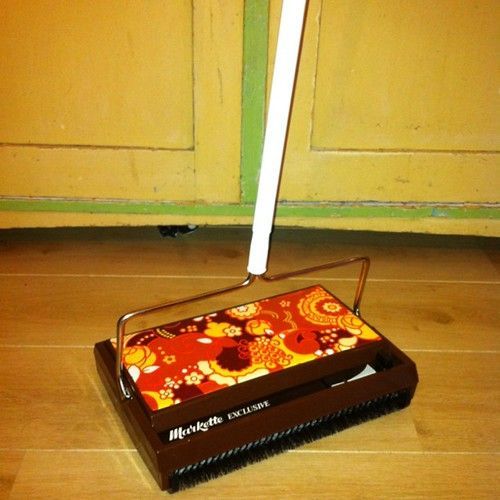
What ended it was its limit where dust was concerned. The sweeper takes the crumbs; it does not take the dust worked into the base of the carpet. When the vacuum cleaner became cheaper and lighter it withdrew from homes. But the idea did not die: it is the sweeper passed quietly between the tables in restaurants, and today’s robot vacuum cleaners use the same rotating brush alongside suction. The carpet sweeper is the motorless ancestor of the robot vacuum cleaner.
03Wash day: a day’s work
Before the machine, laundry was a job that took one whole day of the week, and it had objects of its own. Water was heated in a cauldron, the laundry was soaked in a basin, soaped and washed by rubbing on a ribbed washboard or by beating with a paddle, rinsed several times, wrung by hand and hung. Whites were boiled, a pinch of laundry blue was added to the last rinse to take away the yellowing, and shirts were starched. A family’s weekly wash meant tens of buckets of water and hours of arm power.
This work needed space. In a detached house, the garden or the courtyard; in old apartment blocks, a shared laundry room: very often on the roof or in the basement, a room with a hearth for the cauldron and a stone trough, and beside it a terrace where the washing was hung. The owners of the flats used it in turn. Many a roof room that today has become a lift machine room or a store is an old laundry. The shared laundry was one of the few places in the block where neighbours met regularly; when the machine entered every flat, it disappeared too.
04Wringer, twin-tub, automatic: the machine in three steps
The wringer washer. A tub filled from the top, at its base an agitator that turns the water and the laundry to and fro, and on top a wringing device made of two rubber rollers. The motor does the washing; but you fill the water, you empty it, and you pass the laundry piece by piece between the two rollers. The wringer uses simple physics: the narrow gap between two cylinders squeezes the water out of the cloth. It is far more effective than wringing by hand and it spares the wrists. Its danger is here too: the two turning cylinders also draw in the finger that pushes the laundry. Getting a hand caught in the wringer is a shared memory of that generation.
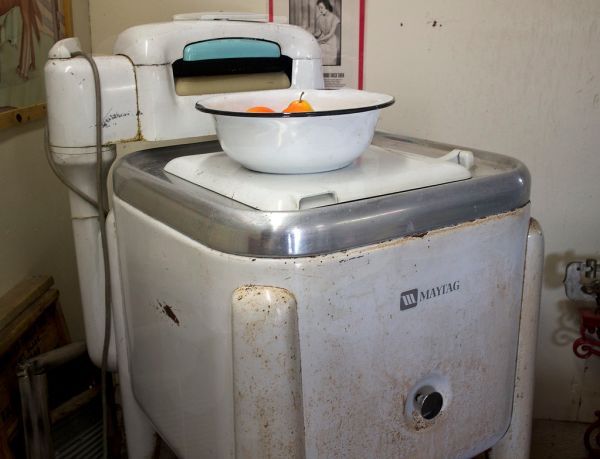
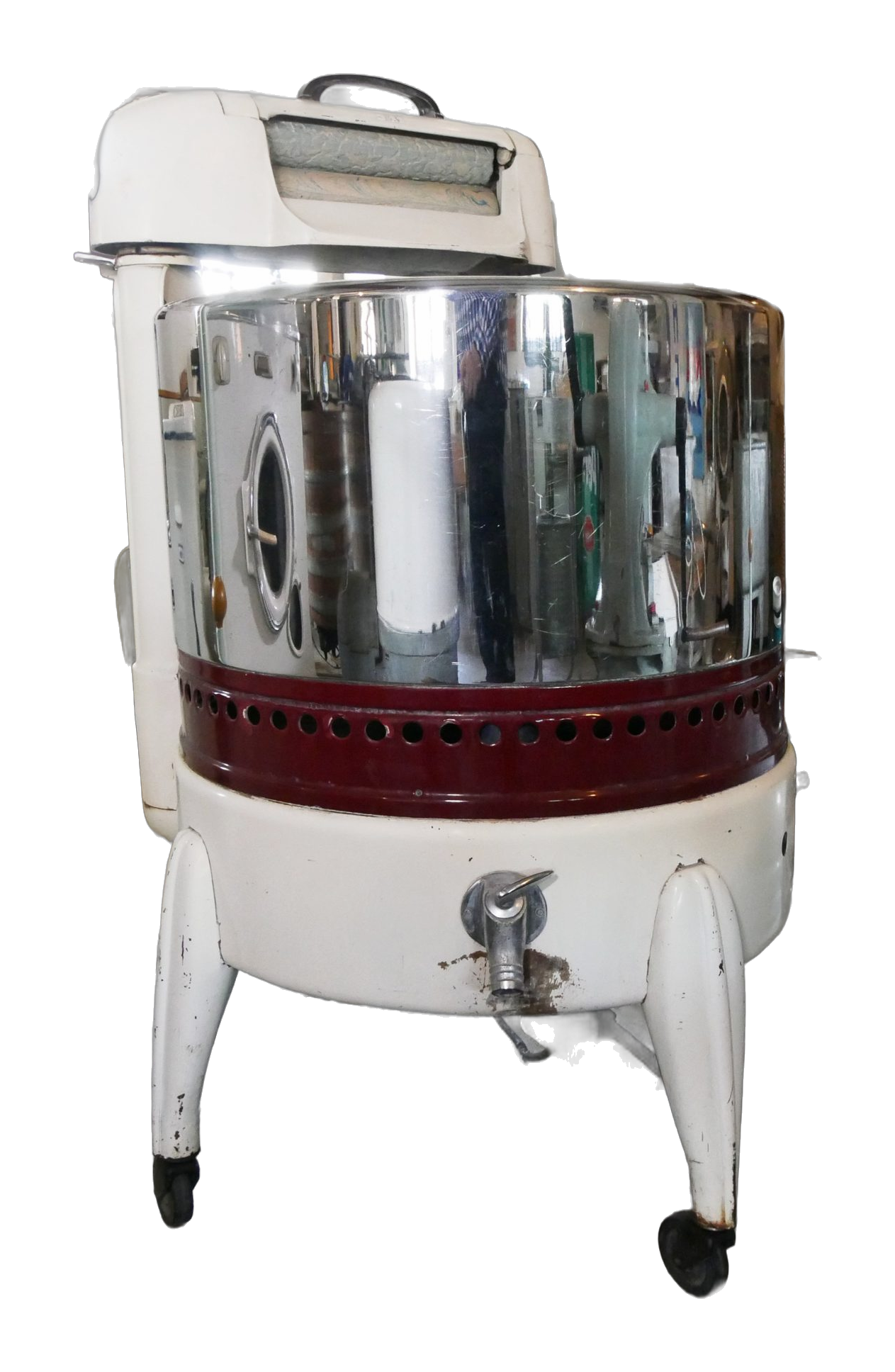
The twin-tub. A box with two compartments and two lids: the wash tub on one side and the spin drum on the other. After washing, the laundry is moved by hand to the other compartment and spun there at speed. Here the principle changes. The wringer squeezes; the spin drum flings. In the turning drum the water flies out through the holes; the laundry comes out almost merely damp.
The walking machine. That generation has one more memory, and it is not made up: the washing machine travelled. When it came to the spin it set off from one corner of the bathroom and went as far as its hose allowed, sometimes coming to rest against the door and shutting you in. The physics is simple. If the wet laundry gathers on one side of the drum, the rotating mass is out of balance and pushes the machine to one side on every turn; this push, repeated tens of times a second, makes a light body hop and walk. The wringer washer, which did not spin, behaved better, but it stood on castors and it too crept slowly as its agitator worked; the real travellers were the twin-tub with its spinning compartment and the first automatics. The members of the household who sat on top of it were the vibration dampers of the day. If today’s machines do not walk, the reason is not intelligence but weight: inside their bodies they carry a concrete block of tens of kilograms, put there only so that the machine stays where it is. What hurts your back when you move the machine is not the laundry but that block.
The automatic machine. It washes, rinses and spins in a single drum, by itself; it takes in its own water and drains it. Two things are needed for this: water under pressure piped into the home, and a drain. The automatic machine is not only an object; it is a demand for plumbing. The first washing machines in Turkey were produced in 1959; the automatic entering every home waited for mains water and uninterrupted electricity to enter every home.
The question of where in the home the machine should go has not been settled in half a century. First it went into the bathroom, because the water was there; the bathroom shrank. Then it went under the kitchen worktop; its noise moved into the living area. Then it was put out on the balcony, and the balcony was glazed in. Today a separate laundry room is being drawn again in new housing. The laundry that came down from the roof into the flat sixty years ago now wants its own room back inside the flat.
05The washing line: the balcony’s real job
Washed laundry has to dry, and in most of Turkey sun and wind are enough for that. This is the reason the balcony was once the hardest-working place in the home.
Balcony irons. The iron arms that reach out from the balcony railings of old apartment blocks, and the wires stretched between them, are clothes lines, designed together with the building. The laundry dries outside the façade, in the air; the balcony stays free.
The pulley line. The solution of the narrow streets is cleverer still. Two pulleys are fixed between two facing buildings, or between a building and a post, and a single line with its ends joined is passed around them. Because the line forms a loop, one works without ever leaning out of the window: the laundry is pegged, the line is pulled, and the next place comes in front of you. The whole street turns into a drying area and nobody leaves home.
Hanging laundry did one more thing: it told the street about the home. How many children there are, whether a baby has been born, whether guests have come, how particular the lady of the house is; all were read from the line. The whiteness of the whites was a matter of standing. Today the same visibility has been reversed: in many housing estates and new buildings hanging laundry on the façade is forbidden by the management plan. The washing line has turned from a sign of neighbourhood into “visual pollution”. This change has to do not with cloth but with class.
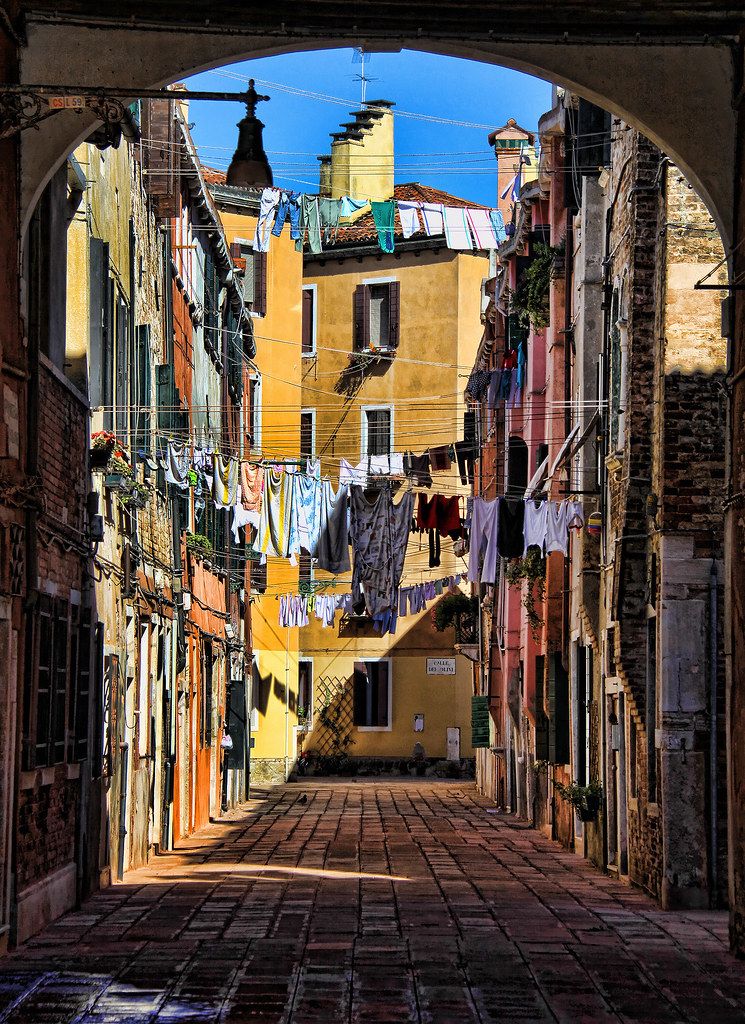
The fate of the balcony was tied to this as well. The tumble dryer and the folding airer opened indoors took the laundry inside; carpets were no longer beaten and wool was no longer spread out. The balcony, left without work, was glazed in and added to the room. In today’s housing plans the shrinking of balconies, or their turning into the “French balcony”, is a loss of work more than a change of taste.
Why does laundry dried indoors make a home mouldy? A machine load of laundry carries a few litres of water when it comes out of the spin. On the balcony that water goes to the wind. Dried in the living room, the same water mixes with the air of the room and condenses on the coldest surface, that is, at the window edge and in the corner of the outer wall. In an uninsulated flat with airtight windows, drying laundry indoors in winter is like spraying a few litres of water on the wall every week. The remedy is not expensive: to leave the window of that room ajar while drying, or to gather the laundry in a single ventilated room.
06Iron, starch, mothballs
The charcoal iron. An iron box with a lid and a chimney, filled with embers. Its weight is not a fault but a function: cloth is smoothed by pressure as much as by heat. Its temperature cannot be set; a practised hand tests the iron on a damp cloth before touching the fabric. The electric iron made it lighter, and the thermostat took the place of skill.
Starch and laundry blue. A starched collar or cloth holds for days the shape the iron gave it, and takes the dirt on the layer of starch and not in the fabric. Laundry blue is an optical illusion: a pinch of blue added to a yellowed white suppresses the yellow and the cloth looks whiter. The optical brighteners in today’s detergents perform the same trick by chemistry.
Mothballs and the chest. Woollens were put away in the chest in summer, with mothballs between them against the clothes moth. The seasonal wardrobe is an arrangement inherited from the bedding cupboard and the chest. The smell of mothballs is a generation’s memory of the start of winter; the substance itself has largely withdrawn from homes for reasons of health.
07Wool: the quilt maker, the wool carder and the bed spread on the roof
Mattress and quilt were filled with wool, and wool is a living material: with time it felts, forms lumps and holds damp and smell. So once a year, most often at the start of summer, the mattresses were unpicked, the wool was washed and spread on the roof, the balcony or the garden to dry in the sun. The dried wool was fluffed up by beating with a stick or by giving it to the carder. The carder’s bow-shaped tool vibrates when its string is struck with a mallet and separates the wool fibres from one another; the sound it made as he passed down the street was the advertisement of the trade. Then the quilt maker put the wool back in its cover and fixed it with patterned stitching; the job of that stitching is to stop the wool gathering in one corner.
The wool quilt is heavy, and that weight was what the cold bedroom needed. When homes became warm it was too much; light synthetic fibre and down took its place. With that, a series of things went too: the carder and the quilt maker, the flat roof and the wide balcony where wool was spread, that great household task of early summer. The habit of airing every day, however, remained: the quilt hung from the window in the morning is the daily form of the same knowledge. Wool takes up damp and gives it up to the sun.
08Side by side
| Object | How it works | The place it needs in the home | What ended it | Today |
|---|---|---|---|---|
| Besom | Gathers with short strokes | Behind the door | It has not ended | For the carpet and the balcony |
| Carpet beater | Drives out dust by beating | Balcony rail, garden line | The vacuum cleaner, carpet-washing plants | Rarely |
| Carpet sweeper | A brush turned by the push | By the wall | The cheaper vacuum cleaner | In restaurants; ancestor of the robot vacuum cleaner |
| Basin, washboard, cauldron | Rubbing, beating, boiling | Courtyard, shared laundry | The machine | For pieces washed by hand |
| Wringer washer | The agitator washes, the rollers wring | Bathroom; pulled into the middle when in use | The twin-tub, the automatic | None |
| Twin-tub | One compartment washes, one spins | Bathroom, balcony | The automatic | In summer houses and the countryside |
| Balcony line, pulley line | Sun and wind | Façade, street | The tumble dryer, estate rules | In old neighbourhoods |
| Charcoal iron | Embers, weight | Beside the brazier | The electric iron | An ornament |
| Wool quilt and mattress | Wool holds air | The bedding cupboard; roof and balcony in summer | Warmer homes, synthetic fibre | Continuing, in decline |
09What did it bring, what did it take away?
To belittle what it brought is never to have done that work. Boiling a cauldron, carrying tens of buckets of water and wringing a family’s sheets by hand was heavy physical labour; the machine lifted it. It gave back hands, wrists and one whole day. This is one of the material conditions of women being able to work outside the home.
What it took away falls under three headings. The first is sharing: spring cleaning, wool washing and the shared laundry were times when the work was spread across the family and the neighbours; the machine shut the work into the home and onto a single person. The second is measure: the easier washing becomes the more we wash, and the easier drying becomes the more electricity we spend on a job the sun does for nothing. The third is space: the laundry room, the drying terrace, the working balcony and the flat roof, that is, the places where the home touched the outdoors, were one by one taken indoors or lost.
As design these objects share a virtue: most rest on a single principle of physics, and that principle can be seen from outside. The brush of the sweeper, the cylinder of the wringer, the loop of the pulley, the bow of the carder. When they fail, it is clear what has failed, and they are repaired at home. Today’s appliances do a far better job, and nobody knows what is inside them. A good question to ask when the objects of the next generation are designed is this: can something be made that is as understandable as the carpet sweeper and as effortless as the automatic machine?
The same objects still ask questions when a dwelling is designed. Where will the laundry be washed, where will it dry, and where will its moisture go? Where will the winter quilt and the summer carpet be stored? If these questions are not asked while the plan is drawn, the balcony gives the answer later: it is glazed in and becomes the store of the home.