01A claim first: every new device closed a door
The shared story of the objects in this article can be put in one sentence: when there was one in the neighbourhood they brought everyone together, when they entered every home they brought the family together, when they entered every room they sent everyone to their own room, and when they entered the pocket they made the room unnecessary as well.
02Radio: the first voice of the home
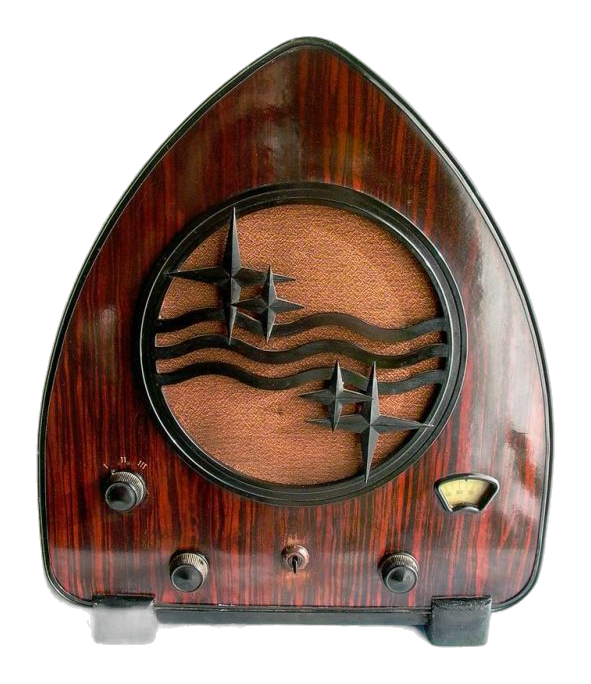
The valve radio waited for the glass tubes inside it to warm up; the knob was turned, and half a minute later the sound slowly arrived. It was large, heavy and expensive; so it was designed like a piece of furniture: a polished wooden case, a loudspeaker covered in cloth, an illuminated dial with the names of cities on it. Istanbul, Ankara, Cairo, London, Moscow. That dial was the home’s first window onto the world.
The radio’s place in the home was that of furniture too: on the sideboard or on a small table of its own, very often with a lace cover. At news time the house fell silent and everyone gathered round the radio; the bulletin was listened to and the daily serial was not to be missed. The neighbour without a radio came for a match or for important news; the radio of the coffee house was the shared ear of the neighbourhood.
In the 1950s a small component that replaced the valve, the transistor, turned the radio into a box that ran on batteries and was carried in the hand. This is the first step towards the personal in this series: the radio left the sideboard and went to the kitchen, the balcony, the field, the beach. The man with a transistor radio pressed to his ear on match day is the ancestor of everyone who walks with headphones today.
03Television: the new hearth of the living room
Regular television broadcasting in Turkey began in Ankara in 1968; in the first years there were broadcasts on only a few evenings a week. The set was expensive and was to be found in one or two homes in a street. So before it was an object, television was an event: there was such a thing as “going to the television”. For the host it was both a pride and a burden; tea and sunflower seeds were served to the guests, and nobody left until the broadcast ended. In villages and coffee houses a whole neighbourhood sat in front of a single screen.
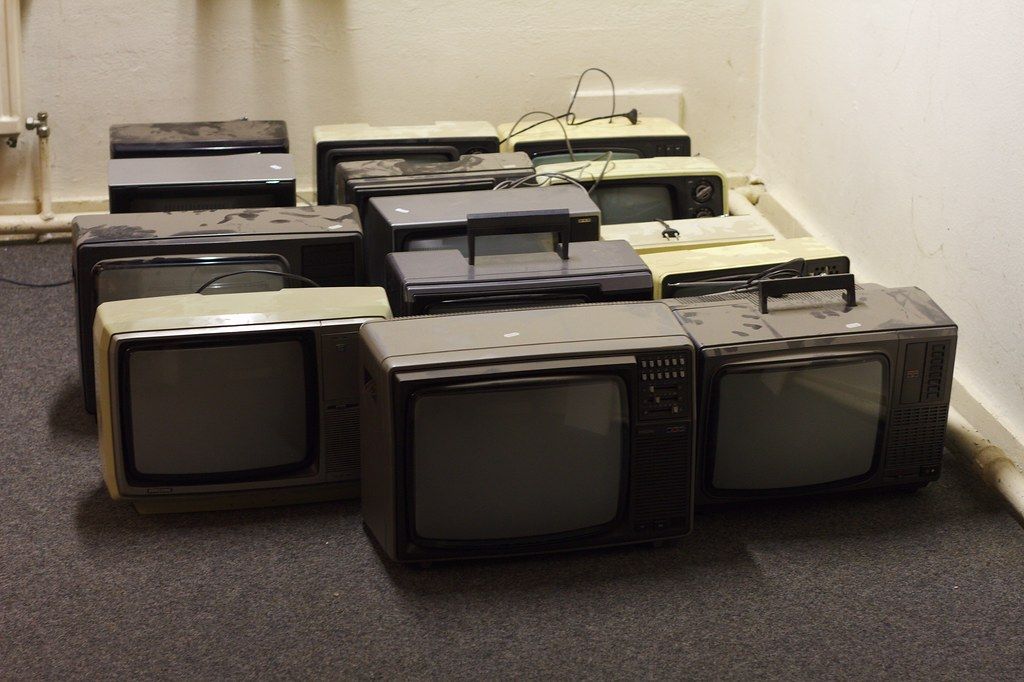
The form the tube imposed. Inside those televisions was a large funnel-shaped glass tube that formed the picture, and the depth of the tube was roughly the width of the screen. This makes the set a box: a screen in front, half a metre of projection behind. Such a box does not stand against a wall; the place where it takes up least room is the corner of the room. The “television corner” was not a habit but a result of geometry. Being heavy, it asked for a sturdy stand or a special cabinet with doors; when the doors were closed the television turned into a piece of furniture.
The lace on top. The top of the television was not left bare: a lace cover, on it an ornament, a picture frame, sometimes artificial flowers. To read this as decoration alone would be incomplete. The home was translating this foreign and expensive machine that had come indoors into its own language and domesticating it; the same had been done to the radio, the sewing machine and the telephone. The cover was a way of telling the machine “you are now an object of this house”. When the screen became thin nothing could be put on top of it, and the habit ended of its own accord.
The seating arrangement. Before television the armchairs faced one another: the arrangement of conversation. In the middle stood the stove or a low table. When television arrived all the seats turned to a single point: the arrangement of viewing. This is one of the largest and quietest changes ever made in an interior. The sofa moved against the wall, the opposite wall was given to the screen, and meals began to be eaten at the low table. Whether the television should be switched off or left on when a guest came was a new question of manners.
In 1984 colour broadcasting became widespread, in 1986 the second channel arrived, in the early 1990s private channels multiplied and the remote control appeared. In the years of a single channel everyone watched the same thing and talked about it the next day; as the choice grew, the quarrel over the remote began inside the home. The solution was a second television: first in the kitchen, then in the bedroom, then in the child’s room. The shared screen dispersed.
Why is the best wall in most living rooms today given to the television? Because the thin screen is hung on a wall and wants to be watched from the front, from a certain distance. This decides the layout of the room from start to finish: the place of the sofa, the curtain at the window, even the height of the sockets. The room is set up around a large black rectangle, and that rectangle is switched off for most of the day. The question to ask when planning a living room is this: is this room for watching or for talking? If you want both, put the screen not on the main axis of the room but on a side wall, or find a solution in which it is not seen when it is off. When the armchairs begin to face one another, the room changes.
04Music: record player, tape recorder, cassette
The record player. A record stores sound as a physical groove: the needle follows the turns of the groove and the vibration is turned into sound. That is why listening to a record is a ritual: taking it from its sleeve, dusting it, lowering the needle, turning it over after twenty minutes. Music is not a background but something one sits down to. Records were expensive; a home’s record collection was the showcase of its taste and its income, and the record player stood in the salon.
The tape recorder and the cassette. The compact cassette, which appeared in the 1960s, freed music in two ways. The first was portability: the battery-powered recorder went to the balcony, the picnic and the car. The second was that for the first time everyone could record: taping a song from the radio, copying from a record to a cassette, filling a mixed tape for someone dear. Sending a recorded cassette in place of a letter to relatives who had gone to work in Germany was the family correspondence of those years. The cassette also opened the way for music that lay outside the large companies and the state radio; arabesk, in the years when it was not played on the radio, spread by cassette and by the tape player of the minibus.
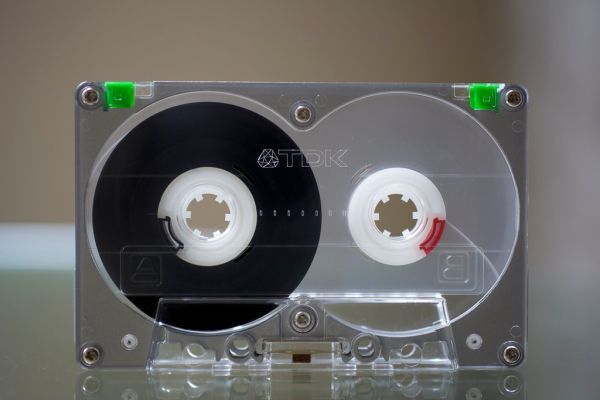
In 1979 the pocket cassette player listened to through headphones appeared, and music became entirely personal for the first time: two people in the same room could listen to different songs. Today’s crowd in headphones begins there.
Video. In the 1980s video brought the cinema home. The machine was expensive; cassettes were not bought but rented from the video shop in the neighbourhood. Choosing a film for the weekend, rewinding the cassette before returning it and inviting the neighbour “to watch a video” was a brief repeat of the shared viewing of the early years of television. Its results were similar too: neighbourhood cinemas and open-air summer cinemas closed one by one. Something done outdoors with hundreds of people moved into a room with the curtains drawn.
05The telephone: the black box in the hall
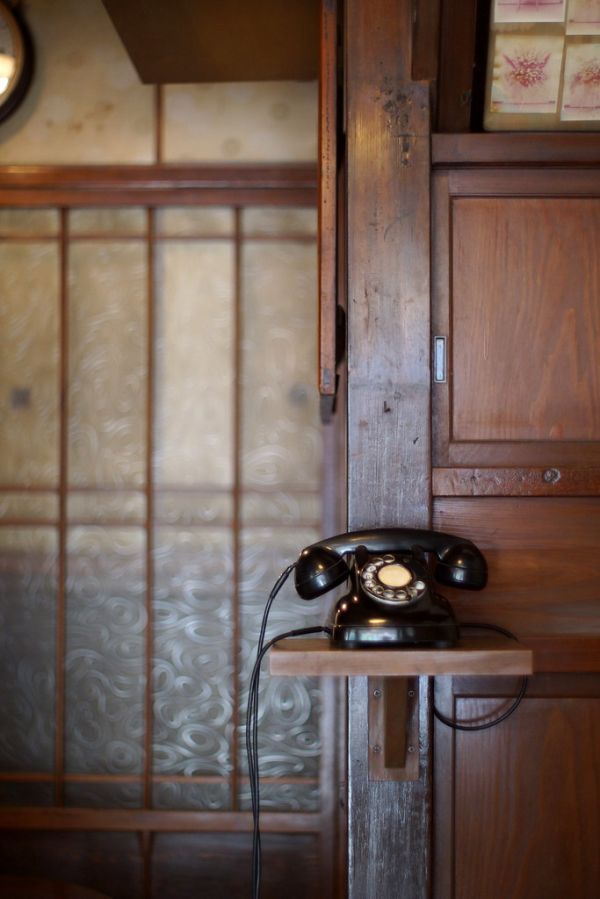
The dial of the rotary telephone transmits the number by counting: you put your finger in the hole and turn, and as the dial returns it produces as many clicks as the digit. Numbers with high digits take longer; one cannot hurry, and if a digit is misdialled one starts again.
In Turkey, until the mid-1980s, getting a telephone was a wait of years: one applied, joined the queue, and when one’s turn came it was celebrated like a festival. So the home with a telephone was the exchange of the whole apartment block. The neighbour’s relative rang you, and you went and knocked on their door; long-distance calls were booked at the post office and waited for over hours. The public telephone in the street worked with tokens; carrying tokens in your pocket was like carrying a charger today.
The telephone’s place in the home tells of this scarcity. It stood in the entrance or the hall, somewhere everyone could reach and nobody could be comfortable, on a small table of its own; beside it an address book and very often a single chair. Its cord was short. Calls were made standing, where everyone could hear, and briefly, because it was expensive and there was only one line. Pulling the cord under the door into a room for a private conversation is that generation’s memory of youth. In some homes a small lock was fitted to the dial.
The cordless handset took the telephone out of the hall, and the mobile phone took it out of the home. The spatial consequence of this is unseen but large: the telephone table disappeared, the hall ceased to be a place of waiting and talking, and for the first time who the members of the household spoke to, and about what, was hidden from the rest of the house. The shared line was, even if unintentionally, a family’s common knowledge.
06Writing and knowledge: typewriter, encyclopaedia, album
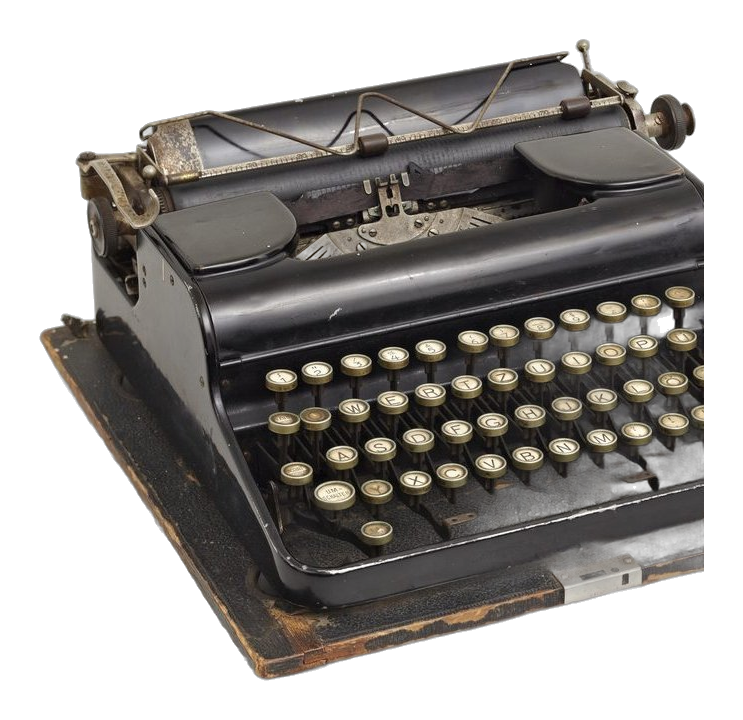
The typewriter. At the end of each key a type slug, in front of the slug an inked ribbon, behind it the paper. When the key is struck the letter is driven onto the paper. A mistake is not erased; so one thinks before writing. The arrangement of the keys is a mechanical solution as well: the common layout was distributed so as to reduce the jamming of the bars of frequently used letters. For Turkish a separate keyboard, arranged by the frequency of the letters, was developed in the 1950s and brought world rankings in typing competitions; with the computer the imported layout became widespread. The sound of the typewriter is the office sound of an era; to have a petition written one went to the public letter-writer outside the courthouse.

The encyclopaedia set. A wall of twenty or thirty volumes with gilded spines, bought in instalments from the salesman who came to the door. Its presence mattered as much as the knowledge inside it: it stood in the bookcase of the salon and told the guest “there is a child in this house who studies”. Homework was done from it. In the 1990s newspapers gave out encyclopaedias for coupons, and a set entered every home. Then the internet came; the volumes went down first to the child’s room and then to the basement. The place of the bookcase in the salon shrank with them.
The photograph album. A film had thirty-six frames, and every frame was money. So photographs were taken selectively; everyone got ready and posed. When the film was finished it was taken to the photographer and collected days later; the result was a surprise. The prints were arranged in an album and shown to guests: looking through the album was a form of hospitality. Today we take more photographs in a day than that generation took in a year, and we look at almost none of them again. Scarcity brought care.
07Play: from the street to the screen
One object is missing from this list, and perhaps it changed the most. Let us look first at what it took the place of. None of the neighbourhood games was bought: hide-and-seek, dodgeball, tag, blind man’s buff, hopscotch, skipping, five stones, marbles, tip-cat, bottle tops, and the football match in which two stones were the goal. What was needed was not toys but three conditions. The first was space: a street with no cars passing, or an empty plot. The second was numbers: enough children outdoors at the same hour. The third was eyes: familiar adults who could see the street from the window, the doorstep and the grocer’s. The urban theorist Jane Jacobs called this “eyes on the street” in 1961; the neighbourhood child was not unsupervised, but watched by a hundred people. The evening call to prayer or a voice from the balcony was the bell that ended the game.
Atari came out in 1977; in Turkey it appeared in the 1980s first as an arcade. The “atari salonu”, a hall lined with token-operated machines, was the neighbourhood’s new street corner, and the word took such hold that every later game device was called “atari” whatever its make. Then came the home: consoles connected to the television, home computers that took minutes to load a game from cassette, and in the 1990s inexpensive consoles whose cartridges passed from hand to hand. The first generation of devices was, surprisingly, a gatherer. One home in the neighbourhood had one, it had two controllers, and one waited one’s turn; a roomful of children looked at a single screen, cartridges were lent and the tricks of the game were passed on by word of mouth. It was a children’s repeat of watching television at the neighbour’s.
One should not look for an easy culprit here. Atari did not take the child off the street; the street was already being taken away. In the same years cars multiplied and the playing space turned into a car park, apartment blocks were built on the empty plots, the floors rose, neighbours ceased to know one another, and school and cramming courses filled the child’s day. The screen filled the place left empty, and did the job very well: it did not end when darkness fell, it could be played in the rain and it did not require a friend. The later steps followed the familiar order of becoming personal: the internet café was the last shared stop, after which the game entered the child’s own room, and from there the pocket. Today children again play in large numbers, but each from a separate home.
The architectural counterpart of this can be read. The child’s room turned from a place for sleeping into a place for staying: desk, screen, socket, closed door. The playground of the housing estate is the designed and fenced copy of the street: its ground is rubber, its equipment fixed, its age range limited. The street game was a found game; rules, pitch and teams were negotiated anew every day, and it was there above all that the child learnt to reach agreement without a referee. Height is part of the matter too: in the observation of the urban designer Jan Gehl, above the fifth floor the link of eye and voice with the street is broken. The mother on the fifteenth floor can neither recognise nor call the child below; that is why the child does not go down.
Because to draw a home is to draw the habits of the person who will live in it. Without knowing where a habit comes from, which condition it answers and what it has evolved into, I cannot set up the right place for that person. Where the child plays, where the family looks in the evening, whether the neighbour knocks on the door; these are the subject of the plan as much as of sociology and psychology, because each of them moves a wall, a door or a window. Design begins with empathy: what I draw without putting myself in the place of the person before me and living their day from beginning to end is only a handsome box. The inventories of objects, spaces and habits in these articles are there not for nostalgia but for this reason.
08Side by side
| Object | Its place in the home | Whom it was shared with | What ended it | Today |
|---|---|---|---|---|
| Valve radio | On the sideboard, the salon | Family, neighbour | The transistor, television | An ornament; its sound is in the phone |
| Tube television | The corner of the room, a special cabinet | First the neighbourhood, then the family | The thin screen | On the wall; in every room |
| Record player | The salon | Family, guests | The cassette, then digital music | Back, among enthusiasts |
| Tape recorder and cassette | Everywhere; the car | Friends, relatives | Digital music | A keepsake |
| Video | Under the television | Neighbours, friends | Satellite, the internet | None |
| Rotary telephone | Entrance, hall; its own table | The whole apartment block | Push-button, cordless, mobile | None |
| Typewriter | The desk, the office | The letter-writer, the secretary | The computer | An ornament |
| Encyclopaedia set | The bookcase of the salon | The family, the neighbours’ children | The internet | In the basement |
| Photograph album | The sideboard drawer | Guests | The phone camera | On special days |
09What did it bring, what did it take away?
What it brought is beyond counting: the sound and picture of the world, the voice of a distant relative, the music one wants at the moment one wants it, knowledge reaching everyone without instalments. Nobody misses the queue for a telephone or the single channel.
What it took away can be said in one word: sharing. What is scarce has to be shared, and sharing brings people into the same room. The neighbour’s television, the block’s telephone and the neighbourhood’s cinema were each a necessity and at the same time a reason to gather. Plenty removed these reasons one by one. The same happened inside the home: the single radio and the single television gave the family a shared evening, and a shared subject to talk about the next day.
The second loss is the sense of ritual. Lowering the needle onto the record, having the film developed, dialling the number were slow acts, and slowness gave weight to what was being done. Today everything is instant, and for that reason light.
For design the outcome of this story is a question about a room. For half a century the sitting room was arranged around a single device; now that device too is dispersing, and everyone looks at their own screen. This is an opportunity to think the living room afresh. The focus of the room can once again be people, a table, a window or a fire. Turning the armchairs towards one another costs nothing, and it is one of the most effective changes that can be made in a home.