01A claim first: Atakule’s only function was looking
Most of the world’s famous towers do a job: they broadcast television, carry a radio mast, store water. The viewing terrace and the restaurant are an income added beside that job. The oddity of Atakule, and its honesty, is that it has no such excuse. It broadcasts nothing and carries nothing. It is a reinforced concrete shaft of 125 m raised on top of a shopping centre for no other reason than to be climbed and looked from, and to be seen from afar.
That makes it less a work of engineering than a work of advertising, and for exactly that reason the truest document of its time. The Turkey of the 1980s had freed imports and was newly acquainted with the shop window and the brand. To place a restaurant, not a broadcasting mast, at the highest point of a city is to write the spirit of those years in concrete: there is now somewhere to look at, to stroll through and to spend in.
For Ankara this had a meaning of its own. In a city with no sea, no strait and no promenade, there was no habit of “going up to the view”. Atakule closed that gap vertically: Ankara’s shoreline was a terrace 87 m up.
02How was it built?
The initiative came from a private company in 1985. About seventy architects were invited; after two rounds of elimination Ragıp Buluç was chosen from the last three. The team travelled from Singapore to Canada to see examples. The aim was to bring two things at once: a tower, and the enclosed shopping arcade that Turkey did not yet know. Four years passed from the initiative to the opening; according to one source the construction itself took two years, from 1987 to 1989. It was opened on 13 October 1989, the 66th anniversary of Ankara becoming the capital, by the prime minister of the day, Turgut Özal. Some fifty thousand people are said to have come on the first day. Its name was chosen by a competition.
The shopping centre at the base was Turkey’s second, after the first example opened in Istanbul in 1987, and Ankara’s first. The building stands on the square where Cinnah and Çankaya avenues meet, beside the Botanical Park, on what is already one of the highest ridges of the city; the height of the hill is added to the height of the tower, and that is why it is seen from most of the city.
03The top: a table that turns
Under the dome three things were stacked: a fixed restaurant at the very top, below it the revolving restaurant that made one full turn an hour, and below that the open viewing terrace and a café. The revolving restaurant is an invention of the 1960s and a mechanical trick: only the ring of floor by the windows turns, while the core in the middle, the kitchen and the lift stay still. The outer edge of the ring moves roughly a metre a minute; too slowly to be noticed, yet by the time you finish your soup you have passed from Çankaya to the citadel. The waiter’s job is not to find the table where he left it when he comes out of the kitchen.
Architecturally this is the strangest thing a room can do: it brings the view to you. In an ordinary restaurant the good tables are few; here every table faces every direction within the hour. In a city like Ankara, where most adults were civil servants and dinner was eaten at home, “dinner at Atakule” meant an anniversary, an engagement, a promotion. The wedding hall in the building answered the same need; couples went up to the top after the ceremony for their photograph.
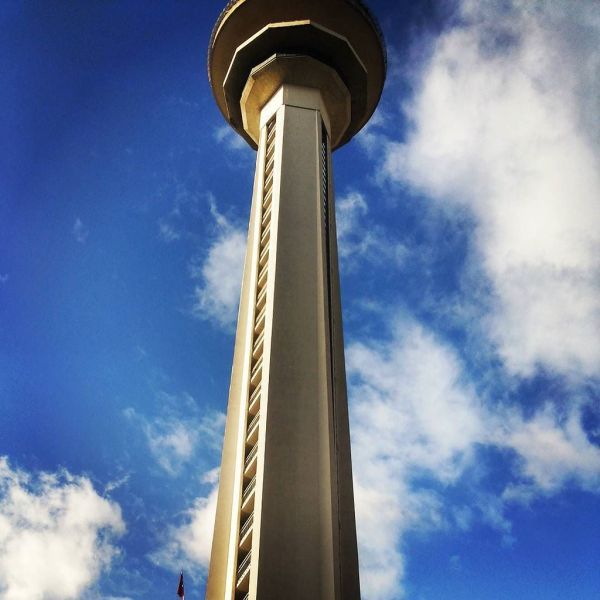
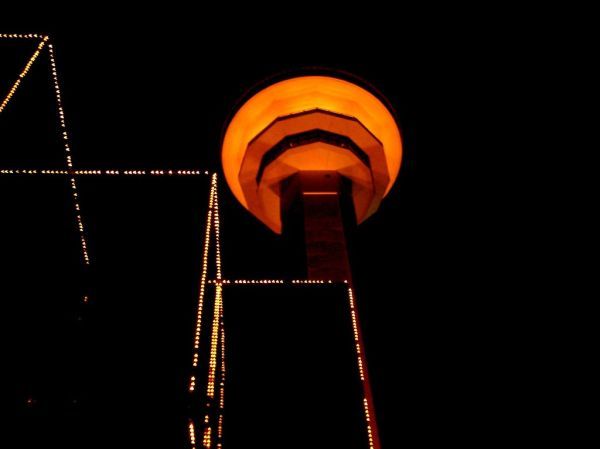
The lift was part of the show too. It was glazed, it climbed the outside of the shaft, and you paid for it. That last detail was much criticised in those years; but on reflection it is the whole business model of the building: looking has a price.
04The middle: the street carried indoors
Until Atakule, shopping in Ankara was done in the street: in Kızılay, on Tunalı Hilmi, in Ulus, inside the passages. The shop window faced the pavement, and if it rained you got wet. Atakule’s arcade reversed this. The shops were set around a multi-storey inner void lit by daylight from above, that is, an atrium; galleries floor upon floor, escalators, a heated and lit “indoor street”.
The type was invented in America in the 1950s for the suburbs, and its architect thought of it as an enclosed copy of a town centre: a square with benches, a fountain and a clock. What spread across the world was not the square but a vending machine with a car park. Atakule is an interesting case in between. Its car park was inadequate and its shops were small; by today’s measure it was a bad shopping centre. But it stood inside the city, somewhere reached on foot, and people went there to be there more than to buy something.
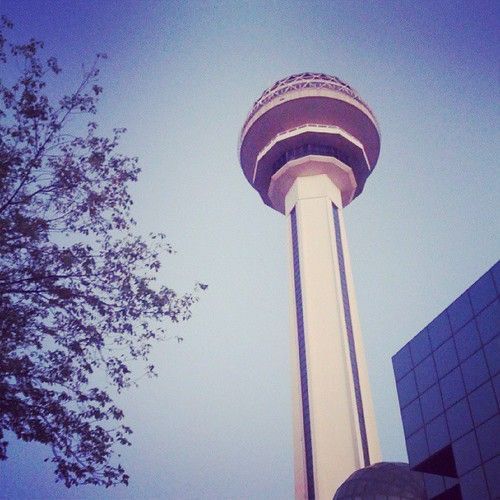
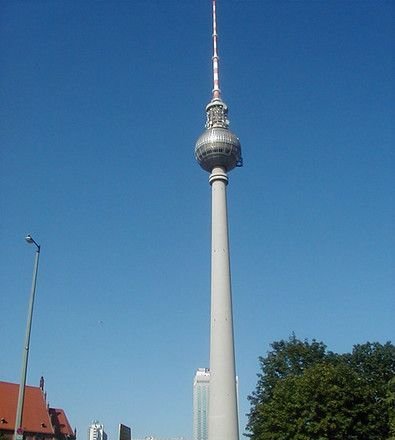
Seen from outside, the mass at the base was made of blue glass cubes. Buluç described the building as a mixture of modern architecture and a style of its own: a round entrance, cubic glass surfaces, a reinforced concrete shaft. The tower was criticised for resembling the television tower in Berlin; the resemblance is the one shared by every tower that puts a sphere or a dish on top of a shaft.
05The bottom: Dreamland
On the lowest floor, where daylight never reached, there was an amusement arcade: Dreamland. What those who remember it tell agrees. Game machines lined up side by side: fighting and racing games played sitting down, a machine for shooting baskets. For the little ones a mirrored play area, soft cylinders and a ball pit. You came at the weekend with the family, and after the games you went up to the pizza restaurant in the same building. In the early 2000s it moved to a smaller space, and then it closed.
That an amusement arcade should be in the basement is no accident; it is a design decision. A screen wants darkness. Where there is no daylight there is no clock either; inside, time stops and the tokens run out. The ceiling is low, the sound strikes the carpet and the bodies of the machines and comes back, a hum blended from a hundred different tunes. To an adult this is noise; to a child it is a promise that begins the moment you step through the door. Casinos are designed to the same recipe: windowless, clockless, carpeted and lit.
What set Dreamland apart from the neighbourhood arcade was its legitimacy. In the eyes of most families the neighbourhood arcade was a place where school was skipped and cigarettes were smoked, and it was forbidden. Dreamland was inside a shopping centre, it was clean, it had an attendant; the family took the child there with their own hands. The same game takes on another meaning in another place. How the game of the street moved onto the screen is the subject of the section on play in the article “The objects of an era · 4”.
06One building, two structures: the child’s Atakule and the adult’s
Look at the section again. The adult’s movement is upward: he buys a ticket, takes the lift, sits at a table and looks at the city. His experience is visual, slow and shared with someone else. The child’s movement is downward: he rides the escalator down and enters the sound and the light. His experience is bodily, fast and most often solitary; even with a friend beside him his eye is on the screen.
| The top | The bottom | |
|---|---|---|
| Whose | The adult’s | The child’s |
| Light | Daylight, the horizon | Darkness, the screen |
| Time | One turn an hour; slow | The length of a token; fast |
| Sound | Fork, knife, low talk | The hum of a hundred machines |
| What is done | One looks | One plays |
| Money | The bill, once in a long while | A token, every week |
| Today | Kept | Demolished |
For a child the token has a meaning of its own: it is very often the first money whose spending he decides for himself. Choosing which machine to feed three tokens to, seeing that it is over when you lose, and waiting for the following week is a small lesson in economics. So is moving fifty metres away from your parents inside a large building, or riding the escalator down alone: a rehearsal of independence under supervision. It gives the child what the street gave, in a closed and safe box and in a smaller dose.
For the adult the same place turns into something else. You realise that the hall which seemed boundless when you were a child was in fact the size of a shop; the space has not shrunk, you have grown. When eye level rises from one metre to a metre and a half the ceiling comes down and the corridor shortens. Memory, though, keeps the first measure. That is why everyone who returns to a place of their childhood says the same sentence: “I remembered this as bigger.”
Because not everyone lives the same space from the same height and with the same intent, and when the designer forgets this the space serves only those who are like him. When I draw a building I think from an adult’s eye level; but in that building there will also be a child, an old person, someone who comes for the first time and someone who comes every day. For each of them the door has another weight, the step another height, the sound another loudness. Understanding why a generation loved a basement so much is the only way to guess who will love what in the next space.
07Decline: when the bigger one arrives
Atakule was overtaken by its rivals. From the 1990s on, larger shopping centres with car parks, cinemas and food courts opened in Ankara one after another; in the 2000s they numbered in the tens. Atakule’s small shops, cramped car park and inadequate services could not compete with them. In the late 2000s the floors began to empty, and the last shops closed in 2012. For a while the tower remained as a symbol with nothing beneath it.
In 2016 a new project began. The old arcade at the base was removed and a new four-storey shopping centre was built in its place; an enclosed car park was added, the tower was repaired in its original form and the revolving floor was kept. The building reopened on 29 October 2018. The blue glass cubes and the hall on the lowest floor are no longer there.
08The sky that was kept, the basement that was demolished
It is instructive to look at what was kept and what was demolished in the renovation. The tower was kept because it was on the city’s skyline; what everyone sees belongs to everyone, and it is hard to touch. The arcade was demolished because it lived only in the memory of those who went inside, and memory holds no title deed. Architectural conservation very often works this way: what is seen from outside is kept, what is lived inside goes. Yet what a generation called Atakule was, to a large extent, that inside.
This is not an accusation. Keeping an arcade that did not work, shops whose services were inadequate and empty floors as they were would not have been a solution either; a building lives only if it is used. But there is a lesson. The value of a place does not rest only in its façade and its structure; it also rests in the habits repeated there: coming at the weekend, going downstairs, then up for a pizza. If a renovation project does not ask which of these habits can be carried over, it makes a better building than the old one and ends up with a place less loved than the old one.
The new building does have an answer to this: the top of the base was made a terrace, and the roof of the arcade was opened so that those inside could see the tower. Looking, the building’s one job from its first day, was set up again, this time from below upward.
09What did it bring, what did it take away?
Three things are left to a designer from Atakule. First, the most valuable place in a building is not always its most expensive place; sometimes it is the cheap hall on the lowest floor. Second, a child lives a space from another height than an adult, at another speed and in another direction; a good public interior leaves room for both. Third, to renovate is not only to renew the material. Without knowing what is remembered, one cannot decide what is to be kept.