01First let us set the words straight
Orthogonal means right-angled: the walls are perpendicular to one another and the plan sits on a grid. The word organic is used in two different senses, and the confusion comes from there. In everyday speech it means a curved, flowing form. Its meaning in the history of architecture is different: the building being one with its site, its material and its function. The most famous house of the most famous advocate of this second meaning, the building that sits above a waterfall, is right-angled almost from end to end. In this article, by “organic” we mean the first sense, that is, curved geometry.
One more distinction: the curve may be in plan, in section, or in both. A curved wall and a dome are not the same thing, and there is a gulf between their costs. We come to this below.
02People built round first, and then found the corner
The first shelters were round: the tent, the hut, dome-shaped mud houses. The reason is pure geometry. The form that needs the least wall to enclose a given area is the circle; it encloses the same area with about 11% less perimeter than a square. Where both material and labour are scarce this difference matters. The circle also offers the wind no corner, and every point is at the same distance from the fire at its centre.
Then settled life arrived and a problem appeared: round houses do not fit side by side. Between two circles there is always an unused gap, a room cannot be added to a circle, and a cupboard does not fit inside it. This is one of the clearest patterns of archaeology: as villages grow, as goods accumulate and as houses are built against one another, the plan turns to the rectangle. Anatolia holds both ends of this transition: the round and oval structures of Göbeklitepe and, a few thousand years after it, the rectangular houses of Çatalhöyük built wall to wall.
Once the right angle was found it made everything resemble itself. In the 5th century BC Hippodamus of Miletus laid out cities on a grid plan; Roman military camps, and later Manhattan, followed the same reasoning. When the plot became rectangular the building became rectangular, and when the building became rectangular, brick, timber, sheet, tile and furniture were produced rectangular. Anyone who wants to build a curve today works against the whole of the world’s industry. The advantage of the right angle comes not from its beauty but from this accumulation.
03But nature is curved: the objection of structure
There is a strong objection to this, and it too comes from physics. The most economical forms of carrying load are curved. The arch, the dome and the shell carry load not by bending but by compression; stone and concrete are very strong in compression. A straight beam needs many times more material to span the same distance. Turn upside down the shape a hanging chain takes and you have the arch that carries its own weight with the least material.
That is why the history of large spans is the history of curves. Anatolia’s most elegant answer to this is the problem of seating a round dome on a square space: the spherical triangles at the corners, the pendentives, turn the square into a circle. The great dome built in Istanbul in the 6th century and the Ottoman mosques of a thousand years later are the marriage of a right-angled plan with a curved roof. In the south-east, in the beehive houses of Harran, the reason is plainer: there are no trees, and a beam cannot be made; the dome built by corbelling brick is the only way of roofing without beams. Geography decided the form.
In the 20th century this reasoning turned into thin concrete shells. The undulating roof of a restaurant built in Mexico in the 1950s is only 4 cm thick and spans tens of metres. Why, then, was so economical a method abandoned? The answer lies in economics. The shell saves on material and loses on labour: setting up curved formwork takes skill and time. Where and when labour is cheap and cement expensive, the shell wins. When labour becomes expensive and material cheap, the flat slab wins. What decides the form is not the engineer’s taste but the ratio between wages and the price of cement.
04Buildability: not every curve is the same
One question is enough to understand the cost of a curve: can this surface be made by bending a flat sheet?
A curved wall is singly curved: plasterboard, plywood and sheet metal bend down to a certain radius, and brick is a small unit in any case. It is difficult but it can be done. A doubly curved surface is another matter altogether: every piece may be of a different size, and every mould is used once.
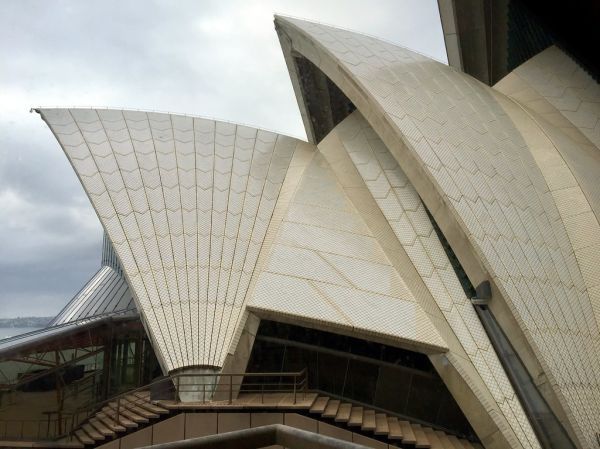
The most expensive lesson in this is the opera house in Sydney. The sail-like shells in the drawing that won the competition in 1957 were drawn freehand, and the geometry of none of them was defined. For years the team tried at least twelve different forms; because every shell was different, building formwork in place was too expensive to be paid for. The solution came in 1961 and was surprisingly simple: all the shells would be segments cut from the surface of a single sphere with a radius of about 75 m. In this way all the ribs, of different lengths, could be cast in the same mould; 2,400 ribs were produced in a factory set up on the site. Even so the building was ten years late, and the cost, forecast at 7 million dollars, rose to 102 million dollars. Its architect left before it was finished.
Why do craftsmen ask of a curved wall “what is the radius?” Because an arc of known radius is drawn on the floor with a nail and a string, is checked at every point with the same template and is repeated with the same mould. Every point of a curve drawn freehand, by contrast, has to be measured separately. The lesson of Sydney holds for the curved worktop in your kitchen too: reduce the curve to a single radius or to a combination of a few arcs. The eye does not see the difference; the bill does.
The computer changed this account but did not do away with it. Since the 1990s curved surfaces have been defined with aircraft software and the pieces cut by machine; every piece being different no longer stops production. But the transporting, numbering and fixing of the pieces and the watertight sealing of the joints between them are still done by hand. The most common defect of curved façades is leakage, because every joint is a separate solution.
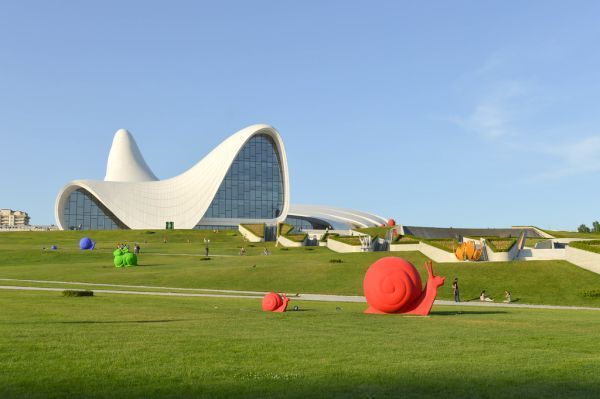
The Sydney of this new period is the Heydar Aliyev Centre in Baku. The building, whose design Zaha Hadid began in 2007 and which opened in 2012, appears as a single unbroken shell that rises from the square and turns into wall, roof and floor again; there is not one corner on the outside of the 57,500 m² building. The difference between the two buildings shows what changed in half a century. In Sydney the curve had to be reduced to a single sphere in order to be built. In Baku there was no need: the surface was defined on the computer and clad, over a steel space frame, with thousands of panels each of a different size. Turkish contractors worked on its construction.
But the price of the curve did not disappear; it only moved. Two months after the opening, in July 2012, a fire broke out during welding work on the roof and the building stayed closed for sixteen months. In a shell whose every panel has been made separately, repair is a small repeat of construction: every damaged piece is measured again, moulded again and produced again. On a right-angled façade the same damage would have been made good within weeks with panels from stock. Sydney taught us how expensive the curve is on site; Baku, that it stays expensive while the building lives.
05Detail and cost: where does the bill swell?
| Item | Right-angled | Curved |
|---|---|---|
| Setting out | String, square, laser; the 3-4-5 rule | Centre and radius, or point-by-point measurement |
| Formwork | Standard panel, used many times | Special formwork; very often single-use |
| Sheet and cladding | Little waste; the offcut is used elsewhere | Much waste; cutting a curve from a rectangle leaves offcuts |
| Glass | Flat glass, from any factory | Bent glass: few producers, long supply, weeks of waiting if it breaks |
| Windows and doors | Standard | The door and window detail in a curved wall is solved from scratch |
| Furniture | Ready-made furniture fits | Made to order; a gap is left behind ready-made furniture |
| Skirting, cornice, worktop | Bought by the metre | Made in pieces or in place |
| Services | Straight duct and pipe | Flexible or in many pieces; access is difficult |
| Repair | The piece is replaced | The same piece has to be produced again |
| Craftsman | Any craftsman | The few craftsmen who know the work |
Looking at the table, this is seen: the cost of the curve accumulates not in one item but as a small excess in every item, and the real price is paid while the building lives. Flat glass that breaks arrives the next day; bent glass that breaks is ordered while the opening waits boarded up for weeks. This is not a reason to avoid the curve; it is a reason to choose where to spend it.
Usable area enters the account as well. The corner of a rectangular room works: the cupboard, the bed and the table sit there. In a circular room no straight object stands along the wall; either everything is made to order or triangular gaps are left behind. In a small dwelling this means square metres bought but not usable.
06The curve indoors: plaster, skirting, bent glass, furniture and the craftsman
The place where we most often meet the curve is not the opera house but the corner of a corridor. A rounded wall corner really is useful in an interior: a sharp corner chips at the first suitcase that strikes it and a round corner does not; it reduces injury in the hospital and the school; and light is not cut at the corner by a hard line but turns in a soft gradation. But this decision, a single arc in the drawing, turns into four separate jobs on site.
The wall itself. A rounding of a few millimetres is solved with a ready-made corner bead and costs almost nothing. As the radius grows the work changes. In a plasterboard wall the curve is set up by cutting the floor and ceiling tracks at intervals and bending them; thin, flexible board is wrapped over them, very often in two layers and wetted. In a brick wall the corner is turned with small pieces, and it is the plaster that gives the real form.
Plaster. On a straight wall the plasterer draws the straightedge between two screeds and the surface levels itself. On a curved surface a straightedge is of no use; a template cut to the radius is needed, and that template is run along the wall at the same height and from the same centre. A curve made by eye, without a template, is not noticed at first glance; when a light that grazes the wall is switched on in the evening, every wave shows. A curved surface shows a fault more than a flat one. That is why, on a curved wall, matt paint, avoiding light from the side and choosing the craftsman at the outset are more important decisions than the material.
Skirting. This is the item most often forgotten and the most troublesome, because skirting is produced straight. There is one question to ask: can the chosen material turn to this radius?
| Skirting | Does it follow the curve? | How |
|---|---|---|
| Flexible plastic or rubber | Yes, down to small radii | Unrolled and glued; in hospitals and schools the floor covering is turned up the wall and takes the place of the skirting as well |
| Wood fibreboard (painted or veneered) | Not by itself | It turns when bent with closely spaced kerfs cut in its back; the kerf marks may show at the front and the paint may crack |
| Solid timber | No | Made to order by gluing thin strips over one another on a mould, or by carving from a thick piece |
| Ceramic and natural stone | No | Divided into short pieces; if the radius is small it turns in facets. Stone can be cut to the radius to order |
| Aluminium and stainless steel | By special process | Bent to the radius in the workshop; the measurement must be taken on site |
| Recessed or shadow-gap skirting | Yes | The skirting is taken into the wall; the wall itself solves the curve |
A practical rule follows from this: fix the radius of the curved wall after you have chosen the skirting. If the chosen skirting turns to a radius of 60 cm at most, to draw a corner of 30 cm is to accept at that corner a patched turn made of straight pieces. The same question is asked at the ceiling for the cornice or the light strip, at the floor for the cutting of tile and parquet, and on the wall for the door frame and the socket plate. A curved wall makes every straight material that touches it ask the same question.
Bottom and top must be the same. The most common fault of a chamfered or rounded corner is that it does not stay the same from floor to ceiling. The craftsman draws a fine curve at eye level; below the knee and above the head the radius changes without his noticing. Once the wall is painted this hardly shows. What makes it visible is the skirting: a skirting bent to the radius in advance, or a flexible one, does not sit on a corner that has not kept its radius at the bottom; behind it there is a gap in one place and strain in another. The same holds for the cornice at the ceiling. That is why the template is used not only for the shape of the curve but also for its staying the same through its height, and before the skirting and the cornice are ordered the bottom, the middle and the top of the corner are checked with the same template.
Cutting the floor to the curve. The tile or stone that meets the foot of a curved wall has to be cut to that curve, and there are three ways here. The diamond-wheel tile cutter scores only in a straight line; it cannot cut a curve. Cutting freehand with a thin cutting disc on an angle grinder is possible, but the edge chips, the line wavers, and the result depends wholly on the hand that day; if the skirting will cover the fault it will do, and if it will not, it catches the eye. The cleanest result is the waterjet: water under pressure cuts the material along a line followed by the computer; the edge is free of burrs and every piece is the same as the next.
The price of the waterjet, however, is paid not on site but on the road and by the clock. The machine does not come to the site; the material goes to the workshop. For this the curve is first measured in place and drawn up, and the tiles are numbered, packed, transported, cut and brought back. Each step takes time and carries the risk of breakage; a measurement wrongly taken means the whole round has to be made again. The cutting itself is also charged by the minute the machine runs; with thick, hard material and with long cuts of tight radius the time and the bill grow. That is, the few rows of tile at the foot of a curved wall can cost more than all the straight cuts in the rest of the room, and add days to the schedule. If this item has not been written into the estimate, it is “dealt with” on site with the angle grinder, and the most visible place of the curve becomes its least careful place.
Bent glass. A curved façade or glass partition is made by heating flat glass and softening it over a mould until it bends. The result is impressive: a surface without corners that turns the light without a break. Its price is paid in four items. It costs several times as much as flat glass, because a separate mould is needed for each radius. Its supply takes weeks and few producers make it. It distorts the image slightly; at tight radii the lines behind it waver. And when it breaks, the same piece has to be ordered again; for that time the opening waits boarded up. If it is required to be toughened or laminated for safety, and double-glazed for heat, each of these adds a further degree of difficulty. That is why two questions are asked at the outset: does the radius really have to be so tight, and can the curve be turned with flat panes, with slender mullions between them? At wide radii flat glass can be bent cold as it is set in its frame; at a tight radius the difference between a faceted turn and a true bend is visible to the eye, and the decision is then a decision of budget.
Furniture that follows the curve. The least discussed consequence of a curved wall is the object that will be put in front of it. Think of an office floor with a round plan: the façade turns, but the desks are rectangular. When you line straight desks along the curved façade, wedge-shaped gaps are left between them; each is dead space in which neither a cupboard fits nor a person passes, and they accumulate in the most valuable place on the floor, in front of the windows. There are three ways out. The first is to have the furniture made to the curve: an arc-shaped worktop, a curved counter, seating that follows the wall. It is beautiful, it is expensive and it cannot be moved elsewhere; when the office moves, the furniture is thrown away. The second is to leave the curve without furniture: to give the place in front of the glass to circulation, waiting and rest, and to set up the desks inside in a right-angled arrangement. Very often this is the most rational, and it opens daylight to everyone. The third is to arrange the desks radially towards the centre; for this the desks have to be chosen in a trapezoidal shape, otherwise wedges are left again.
The same problem arises at home: a straight sofa does not sit against a curved living-room wall, a cupboard does not go into a round room, and a ready-made kitchen unit does not fit a corner with a bay. The rule is this: if you are designing a curved space you are designing its furniture as well; this has to be written into the budget and the schedule from the start. If you intend to choose the furniture later from a catalogue, keep the curve for the places furniture does not touch, that is, the ceiling, the circulation and the entrance.
It is not the drawing that gives the curve but the craftsman. Everything told so far is carried out by the hands of one person. It is he who cuts the template, bends the track and draws the plaster. That is why the quality of curved work is decided by how much time and how many tools that craftsman is allowed; and what decides both is the price.
The party that pushes the price down varies. Sometimes it is the owner: he chooses the lowest bid. Sometimes it is the design team or the contractor: to protect their margin they look for someone who will do the work for less. And sometimes it is a subcontractor who has gone below cost to win the tender and has to make up the shortfall from labour. As the work passes from hand to hand each link takes its share; at the end of the chain, less money is left for the craftsman standing at the wall than the work requires. The result is not a matter of morals but a matter of arithmetic, and it shows in two places:
- Equipment. Curved work needs tools: a laser, templates cut to the radius, track and board that can be bent, the right straightedge, scaffolding. A team working at a low price does not invest in these or does not bring them to site. The eye is used in place of the template, and in place of bending board, straight board snapped and filled with plaster.
- Time. The daily wage, the yevmiye, is the day the craftsman sets aside for that job; the quality of a piece of work is, in the end, how many hours and minutes a day that craftsman spends on it. A curved wall takes several times as long as a straight wall of the same length. If the price per square metre or the lump sum has been given for a straight wall, the craftsman cannot give the curve the time it needs; if he does, he loses money that day. Then the curve is made “as if straight”: no trial is made, the second coat of plaster is skipped, drying is not waited for, and it is not checked.
That is why low-priced work inevitably brings its shortcomings with it. Not because the craftsman means harm, but because he has not been paid for the time it takes to do the work well. The shortcomings are not seen on the day of handover; they appear months later as a wall that ripples in the evening light, a skirting that opens at the bottom, paint that cracks at the corner, and putting them right costs more than the difference of doing it properly the first time. The general form of this account is the subject of the article on the cost of cheap construction.
If you are going to have curved work done, four things prevent this. Have the curved parts priced as a separate item; do not bury them in the unit price of the straight wall. Choose the craftsman by looking at curved work he has done before. Have a sample corner made before work begins, and let it continue only after you have approved it. At handover check the surface with the template together with a light held from the side. All of these take a little money and a little time; and that is the real price of the curve. If there is no intention of paying that price, the right angle is a far more honest choice.
Its cost is read from here as well. In an interior with rounded corners the extra money spent is not on material; it is on the template, the trial, the craftsman who proceeds slowly and the work done a second time. The good news is this: once this work has been set up correctly it repeats. Using the same radius at every corner in a project means solving the template, the track and the skirting detail once and applying them everywhere. The lesson of Sydney holds here too.
07Use and psychology: the eye likes the curve, life uses the corner
The experiments are consistent: people like objects with rounded lines more than those with sharp corners. In a study carried out in 2013 participants were shown photographs of interiors; the spaces with curved lines were found markedly more beautiful. The less often cited finding of the same study is this: on the question “would you want to enter this space?” no difference emerged between the curve and the right angle. We find the curve beautiful, but it does not mean that we choose to live where we find it beautiful.
Looked at from the body, the division of work between the two geometries becomes clear:
- Movement likes the curve. A person does not turn at a right angle; he cuts the corner. The soiled wall at the corner of the corridor and the wear mark on the floor show this. When circulation routes, stairs, handrails and the corners of worktops and tables are rounded, both flow and safety increase. In a home with children, in the hospital and the school, the round corner is not ornament.
- Staying and storing like the corner. The bed, the table, the bookcase and the cupboard are rectangular and want to lean into a corner. So does a person: someone with their back to a corner sees the whole of the space.
- Wayfinding likes the right angle. In a right-angled plan a person knows where they are: ahead, right, left. In a corridor that curves the sense of direction is soon lost. In a museum this gives a sense of discovery; in a hospital, anxiety.
- Sound and light ask for care with the curve. A concave wall or ceiling gathers sound at one point; the whispering effect in domed spaces comes from this. In a meeting room this means speech at one end of the table booming at the other. Light, too, does not spread evenly on a curved surface; this can be a fault, and it can also, if rightly used, be the most beautiful light that washes a wall from end to end.
Display is a problem of use as well. When the New York museum famous for its spiral ramp opened, painters objected: how is a flat painting to be hung on a sloping floor, on a wall that is curved and leans back? The building is a masterpiece, and it resists the work inside it continually. This is the most honest question of architecture: does the building exist for itself, or for the life inside it?
08Culture: what does the curve say, and what the right angle?
Forms carry meaning too, and that meaning changes from period to period. At the beginning of the 20th century the right angle was the language of progress, hygiene and equality: the same daylight for everyone, a room of the same size. After the war the same grid came to be identified with the monotony of mass housing and office blocks; from the 1960s the curve became the sign of objection to that monotony, and of freedom. Today the flowing façade is very often the way a city or a brand says “look, we can afford this”.
The same swing is observed in Turkey. In the Ankara of the early Republic the houses called “cubic” told of the modernity of the new regime with their right-angled masses and rounded corner balconies; those round corners came from the aesthetic of the ships and cars of the period. The build-and-sell apartment block of the following half-century reduced the right angle to its cheapest form: the largest box the plot allowed. The traditional Turkish house very often follows a third way that lies outside this debate: the rooms are rectangular and standard, but the sofa that links them widens, breaks and bends to suit the shape of the plot. Order is in the room; freedom is in the space between.
09The decision: which, and where?
| Criterion | Right-angled | Curved |
|---|---|---|
| Speed of construction | Fast | Slow; supply is long |
| Initial cost | Low | Somewhat higher with single curvature, very high with double |
| Economy of material | Little waste | May be economical in structure; much waste in cladding |
| Efficiency of area | High | Low; needs made-to-order furniture |
| Adaptability | Easily divided and extended | Difficult |
| Maintenance and repair | Easy | Difficult and expensive |
| Movement and flow | Corners obstruct | Fluent |
| Wayfinding | Easy | Difficult |
| First impression | Calm, orderly; dull if badly done | Striking, warm; tiring if badly done |
| Large span | Deep beam | Thin shell, arch |
The conclusion from this table is not to take a side; it is a division of work:
- Set up the structure and the rooms with the right angle. Inexpensive, quick, adaptable and suited to furniture.
- Spend the curve where the body touches and moves. Corner turns, the handrail, the end of a worktop, the entrance, the stair, the wall of a waiting area.
- Stay with single curvature. Parts of cylinders and cones are bent from sheet; for double curvature, have a really valid reason.
- Define the curve by a radius. One radius, or a few, means a curve that can be built and repeated.
- Think of the curve for a large span. There it is not ornament but structure.
- Do not imitate the curve with facets. A “curve” that turns in angles with straight pieces gathers the bad sides of both.
10What did it bring, what did it take away?
The right angle brought the city, standard material, inexpensive housing and the adaptable building. In return it took away variety and brought blind corners and that slight friction between the body and the building. The curve brought the large span, flow and the space that is remembered; it made us pay for it in cost, leakage and inflexibility.
The real mistake is to make the two a matter of belief. The painter who called the straight line godless bent and twisted the floor and façade of a municipal housing block; its upkeep was left to the municipality. The architect who wrote a poem to the right angle designed, late in his life, one of his best-known buildings, a chapel with curved walls and a curved roof. The masters were never soldiers of one side; they chose the geometry that suited each question.
In interior architecture this choice is made every day at a small scale. The corner of a reception counter, the turn of a corridor, the end of a ceiling recess: there the curve is a decision of a few square metres, and put in the right place it changes how the whole space feels. The rule is simple: use the curve sparingly and knowingly. A curve that is everywhere is as ineffective as a curve that is nowhere, and far more expensive.