01A claim first: the lamp that filters lights itself, not the room
Think of the white glass globe in the middle of the ceiling. In Turkey it is called a glop, and for half a century it hung from the ceiling of every flat, every stair landing, every government office. You press the switch, the globe glows, the room “is lit”. But look at the book on the table: because the light comes equally from every direction there is neither a shadow nor an accent on the page; faces look flat and corners grey. The brightest thing in the room is the globe itself, and the eye turns to it whether it wants to or not.
This is the bind of filtering. When you pass light through a material three things happen: part of it is lost, the rest is scattered in every direction, and the whole surface of the lamp becomes a light source. Scattered light is soft, but it has no direction. Light without direction shows nothing; it only removes the dark.
Then why does a good filtering lamp exist? Because sometimes that is exactly what is wanted: an object standing in a corner of the room that can be looked at and that glows like a fire. The good lamps in this article are designed not as light fittings but as luminous sculptures, and they always ask for a second light beside them. The other family, the one that hides the bulb by reflecting it, is the subject of the article “Taming the bare bulb” in this series.
02A little physics: when the surface grows, the eye rests
What dazzles the eye is not the amount of light; it is a great deal of light coming from a small surface. Give the same light from a large surface and the brightness falls. The sum is geometry: make the diameter of a sphere five times larger and its surface becomes twenty-five times larger, and each square centimetre shines one twenty-fifth as bright. That is why putting a bulb of 6 cm inside an opal globe of 30 cm turns a point one cannot look at into a moon one can.
Filtering materials do not do the same job in the same way, and the difference between them separates the cheap lamp from the good one.
- Frosted glass scatters only at the surface. It is clear glass roughened with acid or sand; it lets most of the light through, but the bulb behind it goes on showing as a blurred hot spot.
- Opal glass scatters inside its body. Very fine particles added to the molten glass turn the light again and again; when the light comes out it has forgotten where it came from. The globe glows evenly all over and the bulb cannot be seen. The price is that somewhere between a third and a half of the light stays inside.
- Paper and fabric filter between their fibres. The longer and more irregular the fibre, the more alive the light looks; the texture of handmade paper and the weave of fabric are read together with the light. That is why a paper lamp is one object when lit and another when dark.
- Plastic imitates both: opal acrylic does the work of glass, light and unbreakable, and sprayed resin does the work of paper.
03Before electricity: lantern, shade and Tiffany
Filtering is older than the bulb. A candle or gas flame flickers, goes out and burns; putting paper or glass in front of it was the way to shield it from the wind. The Japanese paper lantern, the glass of the Ottoman oil lamp and the frosted globe of the gas lamp are of one family. The Turkish word for a lampshade, abajur, describes the job as well: in French it means that which brings the light down, that is, dims it.
In the first years of electricity the bulb was weak and the shade was an ornament. The most famous lamps of the period came out of Louis Comfort Tiffany’s studio in New York: shades of dragonflies, wisteria and water lilies in which hundreds of pieces of coloured glass were joined with copper foil and not with lead. These lamps do not illuminate; they dye the light. That many of the patterns long thought to be Tiffany’s own drawing belonged to Clara Driscoll, head of the team of women in the studio, was understood only in the 2000s, when her letters were found.
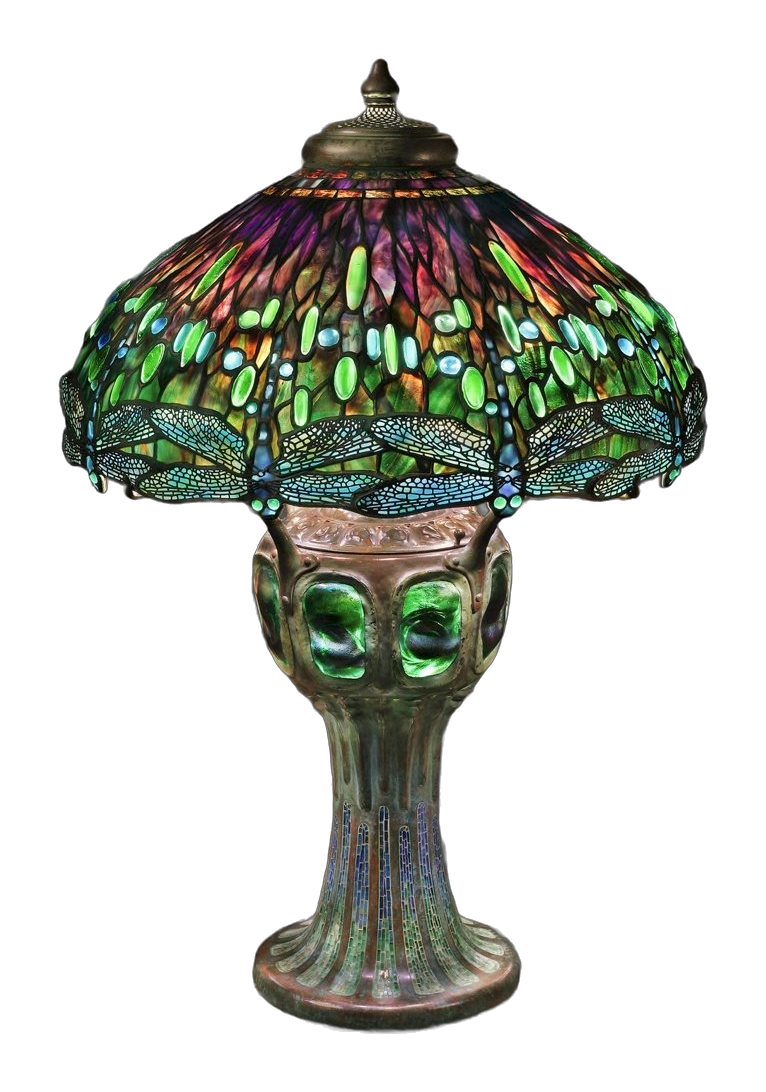
In Turkey the longest-lived member of this family is the fabric lampshade. The standard lamp in the corner of the salon, with its tassels and fringe, was the second light, switched on only when guests came, and the first remedy the home found for the harshness of the single bulb on the ceiling. The colour of the fabric decided the colour of the light; cream and salmon tones were so common because they flatter faces.
041924: the Bauhaus table lamp
The first modern filtering lamp is a piece of student work. In 1924, in the metal workshop of the Bauhaus in Weimar, the twenty-four-year-old Wilhelm Wagenfeld drew a table lamp as a task set by the workshop’s master, László Moholy-Nagy: a round base, a straight stem and on top an opal glass shade a little more than a hemisphere. Joined with Carl Jakob Jucker’s trials with a glass stem, the design has two versions; in one the base and stem are metal, in the other glass.
Every part of the lamp is a geometric solid: circle, cylinder, sphere. Nothing is hidden; the flex can be seen through the glass stem. It is the school’s slogan “art and technology, a new unity” set on a table. The irony is that this lamp, which looks machine-made, was made by hand in the workshop in those years and was expensive; Wagenfeld himself said so years later. Its wide production began again only in 1980, with its designer’s approval.
As physics the lamp is an honest compromise. The opal shade hides the bulb completely and drops a soft light onto the table through the opening beneath it; but it does not give as much light as a reading lamp. To this day the place it is most often put is not the desk but the top of the console.
05Paper: Le Klint and Akari
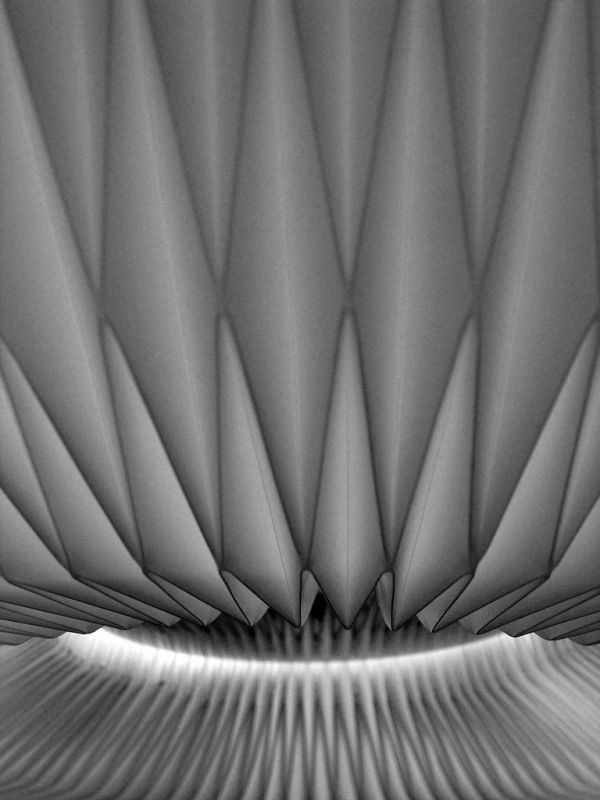
Le Klint. Around 1900 the Danish architect P. V. Jensen-Klint folded a pleated paper shade for his own gas lamp. His invention was not the pleat but the collar: a folded collar that holds the shade in place without string or wire. His son Tage Klint took out the patent on this collar in 1938 and a few years later founded the family company; it took its name from his daughter. The other son of the family, Kaare Klint, the founding name of Danish furniture, also drew shades for the company.
The pleat gives paper three things. A flat sheet carries nothing; folded, it becomes a shell that carries itself. The folds do not let light through equally: one face of each pleat is bright, the other in shadow, and the shade glows line by line. Third, the shade folds flat and goes into an envelope. The same architect’s best-known building is a brick church whose front rises tier upon tier and recalls organ pipes; in paper as in brick the same hand is seen.
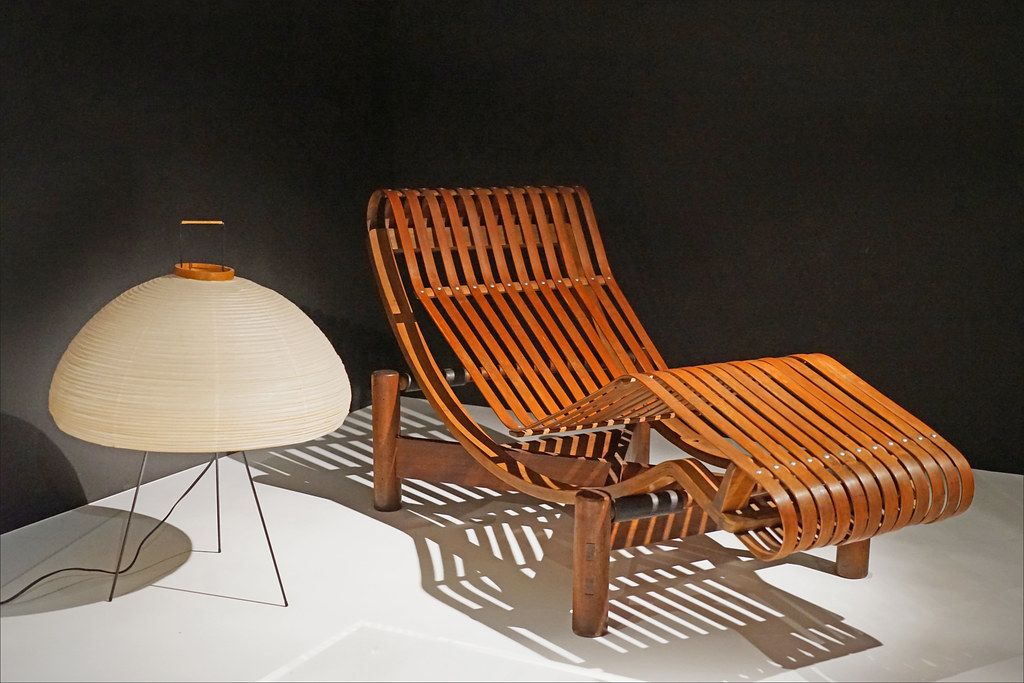
Akari. In 1951 the sculptor Isamu Noguchi stopped in Gifu, the Japanese town known for its paper lanterns. As electricity spread, lantern-making was dying; the mayor asked him to draw something that would bring the craft up to date. Noguchi replaced the candle with a bulb, freed the form by using wire in places instead of the bamboo rib, and gave what he made the name Akari, which in Japanese means light, illumination. The same workshop still makes them by hand today; the number of models has passed two hundred.
Noguchi called these not lamps but light sculptures, and he likened their light to the sun filtered through the paper of a sliding door. The design lesson is this: the body of an Akari is almost nothing. A spiral rib, handmade paper glued over it, and three thin wire legs. It folds into a flat box and weighs a few hundred grams. An object with no weight changes the whole air of a room.
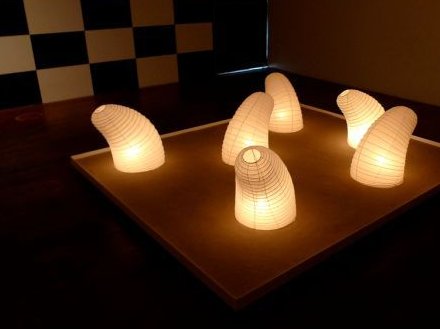
The most widespread descendant of this idea is the cheap paper globe hanging from the ceiling of every student flat in the world. What makes it good is what Noguchi found; what makes it bad is that it hangs alone. Used as the only light in the middle of the ceiling, a paper globe too is, in the end, a glop.
06The cocoon: two lamps from one war material
After the Second World War America laid up the ships it was not using. The equipment on deck was wrapped in netting, and a resin sprayed over it formed a skin on the net like a spider’s web. In the early 1950s the architect George Nelson wanted a Swedish-made silk-covered pendant for his office and found the price too high. Seeing a photograph of these ships in a newspaper, he tracked down the manufacturer; he had a cage made of steel wire and sprayed the same resin over it. The Bubble lamps that went into production in 1952 were born this way: hollow bodies, light as a feather, in the shapes of a ball, a flattened disc, a cigar and a pear.
On the other side of the Atlantic the same material fell into other hands. In 1960 the Castiglioni brothers sprayed the same cocoon resin over a white-painted steel skeleton and drew Taraxacum and Viscontea; Taraxacum, named after the dandelion, really does look like a seed head waiting to be blown. The Italian lighting company Flos was founded in 1962 precisely to make lamps from this material.
What the two stories share is that the design is a transfer of material. Nobody invented a new plastic for a lamp; an architect looked at something made for another job and said “this filters light”. The cocoon’s advantage over paper is that it takes the form of the cage and has no seam; its weakness is that it yellows with time.
07The plastic years: Nesso, Pipistrello, Panthella
In the 1960s the injection mould and opal acrylic did what glass could not: large, thin, unbreakable shades in a single piece. Colour was set free too. The lamps of this decade carry the optimism of the period: the space race, pop art and the belief that “the future will be made of plastic”.
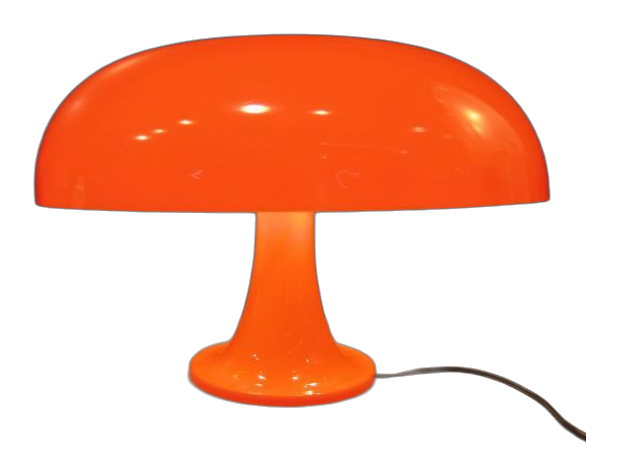
Nesso (1964). Giancarlo Mattioli and a group of young architects drew, for a design competition, a mushroom that comes out of a single mould: stem and cap are of the same material and flow in the same curve. The orange one is famous. Coloured, translucent plastic dyes the light as it filters it; when Nesso is lit the room turns orange. This is not a fault, it is the aim: the lamp is an object that changes the colour of the room.
Pipistrello (1965). The lamp by the architect Gae Aulenti takes its name from the bat: the opal plastic shade is segmented like the taut membrane of a bat’s wing. The real invention is in the stem; the stainless steel tube extends like a telescope and the lamp turns from a table lamp into a low standard lamp. Aulenti had designed it for the Paris shop of the typewriter maker Olivetti; twenty years later the same architect would turn an old railway station in Paris into a museum.
Panthella (1971). In Verner Panton’s lamp filtering and reflecting are joined. The hemispherical opal shade filters the light; the trumpet-shaped white foot beneath it reflects the light that falls from the shade. The whole lamp, base included, gives light. It is the same thought as Panton’s one-piece plastic chair and his coloured interiors: the boundary between the object and its setting is erased.
081998: the return of the globe
At the end of the twentieth century Jasper Morrison redrew the most ordinary lamp of all, the opal globe, and named it Glo-Ball. The difference lies in three details. The globe is not a true sphere; it is slightly flattened, and so it looks calmer to the eye. Its glass has two layers: opal inside and an acid-matted surface outside, so that when lit the globe shows neither a hot spot nor a glare. And the fixing cannot be seen; the globe seems to grow out of the ceiling or out of its foot.
It is the clearest example of the approach Morrison called “super normal”: perfecting the form everyone knows instead of inventing a new one. The difference between Turkey’s glop and the Glo-Ball is not a difference of idea but a difference of workmanship; and that difference is seen in one second when you look at the lit globe.
09Turkey’s filtering lamps: the glop, the fluorescent tube and the energy-saving bulb
The local branch of this story is a story of housing production more than of design. The build-and-sell contractor handed over the flat with a single cable end in the middle of the ceiling; the owner fitted the cheapest solution there, a lampholder and an opal globe. Whatever the plan of the room, the place of the light was settled: the exact centre. The habit took such root that in many projects today lighting is still taken to mean putting a point in the middle of the ceiling.
In the kitchen and the bathroom the fluorescent tube took its place: because it gave much light for little electricity, with a frosted plastic cover in front of it. In the 2000s the energy-saving bulb arrived, and in most homes the cold white one was chosen because the box promised more light. When filtered, directionless and cold-coloured light came together, the result was that familiar room described as “like a hospital”. The problem is not the globe; it is leaving it on its own.
Why does the same room look better in a hotel? Because there is no single globe in the middle of the ceiling there; the light comes from several low points. A filtering lamp stands in a corner, below eye level, and becomes the fire of the room; beside it there is a reading light and a directed light that picks out the wall or the table. You need not take the glop down. Dim it, or leave it with a weaker bulb, and add two low lamps to the room; choose warm white bulbs, that is, around 2700 K. The room is the same room, but now it has shadows.
10Side by side
| Lamp | Year | Filtering material | Main idea | Weakness |
|---|---|---|---|---|
| Tiffany shades | 1890s | Coloured glass | Dyeing the light | Does not illuminate |
| Bauhaus table lamp | 1924 | Opal glass | Pure geometry, visible structure | Not enough to read by |
| Le Klint | 1943 | Pleated paper | A shell that carries by folding | Gathers dust |
| Akari | 1951 | Handmade paper | A weightless light sculpture | Fragile |
| Bubble | 1952 | Sprayed resin | Transfer of material | Yellows |
| Taraxacum | 1960 | Sprayed resin | A cocoon wrapped round the skeleton | Yellows |
| Nesso | 1964 | Coloured plastic | One mould, one curve | Dyes the room |
| Pipistrello | 1965 | Opal plastic | A stem that extends | Heavy and expensive |
| Panthella | 1971 | Opal acrylic | A shade that filters, a foot that reflects | Takes up room |
| Glo-Ball | 1998 | Two-layer opal glass | Perfecting the ordinary | On its own, still a glop |
11Who designed what else?
| Designer | Main profession | Known work other than lamps |
|---|---|---|
| Louis Comfort Tiffany, Clara Driscoll | Painter and glass artist; studio manager | Stained glass, mosaics, glass vases |
| Wilhelm Wagenfeld | Silversmith, industrial designer | Stacking glass storage containers, a glass teapot, salt and pepper shakers |
| Kaare Klint | Architect, furniture designer | The folding safari chair, furniture teaching based on human measure |
| Isamu Noguchi | Sculptor | The glass-topped coffee table, gardens, playgrounds, stage sets |
| George Nelson | Architect, writer | The ball clock, the sofa of cushions, the idea of the cupboard as a partition wall |
| Gae Aulenti | Architect | The conversion of a railway station into a museum, exhibition and shop designs, a glass table on wheels |
| Verner Panton | Architect | The one-piece plastic chair, coloured interiors |
| Jasper Morrison | Industrial designer | Chairs, a tram, kitchen utensils; the “super normal” exhibition |
One thing stands out in the table: apart from Noguchi none of them is remembered as an artist, yet the work they did is the kind of lamp closest to sculpture. The filtering lamp is the only lamp whose body and whose light are the same thing; if its form is bad, there is nowhere to hide.
12What did it bring, what did it take away?
The subject of the master’s thesis I wrote on exhibition lighting is a neighbour of this: setting up sub-spaces with light inside a space. Filtered, even light cannot do that, because it does not separate; it unites. For a picture gallery that is very often the right choice; for a sculpture or a living room it is not. At home the rule is the same: the filtering lamp gives the room its mood, and another light does the work.
So three questions are enough when choosing a good filtering lamp. When it is lit, can you tell where the bulb is? If you can, the material is cheap. Is it beautiful when it is off as well? That is how it will stand for most of the day. And is there another light in the room besides it? If not, what you have bought is not a lamp but an expensive glop.
The other articles of the series: desk lamps are the subject of “Staying in balance”, and those that rebel against the ceiling outlet of “Reaching, hanging, playing”.