01A claim first: the worst lighting decision is the hole in the middle of the ceiling
In almost every flat in Turkey each room has a single ceiling outlet, and it is at the exact centre. It is buried in the reinforced concrete slab during construction; to move it you have to break the ceiling or run a suspended ceiling beneath it. The dining table stands near the window, the sofa leans against the wall, the bed is in a corner. The light is always in the same place: at the midpoint where nobody sits and nothing stands.
The result is a familiar sight: the chandelier that does not come over the middle of the table, the pendant dragged sideways on a hook, the spare flex drooping from the ceiling. For a tenant it is harder still; he may not touch the ceiling. The Italian designers of the 1960s struggled with exactly this problem, because their cities too were full of old buildings and tenants. The solutions they found are in museums today, but all of them were born of the same practical question: how do I bring the light where I want it without drilling the ceiling?
021962: Arco, a pendant without a ceiling
The question Achille and Pier Giacomo Castiglioni asked was this: can there be a lamp that hangs over the dining table like a pendant but is not fixed to the ceiling? The answer has the form of a street lamp: a heavy base on the floor, a stainless steel arc rising from it and reaching more than two metres, and at its end a perforated aluminium head. The lamp is close to two and a half metres tall; a person walks under the arc, and one can move around the table.
What makes Arco a textbook case is its base. A weight at the end of a long arm wants to tip the lamp over; against it there has to be a base that is heavy enough. The Castiglioni brothers chose the cheapest dense material: a block of Carrara marble of about sixty-five kilos. Then they added two details. The corners were chamfered, because the sharp corner of a stone at this height can injure a shin. A hole was drilled through the middle of the block; it is taken for an ornament, yet a broomstick is passed through it and the lamp is carried by two people. Castiglioni’s whole attitude is in that hole: every form should have a reason and, if possible, should raise a smile as well.
Arco has been copied so much that the copyright protection of the design went before the courts in Europe. Most copies go wrong in the same place: they lighten the base. Put a hollow box where the marble was and the arc has to be shortened, and the lamp no longer reaches the middle of the table; only the form is left.
031950: Prouvé’s wall arm
Twelve years earlier a French metalworker had given another answer to the same question. Jean Prouvé’s lamp called Potence is a slender steel tube of two metres hinged to the wall; at its end is a bare bulb, and the tube is carried by a wire stretched from its tip to the wall. The arm swings through a hundred and eighty degrees like a door. There is no base, no fixing to the ceiling, not even a shade. Prouvé had designed it for the demountable houses he drew himself; in those houses it was not possible to hang anything from the ceiling. It is a crane jib brought indoors, and the lamp with the fewest parts in this article.
041962: Toio, a lamp from ready-made parts
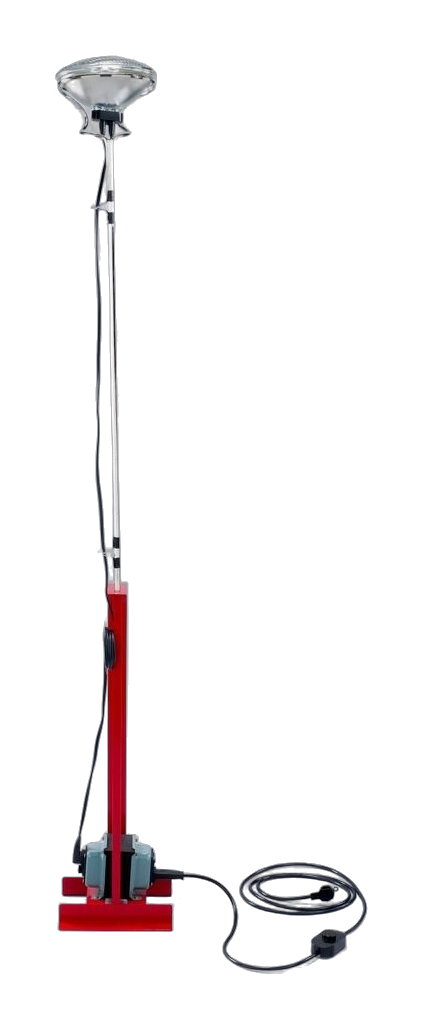
The Castiglioni brothers’ other lamp of the same year is a lamp none of whose parts was made for a lamp. The light source is a car headlamp. The transformer the headlamp needs is not hidden; it is put in the base and becomes the weight of the lamp. The stem is a hexagonal rod of adjustable height; the flex climbs beside the rod, passing through the rings used on fishing rods. The headlamp faces the ceiling, and the room is lit by light reflected from the ceiling.
In the history of art this is called the ready-made: taking a thing as it is and putting it in another setting. What sets the Castiglioni brothers apart is that they did not leave it as a joke; Toio really is a good ceiling washer. That is also what it teaches a designer: the part you need is most probably already being made in some other industry.
051970: Parentesi, a light that stays on a cable
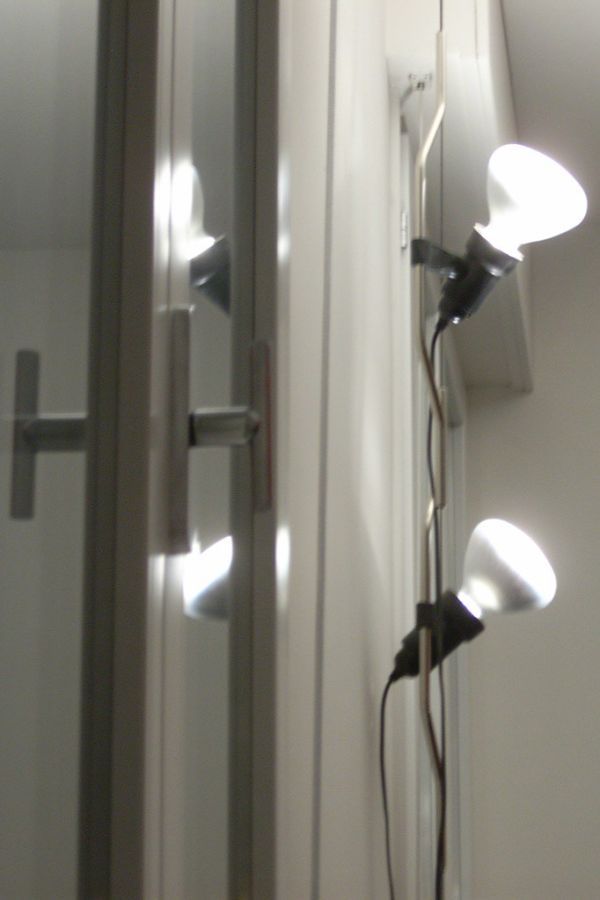
The idea comes from a sketch by the designer Pio Manzù, who sadly lost his life at a young age; Achille Castiglioni simplified and finished it. A steel cable is stretched from ceiling to floor; at its lower end hangs a weight that keeps the cable taut. On the cable slides a short steel tube bent slightly like a bracket, and the spot bulb is fixed to this tube. You take the tube to the height you want with your hand and let go; it stays there.
Why does it stay? The cable is straight, the tube is curved. As the taut cable passes through the tube it presses against the wall of the tube at three points, and that pressure gives rise to friction. As long as the friction is greater than the weight of the bulb and the tube, the tube does not slip. There is no screw, no spring, nothing to tighten. The lamp consists of five or six parts that fit in an envelope, and it is sold that way, in a flat pack. In 1979 it won Italy’s most important design prize.
06Play on the table: Eclisse and Snoopy
Eclisse (1965). Vico Magistretti’s bedside lamp consists of three hemispheres: one is the base, one the outer shell, one an inner shell that turns inside. When you turn the inner shell with your finger it moves in front of the bulb and the light is dimmed, like an eclipse of the sun, from a crescent to full darkness. The name means eclipse. In years when the dimmer switch was not common it did the same job without electronics, by geometry alone. Its one fault is famous: used with an incandescent bulb the shell heats up and burns the finger that turns it. The LED erased that fault; at sixty the lamp is working for the first time exactly as intended.
Snoopy (1967). The Castiglioni brothers’ table lamp is a heavy marble cylinder leaning forward and, sitting on it, a black enamelled head that reaches out like a nose. It takes its name from its likeness to the dog in the comic strip. The marble balances the weight of the head that overhangs in front; in other words it is the idea of Arco come down onto the table. The thick glass disc under the head filters the light; the holes on top cool the bulb. It is a caricature drawn over a serious calculation of balance.
07Ingo Maurer: the man who turned the lamp into poetry
The German designer Ingo Maurer had trained as a typesetter and in graphic design; he came to lighting from outside and never went in. His first lamp, made in the second half of the 1960s, was a giant bulb with a small bulb standing inside it: making a monument of the thing everyone was trying to hide.
YaYaHo of 1984, though, is an invention more than a toy. Two fine cables are stretched between two walls of the room; they carry low voltage and are harmless to touch. Small halogen lamps, counterweighted rods and reflectors are hung on these cables, slid along them and moved about. The cable is both the structure and the wiring. All the tension-cable and track lighting systems we see everywhere today are descendants of this idea, and it is the most flexible answer given to the problem of the single ceiling outlet: light for every part of the room from one point of connection.
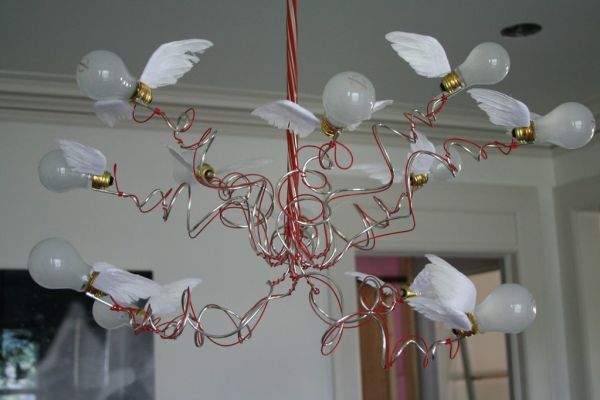
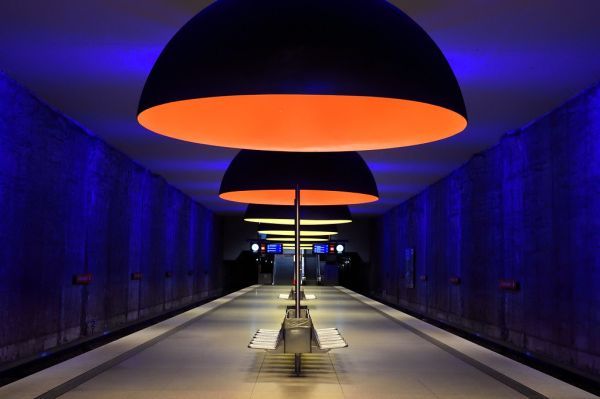
What follows grows steadily more poetic. In 1989 he fitted two wings of goose feather to a bare bulb. In 1994 he made a chandelier of broken porcelain plates and forks, frozen at the moment of explosion. In 1997 he brought out a pendant of sheets of paper clipped to the ends of wires; half the sheets are blank, and what is written on them is for the owner to decide. It was also he who made one of his first objects with LEDs in 1996. In 1998 he lit an underground station in Munich with aluminium domes close to four metres across, hung above the platform and painted blue, red and yellow inside. He sadly passed away in 2019.
Maurer’s importance lies not in his jokes but in his seriousness. The rule in the first article of this series was that a good lamp does not show its source. Maurer did the opposite and was proved right, because the rule is really this: either hide the source or give it a meaning worth looking at. The middle, the bare bulb that is neither hidden nor thought about, is what is bad.
08Side by side
| Lamp | Year | Where it brings the light from | Main idea | Weakness |
|---|---|---|---|---|
| Potence | 1950 | From the wall, on a swinging arm | The fewest parts | A bare bulb |
| Arco | 1962 | From the floor, drawing an arc | A pendant without a ceiling | Needs much room, heavy |
| Toio | 1962 | From the floor to the ceiling | A lamp from ready-made parts | Indirect light only |
| Eclisse | 1965 | From the bedside | Dimming by geometry | Heats up with an incandescent bulb |
| Snoopy | 1967 | From the table | Turning balance into a joke | Heavy and expensive |
| Parentesi | 1970 | From a cable, at any height | A tube held by friction | Fixed to ceiling and floor |
| YaYaHo | 1984 | From a cable between two walls | The structure is the wiring | Installation takes skill |
09After the LED: the lamp is disappearing
Every lamp in this series started from the same given: the light source was a glass balloon the size of a fist, hot and fragile. The shade was there to hide it, the arm to carry it, the base to balance it. The LED removed that given. The source is now the size of a grain of rice; it is set out along a strip, sunk into a profile, slipped under a shelf, into the riser of a step, behind a mirror. A “lamp” is no longer needed to give light.
In Turkey the present form of this is two things everyone knows: the hidden band of light at the edge of the suspended ceiling, and the black magnetic track. Both are very good when rightly used. The trouble is that both are beginning to be the new glop: the same track and the same band in every room, without asking what they are to light. The track runs through the middle of the ceiling and the spots look at the carpet. The outlet has moved; the thoughtlessness has stayed where it was.
What disappears is the object. An Arco is a person in the room even when it is off; a hidden LED strip, when it is off, is nothing. That is why a well-designed home has both: a general light sunk into the architecture and unseen, and a few lamps that stand there to be seen.
How low should the pendant over the dining table hang? Roughly 70 to 80 cm above the table top; that is, just above the eye level of someone seated and below that of someone standing. Higher, and the bulb gets in the eye and the light spreads into the room and not onto the table; lower, and it cuts across the face of the person opposite you. If the outlet is not over the table there are three ways: to shift the flex on the ceiling with a hook, to use a lamp that reaches from the wall or the floor, or to have the outlet opened anew to suit the table during the renovation. The third is the cleanest and should be done if the place of the table is settled; that is why lighting is drawn not after the furniture layout but together with it.
10What did it bring, what did it take away?
At the end of four articles what can be said for a room is brief. Give light not from one place but from several, and from different heights. Either hide the source or give it a meaning. Leave the light that goes over the work in the user’s hand. And let the place of the light be asked not of the electrician but of the place of the table, the sofa and the bed. In the master’s thesis I wrote on exhibition spaces I studied the sub-spaces set up with light; a living room is set up in the same way: the pool of light over the dining table is one room, the reading light beside the sofa is another, and there is no wall between them.
The other articles of the series: those that reflect the light are the subject of “Taming the bare bulb”, those that filter it of “Filtering the light”, and desk lamps of “Staying in balance”.