01A claim first: they are beautiful not because they are beautiful but because they are right
None of these lamps was drawn to be beautiful. One is the work of an engineer of car suspensions, one of a mechanic, one of a designer looking for a lamp for his own desk. Yet they are in museums and have been copied for ninety years. The reason is this: an object that solves a problem of mechanism with the fewest parts gains a form of its own accord. There is no need to hide the spring, the arm and the joint, because each is there because it has to be.
Everyone knows the reverse as well. The spring of an inexpensive copy slackens within a year and the lamp slowly bows its head; you tighten the joint, and now it does not move at all. At that moment it becomes clear that in these lamps the form can be imitated, the balance cannot.
02A little physics: why does the arm fall?
Hang a weight on the end of an arm. What turns it downward is the weight multiplied by its horizontal distance from the joint; in physics this is called the moment. When the arm is upright the horizontal distance is zero and the arm stays. When it lies flat the distance is greatest, and that is when the arm most wants to fall. So the force to be balanced is not constant; it changes with the angle. The whole difficulty is here.
Three answers have been given to this.
- Friction. You tighten the joint; as long as the friction is greater than the largest value of the moment, the arm stays. It is the simplest and oldest way. The price is that you have to overcome that friction every time you move the lamp: it is held with two hands, and sometimes a wing nut is loosened.
- Counterweight. You put a weight on the other side of the joint. It is like a pair of scales: if weight times distance is equal on the two sides the arm is in balance at every angle, because as the arm turns the horizontal distance of both sides changes in the same proportion. It moves with one finger. The price is a second arm reaching backwards, and extra mass.
- Spring. You pull the arm back with a spring. An ordinary spring does this job at one angle only. For it to work, the pull of the spring has to change in the same way as the moment of the arm; the special spring and the right point of attachment that make this so were found in 1932.
031921: the Lampe Gras and the elegance of friction
In 1921 the French engineer Bernard-Albin Gras patented a series of lamps for the office and the workshop. The famous thing about the design is the way it is made: there is not a screw or a weld in the body. The parts slot into one another; the arm rests by friction in a ball socket in the base and turns in every direction. With no screws there is nothing to work loose.
The lamp was made for factory benches and drawing offices, but its real fame was made by those who put it on their own desks: Le Corbusier used it in his office and in the houses he built, and so did the other modern architects and painters of the period. The idea of an industrial product counting as a “design object” begins with this lamp, and the story has repeated itself in the same way ever since: first the workshop, then the architect’s desk, then the living room.
041932: Anglepoise, a suspension engineer’s spring
George Carwardine was an English engineer who designed car suspensions. Working with springs in his workshop, he found an arrangement in which a spring could hold the arm it was attached to in balance at every angle, and in 1932 he applied for a patent. He took the human arm as his model: shoulder, elbow, wrist; the springs stand in for the muscles. The spring maker Herbert Terry and Sons took on production under licence in 1934. The first model had four springs and was for workshops and surgeries; in 1935 the three-spring 1227 came out for the home, and that is the Anglepoise everyone knows.
The subtlety of the invention is in the spring. An ordinary spring pulls harder the more it stretches, but its pull is proportional to its extension, not to its length. Carwardine’s spring is wound so that its force is proportional to the whole length of the spring. When this spring is attached at the right point on the arm, it exactly meets the moment that grows as the arm leans. The result is a balance that needs no friction at all: the lamp moves with one finger and stays where it is left.
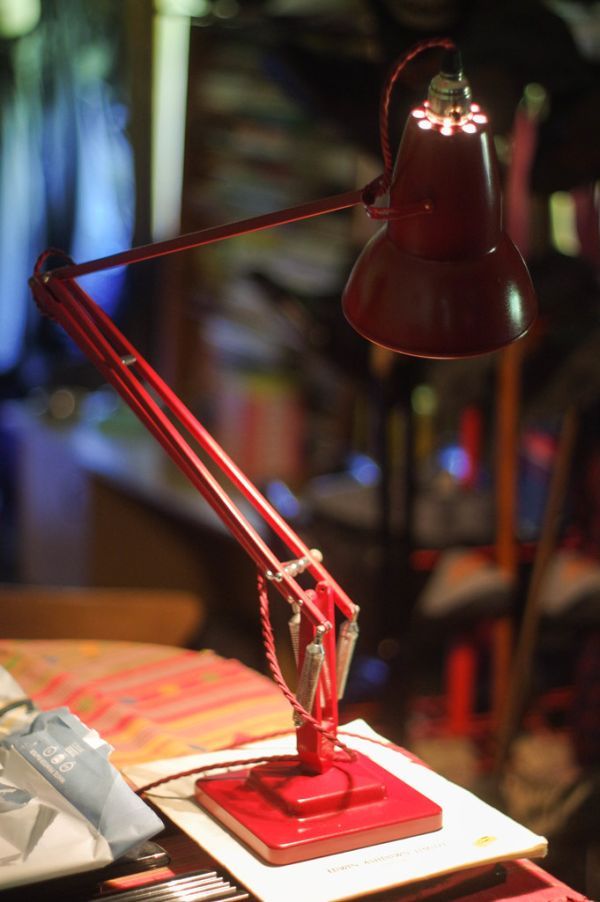
In the Second World War the same lamp was fitted to the navigators’ tables of bombers. The lamp of an aircraft raised from the bottom of a lake in 1985 lit up when a new battery was fitted. It is hard to find better evidence of how right a mechanism is.
051937: Luxo L-1 and every drawing board in the world
The Norwegian Jac Jacobsen took the same arrangement of springs and in 1937 brought out his own lamp: the L-1. The difference is that the springs, instead of being gathered at the base, sit outside along the arms, and that the place of the base is very often taken by a clamp. The clamp fixes the lamp to the edge of the desk and leaves the whole top free for work. That detail made it the lamp of the drawing board, and it sold in the tens of millions.
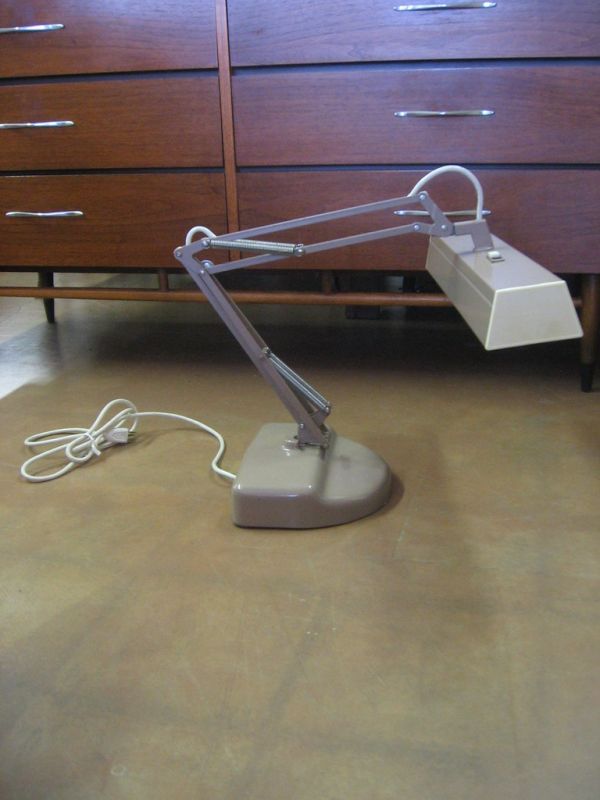
In Turkey the name of this lamp is “the architect’s lamp”. Before the computer, in every architect’s office, one stood clamped to the top left corner of every drawing board; with tracing paper, the technical pen and the T-square it was one of the four objects of the profession. The same lamp stood on the bench of the jeweller, the watchmaker, the dental technician and the tailor; that is, of everyone who fixes the eye on one point. It entered the student flat when its copies became cheap, and a generation spent its exam nights under it.
In 1986 an animation studio chose this lamp as the hero of one of its first computer-made short films: a desk lamp that hops, is curious and grows shy. The choice is no accident. An object that has a shoulder, an elbow and a head can tell of feeling without having a face; the model Carwardine took from the human arm came back fifty years later.
061950: Jieldé, the joint whose cable never breaks
Jean-Louis Domecq, a mechanic from Lyon, could not find a sturdy lamp for his workshop and so made one himself; its name is the French reading of his initials. The problem he solved is the weakest place in jointed lamps: the cable. At every joint the cable bends, and over the years it breaks inside. Domecq took the cable out of the joint; the current passes through circular contact rings inside the joint. The arm turns as far as you like, in whichever direction, and there is nothing in it to break.
Balance is by friction and the lamp is heavy; nor does it try to be light. Because its arms are modular, it is built from the same parts with anything from one arm to six. Its move out of the factories and into living rooms came in the 1990s, in the years when industrial buildings were being converted into housing; today it is a fixture of the interior style called “industrial”.
071972: Tizio, the lamp that became a pair of scales
Richard Sapper wanted a lamp for his own desk: it was to reach over a wide area, yet take up little room on the desk. His solution joins three ideas. The first is balance: he used two counterweights and no spring; the arms are in balance like scales and move at a fingertip. The second is the cable: a transformer in the base brings the voltage down to 12 volts, and the current passes through the two slender arms themselves, which run side by side. There is no cable, because the arm is the cable. The third is the source: the small halogen bulb, until then used mostly in car headlamps, shrinks the head to the size of a matchbox.
The joints are held by snap fasteners. If the lamp is knocked over the arms do not break; they come apart and are pushed back on. Black, thin and angular, Tizio became the emblem of the office desk of the 1980s; to have it in a director’s room was a kind of statement. It is in the permanent collections of the great museums.
Tizio’s real importance is that it foretold what would come forty years later: low voltage, a small source, a body that carries the current. Nearly all of today’s LED desk lamps are built on these three ideas.
081985 and 1986: Berenice and Tolomeo
Berenice (1985). With the same low-voltage halogen, Alberto Meda and Paolo Rizzatto went to the other extreme: making the lamp all but invisible. The arms are as thick as a pencil, the joints are moulded in reinforced plastic, the head is a coloured glass reflector the size of a palm. It shows the limit of how far a work lamp can be thinned.
Tolomeo (1986). Michele De Lucchi and Giancarlo Fassina went back to the spring of the Anglepoise and hid it. The springs are inside the aluminium arms; outside only the fine steel cables attached to them can be seen. De Lucchi tells that he took the idea from an angler who tensions the tip of his rod with a line. The matt aluminium head turns on its own axis. The result is a lamp whose mechanism shows without looking crowded, and in 1989 it won Italy’s most important design prize.
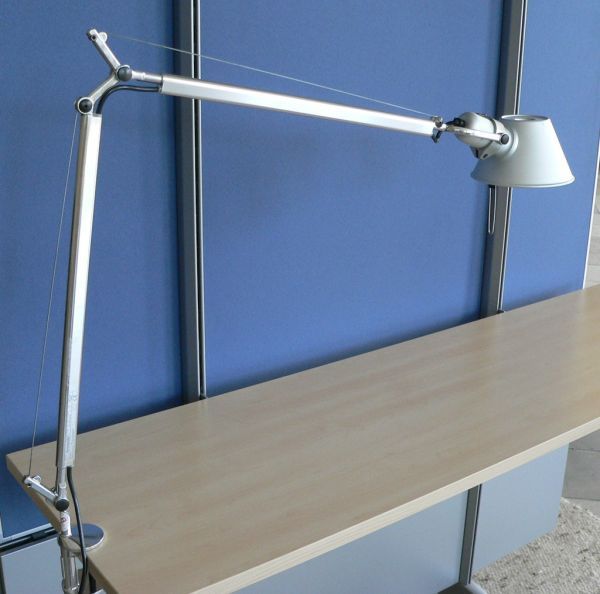
Tolomeo is today one of the best-selling designer lamps in the world, and in architects’ offices it has taken the place of the Luxo. There is a design reason for this: the table, wall, floor, pendant and clamp versions are built with the same head and the same arm; an office meets all its needs from a single family.
09Side by side
| Lamp | Year | Balance | Main idea | Weakness |
|---|---|---|---|---|
| Lampe Gras | 1921 | Friction | A body with no screws or welds | Adjusted with two hands |
| Anglepoise 1227 | 1935 | Spring | A spring that balances at every angle | Bows its head when the spring tires |
| Luxo L-1 | 1937 | Spring | The clamp, the desk left free | Looks cluttered |
| Jieldé | 1950 | Friction | The joint without a cable | Heavy |
| Tizio | 1972 | Counterweight | The arm that carries the current, halogen | The head gets hot, the light is narrow |
| Berenice | 1985 | Spring and friction | The slenderest arm | Delicate |
| Tolomeo | 1986 | Hidden spring | Every version from one family | Its cables gather dust |
10Who designed what else?
| Designer | Main profession | Known work other than lamps |
|---|---|---|
| Bernard-Albin Gras | Engineer | The lamp series itself |
| George Carwardine | Car engineer | Suspension systems |
| Jac Jacobsen | Importer of textile machinery | The lighting company he founded |
| Jean-Louis Domecq | Mechanic, workshop owner | The lamp workshop he founded |
| Richard Sapper | Industrial designer | The whistling kettle, an espresso maker, a folding radio, the black laptop computer |
| Alberto Meda | Mechanical engineer | A light carbon-fibre chair, office chairs |
| Michele De Lucchi | Architect | Coloured Memphis furniture, office machines, bank and museum buildings |
In the tables of the first two articles architects were the majority; here it is engineers and craftsmen. Shaping light is a knowledge of space; holding light up in the air is a knowledge of mechanics.
11After the LED: is balance still needed?
All these lamps answered the same problem: at the end of the arm there was a heavy, hot head. The incandescent bulb, with its holder, its reflector and the volume needed to cool it, weighed a few hundred grams. The LED has all but removed that weight. An arm with a strip of light of a few grams at its end stays in place with a simple friction joint; there is no need for a spring or a counterweight. That is why most new desk lamps consist of a single thin line.
What is gained is slenderness and silence. What is lost is legibility. Someone who looks at an Anglepoise sees how it works; the spring tightens, the arm rises. The new lamps have no mechanism to be seen. That the LED versions of the old models are still among the best sellers shows that people want not only light but also an object they can understand.
Where on the desk does the desk lamp go? On the left if you use your right hand, on the right if you use your left; otherwise the shadow of your writing hand falls where you write. The head should stay below eye level and the bulb should not be seen; if you work at a screen, the light should fall on the keyboard and the paper, not on the screen. That is also the whole point of a lamp with a moving arm: it changes place to suit the work. If the lamp you bought was adjusted once and has stood that way ever since, either it is in the wrong place or its joint does not let you move it.
12What did it bring, what did it take away?
When I design an office or a study these lamps always remind me of the same thing: a working person does ten different jobs in a day, and none of them wants the same light. Reading, drawing, looking at a screen, talking with someone, the place of the light should change. You cannot solve that from the ceiling; you have to put part of the light into the user’s hand. The distinction in the master’s thesis I wrote on exhibition lighting holds here too: general light sets up the space, directed light shows the work. Those that reflect the light are the subject of the article “Taming the bare bulb”, those that filter it of “Filtering the light”, and those that rebel against the ceiling outlet of “Reaching, hanging, playing”.