01When did the lamp become something that “had to be designed”?
The first electric bulbs were weak. A carbon-filament bulb gave a yellowish light that took the place of a candle or two; even if you left it bare, it bothered nobody. People dressed it up as a gas lamp: a brass arm, a glass globe, a tasselled shade. The only new thing was the switch.
The problem appeared when the bulb improved. In the 1910s tungsten replaced the carbon filament, and then the bulb was filled with gas. These bulbs, which gave several times more light from the same electricity, were too bright to look at when they stood bare at eye level. In 1925 manufacturers found a remedy by frosting the inside of the glass, but this only made the point larger. The real work was left to the lamp.
In the same years electricity was also spreading into homes. The socket, a sign of wealth at the beginning of the century, was on the walls of ordinary homes in the cities of Europe and America by the 1930s. So two things coincided: the bulb became very bright, and it entered everyone’s home. The designer lamp was born at this intersection. Nobody set out saying “let us make a beautiful object”; the question was simpler: How are we going to look at this light?
02A little physics: what can a shade do to light?
What disturbs the eye is not the amount of light; it is too much light coming from a small surface. If you spread the same light over a surface ten times larger, the eye is not dazzled. The whole skill of lamp design lies in this sentence, and there are three ways of doing it.
- Hiding. You put the bulb inside an opaque vessel. The eye does not see the source, and the light comes out only from below. It is simple, but the rest of the room stays dark.
- Reflecting. You first make the light strike a surface, and from there it returns to the room. The eye sees not the bulb but the broad, illuminated surface. A matt white surface gives back roughly four fifths of the light that falls on it and scatters it in every direction; polished metal, like a mirror, sends it in one direction.
- Filtering. You pass the light through a semi-translucent material such as paper, opal glass or fabric. This way is the subject of the article “Filtering the light” in this series.
All the lamps in this article are masters of the third way, that is, of reflection. The difference between them is where they place the surface and what form they give it.
03The first idea came from the stage: Mariano Fortuny
The person who first brought into the home the idea of softening light by reflecting it off a surface was not really a lamp designer. Mariano Fortuny, a Spanish painter and stage designer living in Venice, developed a system at the beginning of the century for lighting theatre stages: a powerful source was turned towards a large dome that was white inside, and an indirect light, as diffuse as the sky, fell on the stage. In 1907 he brought the same principle down to a floor lamp: a three-legged stand and, on top of it, a head that is reflective inside and resembles an umbrella.
That lamp is still in production more than a hundred years later, and it is regarded as the ancestor of the lighting umbrellas in photography studios. Today most people know Fortuny for another piece of work: the finely pleated silk dress he designed in the same years. A stage light, a dress and a lamp had come out of the same workshop. In the story of designer lamps this is almost the rule; the person who draws the lamp almost never draws only lamps.
04Poul Henningsen: forty years in pursuit of a curve
Henningsen was born in 1894, the son of two writers. He studied architecture at technical schools, but left without taking his diploma. From 1921 he wrote about architecture for a Copenhagen newspaper; he came to the lamp as a critic, that is, by complaining. His complaint was this: electric light was no dirtier than the gas lamp, but it was a far cruder light.
In 1925, for the great exhibition of decorative arts in Paris, he made a lamp together with Louis Poulsen, a Copenhagen company dealing in electrical supplies, and won a gold medal. The real invention came a year later. He developed the three-shade system for the lighting of the new exhibition hall in Copenhagen.
At the heart of the system is a mathematical curve: the logarithmic spiral. One property of this curve makes it a perfect fit for a lamp. A ray leaving its centre meets the curve at the same angle, whatever point it meets it at. If you cut the shades from this curve, the light from the bulb falls on the whole surface at an equal slope, and every part of the surface appears equally bright. There is no bright ring and no dark band.
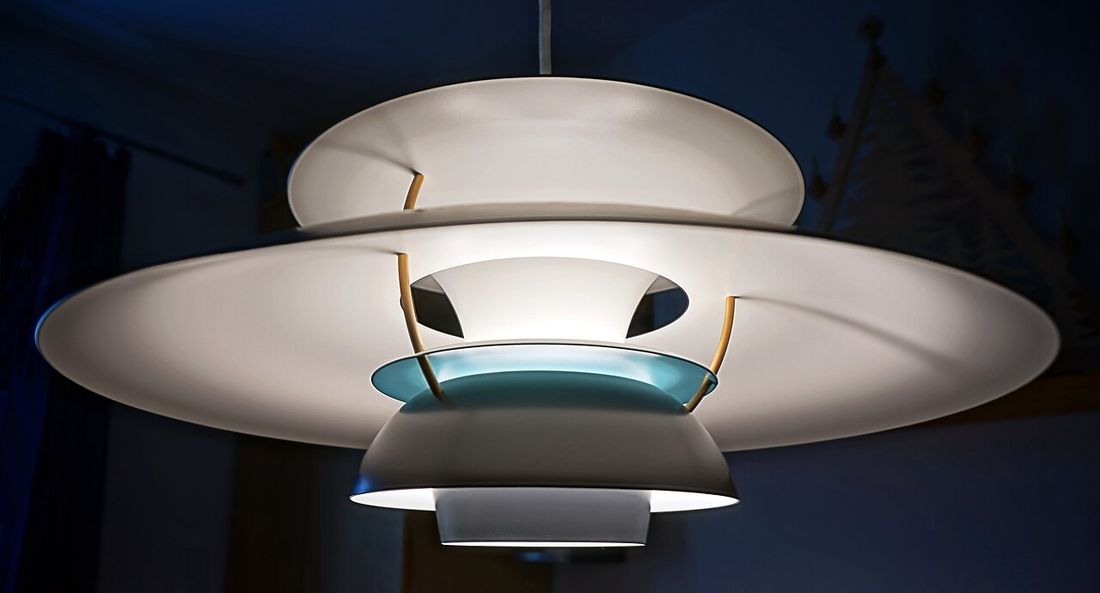
The three shades sit one inside the other, and each catches a part of the light: the broad upper one spreads it into the room, the middle one sends it downwards, and the small lower one hides the bulb from the eye. From whatever angle you look, you cannot see the bulb. This is not really a single lamp; it is a principle of construction, and over the years about a thousand models were derived from the same principle. Table lamps, pendants, wall lamps, even a piano lamp.
PH 5 (1958). Thirty years later Henningsen met a trouble that designers still know very well today: bulb manufacturers kept changing the shape, the length and the colour of the bulb, and the calculations of the old shades no longer held. His answer was a pendant that does its job whatever bulb is fitted into it. It takes its name from its diameter of 50 cm. The small cones inside it and the surfaces painted red and blue correct the colour of the light; it was designed to be hung low above the dining table. It has been in production without interruption ever since.

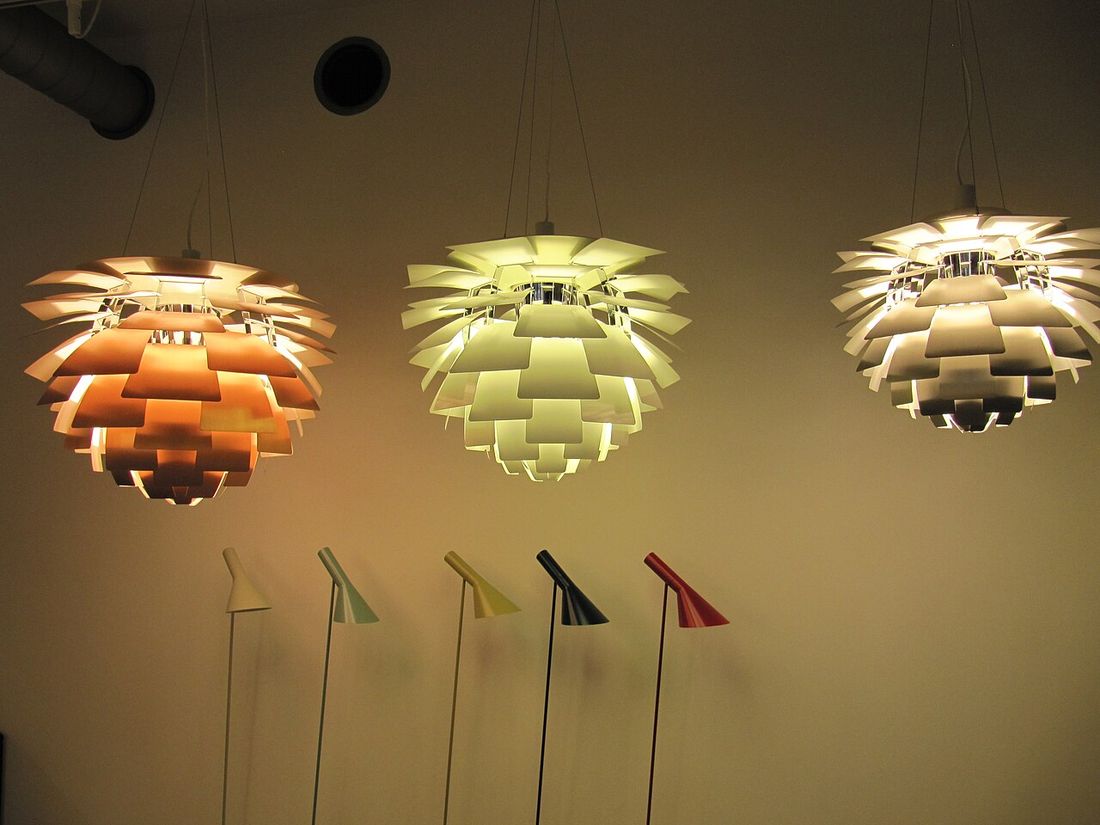
Artichoke (1958). It was drawn in the same year for a restaurant in Copenhagen. Seventy-two copper leaves arranged in twelve rows cover the bulb from every direction; each leaf passes the light it receives from the one above to the one below. It is still largely assembled by hand today. It is the most spectacular form of Henningsen’s principle, and it proves one thing: if the physics is right, the form can be as generous as it likes.

Henningsen’s other work is no less colourful than his lamps. He designed a grand piano, wrote and staged revues that bore his own name, made a documentary about his country and published a journal of criticism. In 1938 he was dismissed from his newspaper; in 1943 he had to flee to Sweden. After the war he returned and rebuilt the glass hall that had been destroyed in Copenhagen’s famous amusement park. The lamp was only one of this man’s many battles.
Why is a good pendant hung so low over the dining table? Because the shade hides the bulb only up to a certain angle. If the lamp rises above eye level, the person sitting sees the bulb from beneath the shade. With a pendant hung 55–65 cm above the table, the light falls on the plate, the face of the person opposite you is lit, and nobody is dazzled. The rule was set in the 1920s and has not changed with the LED.
05The Poulsen family: one company, a hundred and fifty years, many signatures
Louis Poulsen was founded in 1874 as a wine importer; it turned to lamps when electricity came to the city. What makes the company interesting is that it stayed loyal to the same question after Henningsen too: first the path of the light is drawn, then the form. The designers who work under the same roof do not resemble one another at all, but all of them deal with glare.
| Designer | Lamp | What else they designed |
|---|---|---|
| Poul Henningsen | Three-shade lamps (1926), PH 5, Artichoke and Snowball (1958) | Grand piano, revues, documentary film, critical writing |
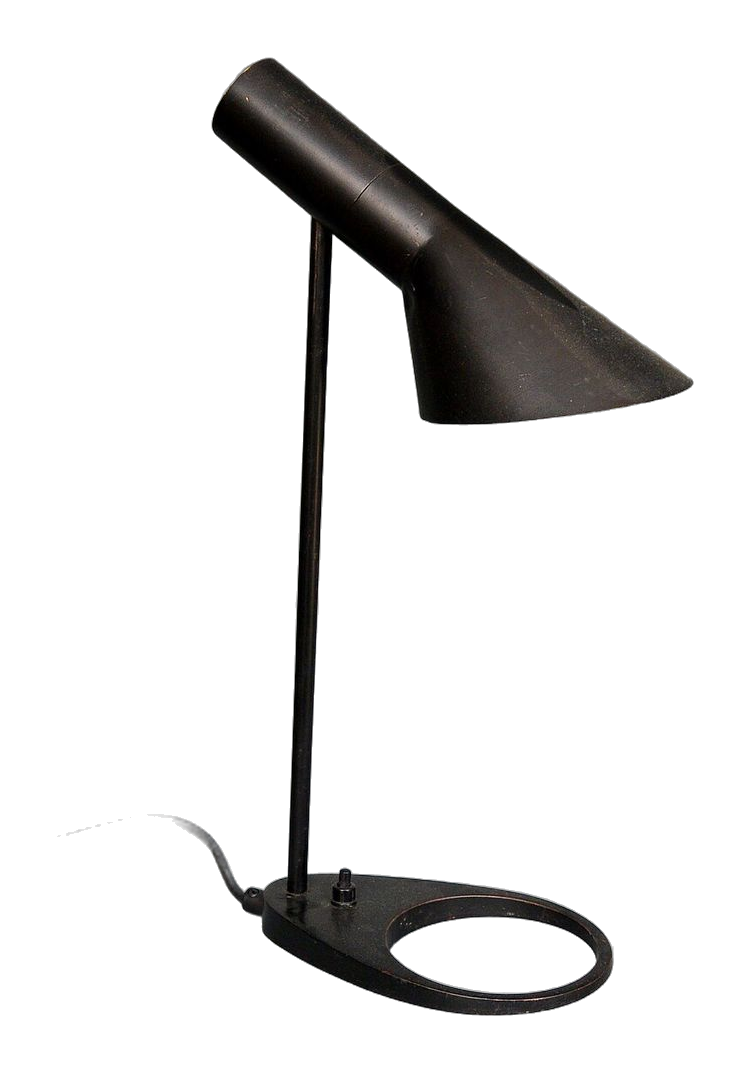
| Arne Jacobsen | AJ series (1957–60): table and floor lamps with obliquely cut conical heads, drawn for the hotel in Copenhagen | The building of the same hotel and all its furnishings; the Egg, Swan and Ant chairs; a cutlery set; a tap |
| Verner Panton | Panthella (1971): a hemispherical head and a trumpet-shaped foot that reflects the light back | One-piece plastic chair; interiors coloured from top to bottom |
| Louise Campbell | Collage (2005): three overlapping, laser-cut layers; light filtering through the leaves of a tree | Furniture and tableware |
| Shoichi Uchiyama | Enigma (2003): discs suspended in the air; the source hidden at the top | Architectural lighting |
| Øivind Slaatto | Patera (2015): a sphere built on the spiral in which sunflower seeds are arranged | Loudspeaker |
| Olafur Eliasson | OE Quasi (2019): two geometric frames, one inside the other; light is reflected from the outer corners onto the inner surface | Large art installations that work with light, water and mist |
Jacobsen’s lamp is a good example of the subject of this article. The head is an obliquely cut cone; it is white inside. The light falls only downwards, onto the book, and does not reach the eyes of the person in the armchair. The lamp drawn for a hotel room stands at bedsides in homes sixty years later.

06From the workshop to the desk: the hard-working lamps of the 1930s
Bestlite (1930). Robert Dudley Best was the heir of a family that had been making lamps in Birmingham since 1840. In 1925 he visited the Paris exhibition, studied design in Düsseldorf and Paris, and became a friend of the founder of the Bauhaus. When he returned, he removed everything from the ornate lamps of the family company: what remained was a base, a tube, an adjustable arm and a head that is white inside. The lamp caught on first in the workshops of the air force and of car mechanics, and then on architects’ desks. A professional journal declared it the first British design inspired by the Bauhaus.
Kaiser Idell (1931). Christian Dell was a silversmith, and between 1922 and 1925 he was foreman of the metal workshop of the Bauhaus. After the school he gave all his attention to the lamp. The dome-shaped head of the series introduced in 1931 sets the bulb deep inside: the light falls on the desk and does not reach the eyes of the person sitting. The swivel joint that carries the head was patented; the model that extends from the wall on a scissor arm is also one of the first examples of its kind. The name is a play on words: the name of the manufacturer, “Idee”, which means idea in German, and Dell’s surname. Dell received an offer of work from America; he did not go, but stayed in Germany and went on drawing lamps. After the war he opened a jeweller’s shop.
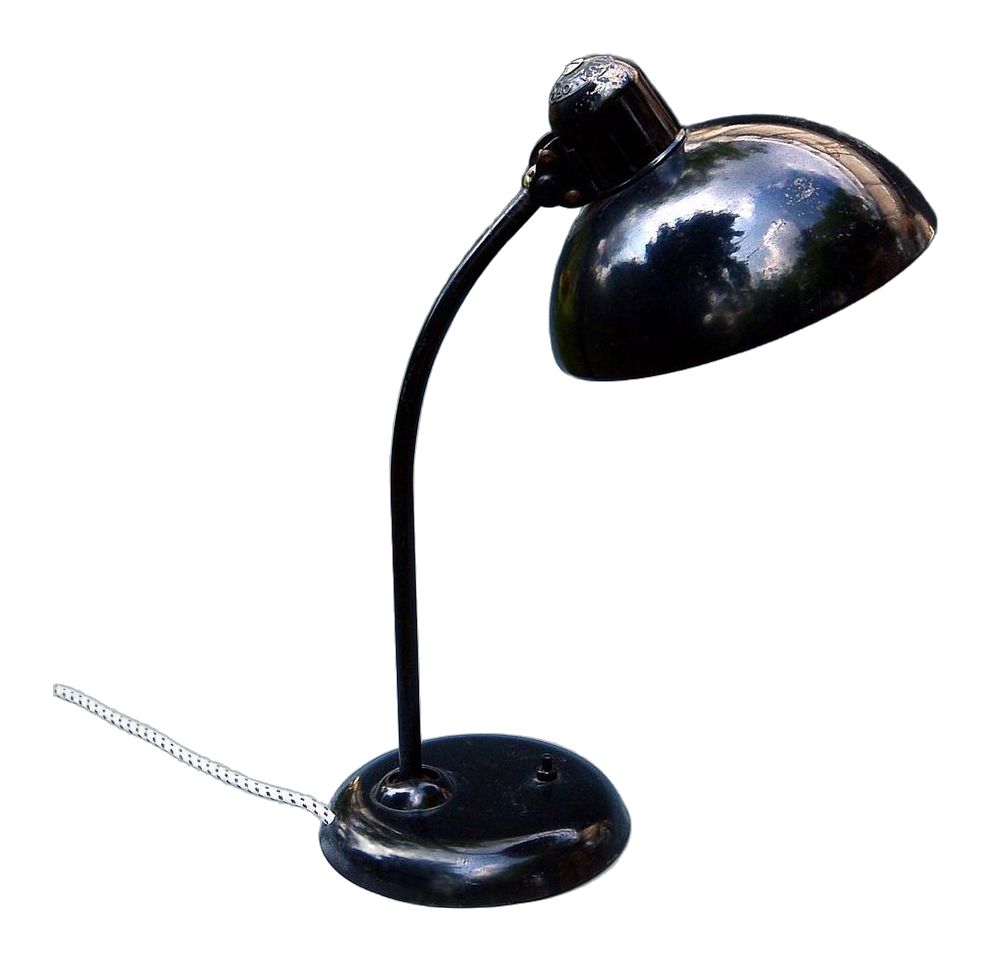

What the two lamps share is an attitude. Both abandoned the ornate shade and brought the honesty of the workshop lamp into the home: a visible joint, painted sheet metal, a reflector that is white inside. All the desk lamps sold today as “industrial” are the grandchildren of these two models.
07After the war: a slender arm, a small head
Grasshopper (1947). The Swedish architect Greta Magnusson-Grossman had emigrated to Los Angeles, where she was drawing houses on slender legs for the hillsides. She carried the same slenderness into the lamp: a three-legged stand leaning backwards, with a long cone at its end. Although the stand leans backwards it does not tip over, because the weight falls between the legs. The cone hides the bulb sunk inside it and sends the light to the page being read.
Serge Mouille (1953). In Paris a silversmith, reacting against the complicated lamps coming from Italy, made hand-beaten heads of black-painted aluminium. The heads are white inside and each turns at the end of a joint; long, slender arms reach into the room from the wall or the ceiling. Mouille produced for only about eight years, making and numbering every lamp by hand. Then he stopped and returned to teaching. Scarcity turned the lamps into a legend.
In the same years Le Corbusier drew a wall lamp for the flats of the large housing block in Marseille: two cones back to back. One sends the light down, to the place where one reads, the other up, to the ceiling. A single source becomes both task light and general light. Here is the architect’s view of objects: two jobs with the fewest parts.
08Italy: the reflector becomes an idea
Taccia (1958–62). This table lamp by the brothers Achille and Pier Giacomo Castiglioni has one of the most instructive prototype stories in the history of the lamp. The idea was this: let the light source sit in the base and face upwards; above it a transparent bowl, and on top of the bowl a concave white reflector. The light rises, strikes the reflector and returns to the room. Indirect light without touching the ceiling.
In the first example, prepared at the end of 1958, the bowl was of transparent plastic. The trials gave a bitter result: the heat of the incandescent bulb bent and warped the plastic. The brothers gave up plastic and had the bowl made of blown glass; the lamp could go into production only in 1962. The fluted aluminium body in the base is not decoration either; the flutes dissipate heat like the cooling fins of an engine. The end of the story is a happy one: in 2016, thanks to the low heat of the LED, the manufacturer was at last able to make the bowl of plastic, as the brothers had first wanted. An idea waited fifty-eight years for its own light source.
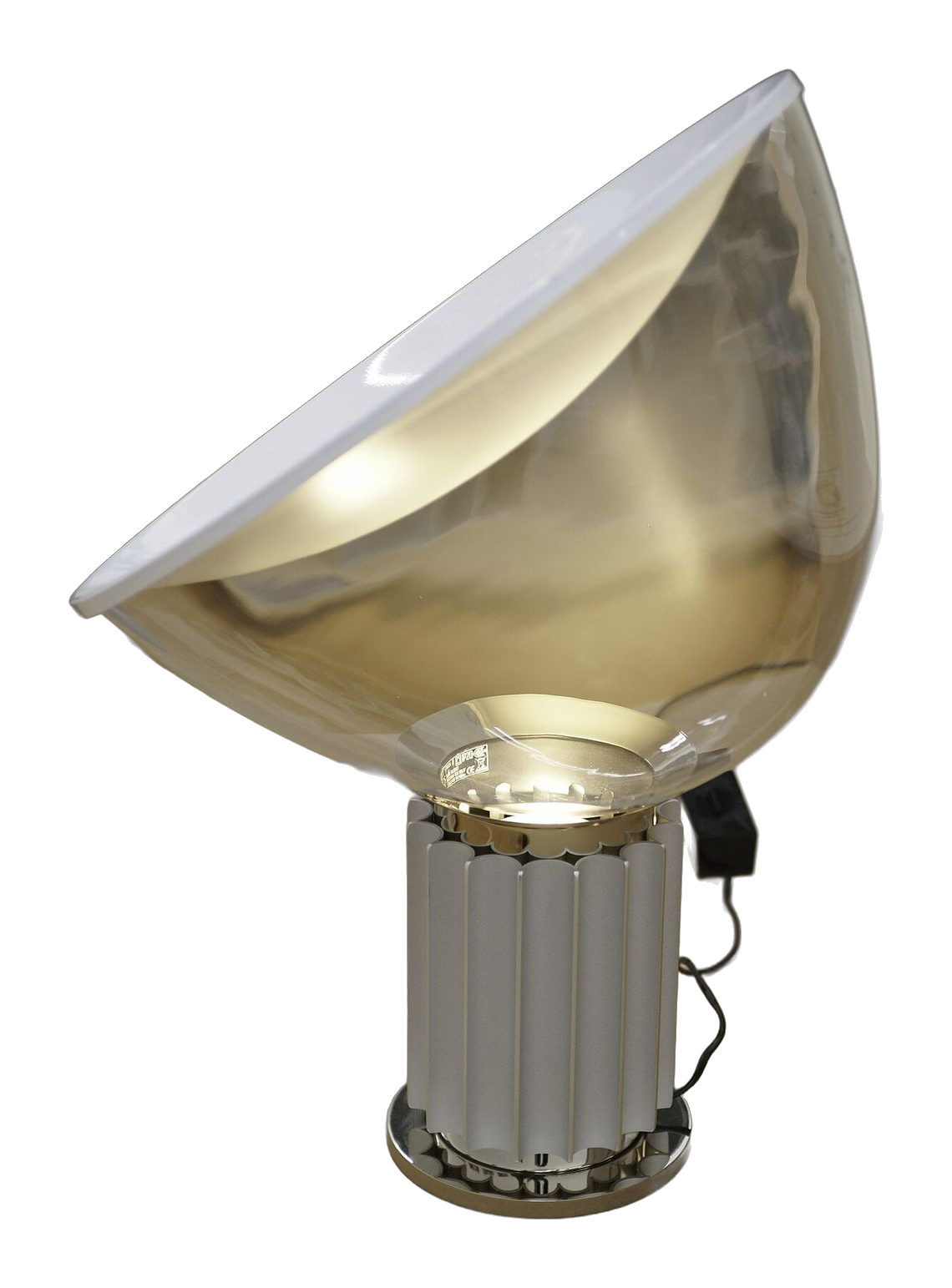

The Castiglioni brothers drew much besides lamps: a stool made from a tractor seat, a telephone stool that rocks on a bicycle saddle, a music system whose face turns, exhibitions. In all of them there is the same question: what job does each part of this object do? We shall return to their other lamps, that is, the floor lamp made from a car headlamp and the lamp on a steel cable stretched between ceiling and floor, in the fourth article of the series.
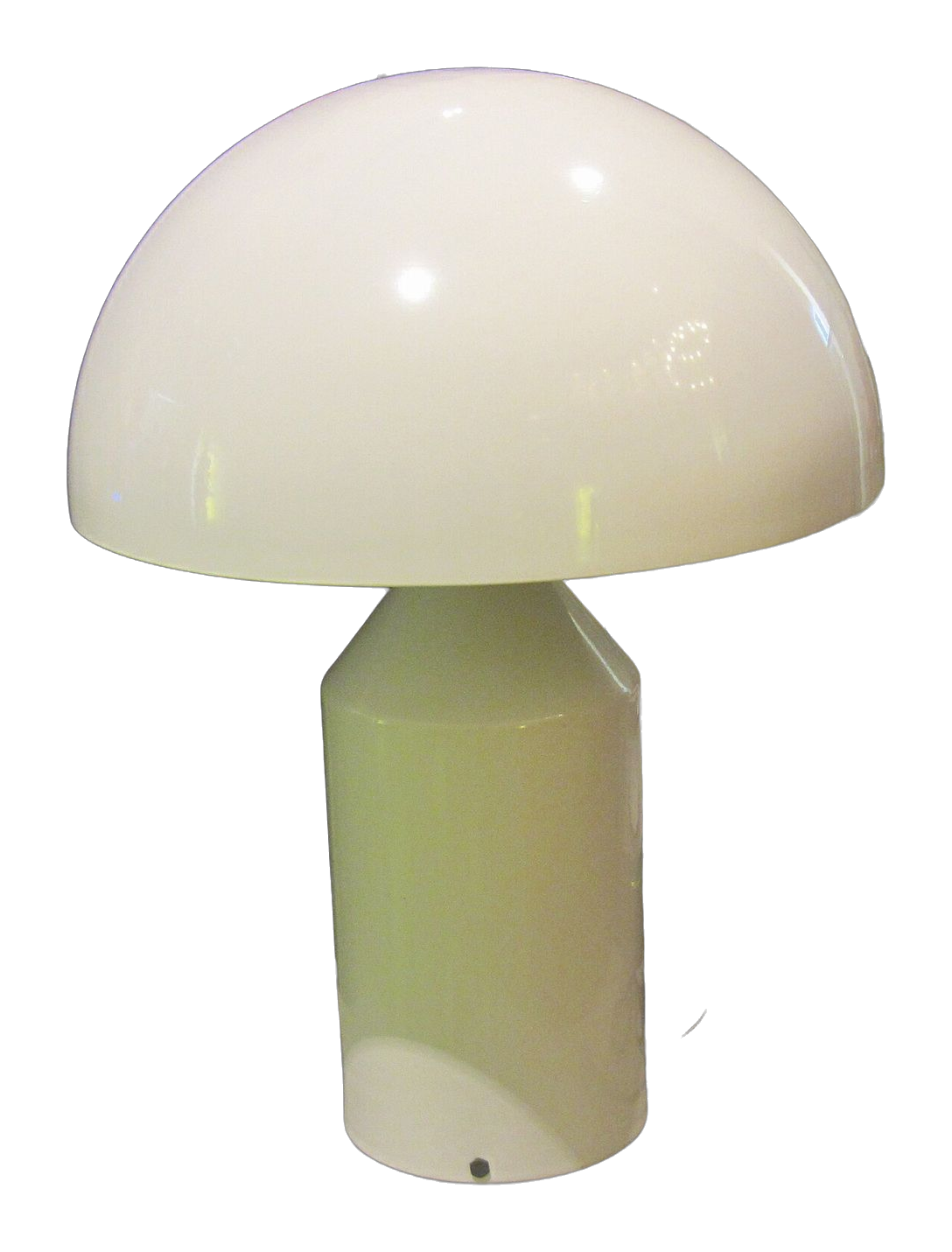
Atollo (1977). Vico Magistretti turned a table lamp into a geometry lesson: a cylinder, on top of it a cone, and on top of that a hemisphere. The bulbs are hidden inside the hemisphere; the light is reflected downwards from the inner surface of the sphere and illuminates the sloping surface of the cone. The lamp’s own body becomes its own reflector. Two years later it received Italy’s most important design award. Magistretti was an architect; stackable plastic chairs, a sofa with a folding backrest and a small bedside lamp that darkens like an eclipsed moon, which we shall describe in the fourth article of the series, are also his.

091968: two hemispheres, two quarter-circles
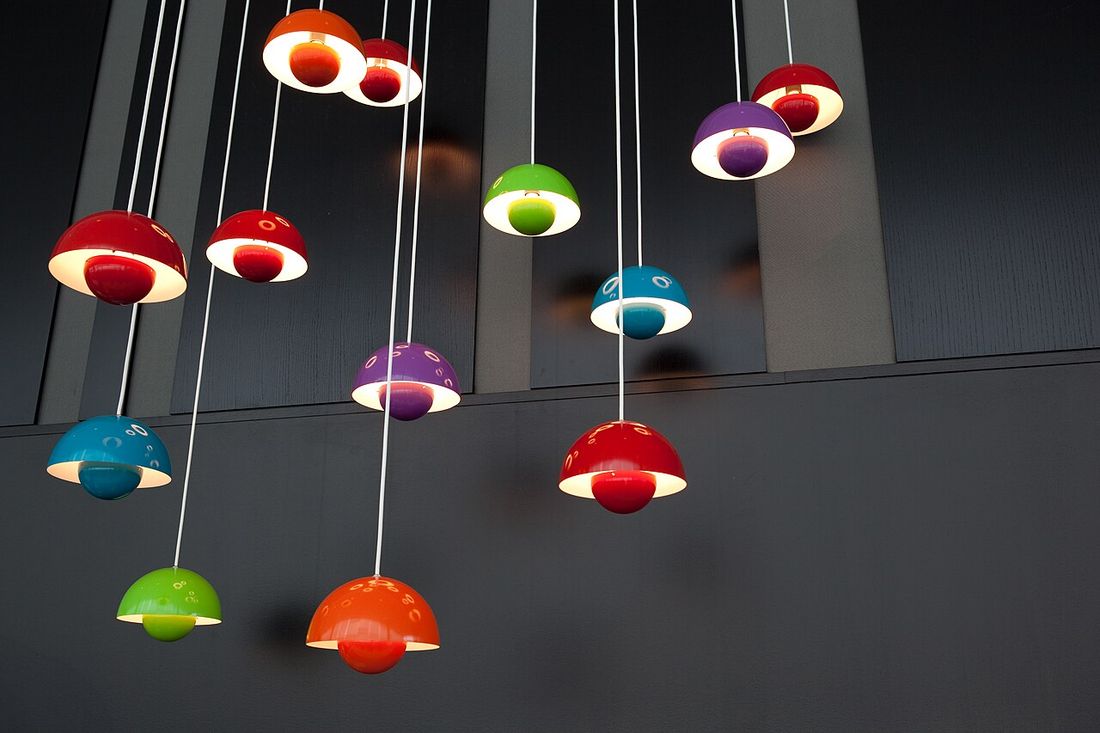
Flowerpot (1968). Verner Panton’s pendant consists of two hemispheres. The large one faces downwards, the small one faces upwards and hides the bulb right in the middle. The light goes from the inside of the small sphere to the inside of the large one, and from there to the table. Its bright enamel colours carry the spirit of the period; it also takes its name from the flower children of those years. The physics is the same as Henningsen’s, the temperament entirely different.

Semi (1968). Two Danish students of architecture, Claus Bonderup and Torsten Thorup, drew a pendant of two quarter-circles back to back for a school competition. Seen from above it is a very slender funnel; seen from below, a wide mouth that is pure white inside. It is so plain that it can be described with a single line. In the 1980s it became one of the best-selling lamps of its country.
10Who designed what else?
Almost none of those who drew the lamps set out as a “lamp designer”. This is no coincidence. The lamp is the place where an architect or a craftsman tests everything they know in one small object.
| Designer | Main profession | Known work apart from lamps |
|---|---|---|
| Mariano Fortuny | Painter, stage designer | Pleated silk dress, printed fabrics, stage-lighting dome |
| Robert Dudley Best | Heir of a lamp-making family | Management of the family company |
| Christian Dell | Silversmith | Teapots and service sets in the Bauhaus metal workshop; jewellery |
| Greta Magnusson-Grossman | Architect | Hillside houses in Los Angeles, furniture |
| Serge Mouille | Silversmith | Silverwork; teaching |
| Le Corbusier | Architect | Housing blocks, a chapel, a tubular-steel armchair and chaise longue |
| The Castiglioni brothers | Architects | Tractor-seat stool, music system, exhibition designs |
| Vico Magistretti | Architect | Stackable plastic chair, sofa with a folding backrest |
| Bonderup and Thorup | Architects | Housing and public buildings |
11What do these lamps leave for the home?
- Look for the bulb first. Look at a lamp from where you sit. If you can see the bare surface of the source, the lamp is not doing its job, however expensive it may be.
- Look at the inner surface. If the inside of the head is matt white, the light comes soft and broad; if it is polished metal, sharp and narrow. Both are right; it is enough to know which you want.
- Set the height by the eye, not by the lamp. A pendant should be close to the table, a reading lamp behind your shoulder, a bedside lamp below eye level.
- Do not forget indirect light. Light that strikes the ceiling or the wall and returns gives a more spacious room than a spotlight that gives the same power directly. The detail of this is the subject of a separate article on lighting.
The same principles hold at a large scale too. In my master’s thesis I studied the sub-spaces created by lighting in museum and exhibition spaces; there too, the distinction between the light that shows the work and the source that tires the eye is the same as in a table lamp. Only the scale changes.
The rule set a hundred years ago still holds: a good lamp shows its light, not its source. The LED made the bulb smaller and cooler, but a bright point is still a bright point. The other way, that is, lamps that filter light through paper, glass and fabric, is the subject of the article “Filtering the light” in this series. Desk lamps that stay in balance by spring, counterweight and friction are the subject of the article “Staying in balance”. Lamps that reach, hang and play are the subject of the article “Reaching, hanging, playing”. As for the general story of the lamp, the light sources and the costly lesson of the halogen lamp, they are the subject of our article a hundred and fifty years of the lamp.