INTRODUCTIONEvery style is the answer to a question
“Modern”, “classic”, “industrial”, “Scandinavian”. Today we use these words as if we were choosing a colour from a catalogue. Yet each of them was, in its own time, the answer to a very concrete question. How do we make cheap chairs for so many people? How do we cope with tuberculosis? With what does a country that has come out of a war furnish its homes? What happens when the price of oil quadruples?
This article follows those questions in order. At the end of each period you will find a summary under the same five headings: what the need was, which object was its icon, what it brought, what it took away, and what it became. In the “Who said what” notes you will find what the thinkers who read that period best had to say; in the “So that is why” notes you will find the surprising origin of something you see today in your home, in your office or in the street.
It is a long article; you can jump to the period you want from the contents below. But if you read it from beginning to end, you will know at the end why the white tiles in your bathroom, the depth of your kitchen worktop and the off-road vehicle in the car park are the way they are.
- BEFORE 1760Before the machine: the world of the craftsman
- 1760–1860The Industrial Revolution: abundance and the first crisis
- 1860–1910The first objection to the machine: Arts & Crafts and Art Nouveau
- 1895–1930Cinema is born: the first interior that everyone saw
- 1907–1914Industry hires the designer
- 1908–1927The Ford Model T: one car changes everything
- 1904 TO TODAYRolls-Royce and the others: handwork in the machine age
- 1914–1918The First World War: the old world collapses
- 1919–1933The Bauhaus and modernism: the pendulum makes peace with the machine
- 1925–1939Art Deco: luxury meets the machine
- 1929–1939Depression and streamlining: the toaster imitates the train
- 1930–1960Scandinavian modern: the touch of wood on the machine
- 1939–1945The Second World War: a terrible laboratory
- 1948The Land Rover: going out into nature by car
- 1945–1965After the war: good design for everyone
- 1943–1965IKEA: how did it come about, and why?
- 1927–1983Buckminster Fuller: doing more with less
- 1950–1975Concrete and utopia: Brutalism, Metabolism, Archigram
- 1957–1972The space age, plastic and pop
- 1957–1970The consumer society: the object becomes a sign
- 1965–1975The hippies and the counterculture
- 1955–1980The other objections: the Beats, radical design, punk
- 1973–1980The oil crisis: a preference becomes a necessity
- 1947–1984From the transistor to the desktop: the quiet road to the computer
- 1980–1995Postmodernism, Memphis and the reaction to it: minimalism
- 1984–2007Digital: the object migrates to the screen
- 2007 TO TODAYAfter the screen
- SYNTHESISHow is everything connected?
Let us first see the whole story in a single figure.
When the machine makes something cheaper and more plentiful, people notice after a while what they have lost and turn in the other direction. We shall meet this swing several times in the course of the article. But it is not only the machine that pushes the pendulum. Wars, economic crises, epidemics, relations between classes, and what philosophers and sociologists have said about objects are at least as influential. We shall look at all of them in turn.
BEFORE 1760Before the machine: the world of the craftsman
Before industry there was no profession called “designer”, because the person who drew and the person who made were the same. The material came from nearby, and the form was handed down from generation to generation. Objects were few, they were expensive, and they were inherited.
Space was shaped accordingly. The room of the traditional Turkish house is a good example: the divan is fixed along the wall, the bedding is put away in a cupboard during the day, and meals are eaten at a low table set on the floor. The same room is a sitting room, a dining room and a bedroom in the course of a day. The same is true of the Japanese house. The idea that we rediscover today as “flexible space” had been there for centuries.
1760–1860The Industrial Revolution: abundance and the first crisis
The steam engine, cast iron and large sheets of glass changed the scale of production. In England Josiah Wedgwood organised his pottery by dividing the work into parts, and sold his products by catalogue and in a showroom. For the first time the person who drew was separated from the person who made; the root of the profession of “designer” lies here.
The railway, for its part, rearranged life itself. So that trains could keep to a timetable, each town stopped using its own solar time; standard time is an invention of the railway. Stations appeared as a new type of building made of iron and glass. And for the first time goods produced in a factory could travel cheaply to the other end of the country.
The Crystal Palace, built for the Great Exhibition in London in 1851, was put up within months from iron and glass parts produced in factories and assembled on site. The building showed the future. The products inside it showed a crisis: because the machine could make anything, ornament had been stamped on everything; stoves had been made to look like Gothic cathedrals and lamps like bunches of flowers.
In the same years the Viennese Michael Thonet found another way. Chair No. 14 (1859), which he produced by bending beech rods with steam, is the first great design success of series production.
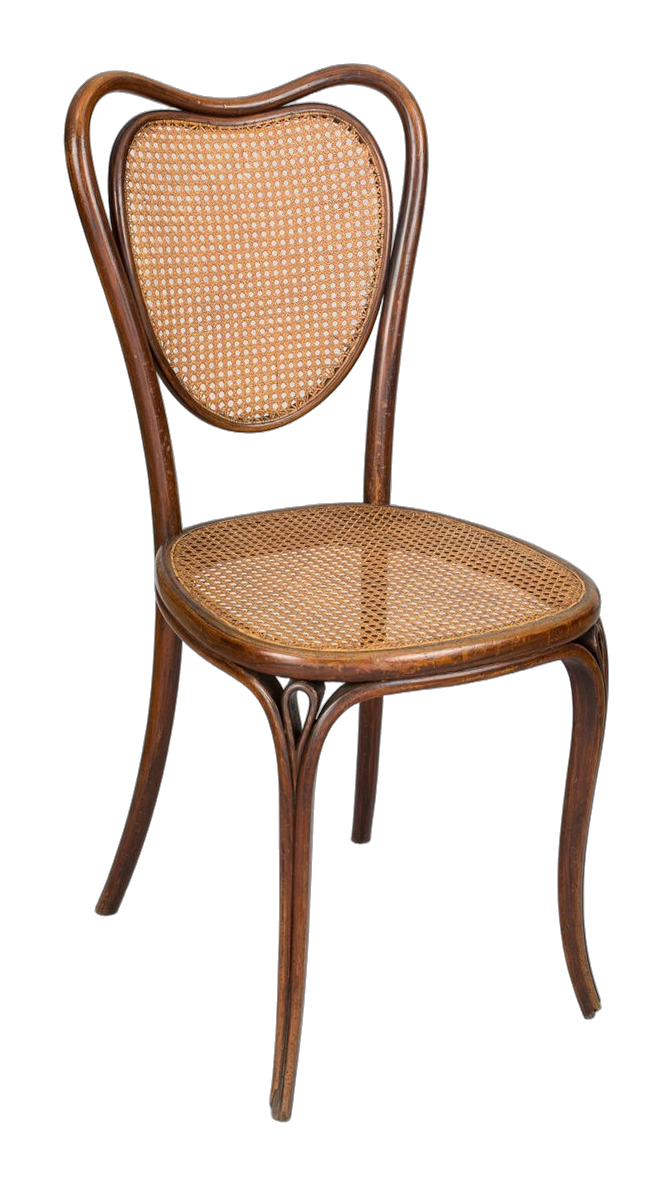
Without the railway, Thonet’s chair could not have gone further than a Viennese café. The two inventions carried each other: the train opened the market, and the knock-down design fitted that market.
Why is the top floor the most expensive floor? Until the 1850s it was exactly the opposite: because climbing stairs was hard work, servants and the poor lived on the top floor. The safe lift reversed this order; together with the steel frame it made the skyscraper possible, and with the skyscraper the penthouse.
The factory rebuilt society together with its objects. Migration from village to city, paid work, working hours, and the middle class as a new class are products of this century. The middle class wanted to buy ready-made in a shop the objects that the nobility ordered and waited for. The department store, the shop window, the price tag and the advertisement were born around this demand. The whole history of design from this point on is the history of what this new buyer wanted, and why.
The craftsman knew the table he made from beginning to end. The factory worker tightens the same screw a thousand times a day and perhaps never sees the finished product. Marx called this alienation. He also described the buyer’s side of the same situation: the object in the shop conceals who made it and under what conditions; we see only its price and its shine. William Morris was a socialist who had read Marx; his call for a return to handwork was a matter of labour before it was a matter of taste.
1860–1910The first objection to the machine: Arts & Crafts and Art Nouveau
The reaction was not long in coming. In England William Morris argued that the factory product made both the object and the worker ugly, and in 1861 he founded his workshop producing handmade furniture, fabric and wallpaper. The Arts & Crafts movement was born here: honest material, visible joints, pattern taken from nature.
The movement had a tragic contradiction. Morris wanted beautiful objects for everyone, but handwork was expensive; only the rich could buy his products. This contradiction would remain unresolved for a hundred and fifty years, and we shall meet it again at the end of the article.
In the same years a new influence came from an unexpected place. When Japan opened its ports to the world in the 1850s, Japanese prints, ceramics and the arrangement of the Japanese house reached Europe. A surface left empty, asymmetry, plain wood: Western designers saw for the first time that there could be a beauty outside ornament.
In the 1890s Art Nouveau combined the longing for nature with new materials. In Victor Horta’s Tassel House of 1893 in Brussels the iron columns curl like ivy; the staircase, the balustrade, the floor mosaic and the wall painting are the continuation of a single line. The entrances of the Paris Métro that rise like plant stems, Gaudí’s houses in Barcelona and Tiffany’s stained-glass lamps belong to the same family. The idea that everything from the door handle to the chandelier should be designed by one hand, that is, the idea of the total interior, comes from here.
The profession of interior design was also born in these years. Until then homes had been furnished by upholsterers and furniture makers. In New York, at the beginning of the 1900s, Elsie de Wolfe became one of the first to practise this as an independent profession, and she turned heavy, dark drawing rooms into light-coloured, airy rooms.
Two quiet developments made this possible. The first was electricity: the light bulb that Edison made commercial in 1879 took the soot of the gas lamp out of the home. Without soot, walls could be painted in light colours. The second was the germ.
Why are bathrooms covered in white tiles? In the 1880s it was proved that diseases are caused by germs. Bathrooms, which until then had been panelled in wood, carpeted and curtained, suddenly became suspect. White tiles and the white enamel bath, on which dirt is seen at once and which are easily wiped, were not a matter of taste but a health measure. The disappearance of heavy velvet curtains and tasselled covers from homes is a result of the same fear.
In 1899 the American economist Veblen put forward the concept of conspicuous consumption: people buy expensive things not because they are useful but so that others can see that they are expensive. A silver spoon does not serve soup any better than a steel spoon. In 1904 the German sociologist Simmel explained how fashion works: the upper class adopts a form, the lower class imitates it, and the upper class moves on to a new one in order to set itself apart. The rise and fall of every movement in this article can also be read through this simple mechanism.
1895–1930Cinema is born: the first interior that everyone saw
On 28 December 1895, in the basement of a café in Paris, the Lumière brothers showed their first films to a paying audience. Each was shorter than a minute. The film that entered the programme a few weeks later became a legend: a train approaching a station. It is said that the spectators, thinking the locomotive was coming at them, jumped from their seats. The story is very probably an exaggeration, but it tells something true: for the first time people had entered an image. And in that image was the train, the greatest designed object of the age.
Seven years later Georges Méliès made “A Trip to the Moon” (1902). A rocket fired like a cannon shell lands in the eye of the Moon. This film began two things. The first is set design: Méliès painted, built and lit a world that did not exist; for the first time an imagined space became something that was built. The second is the dream of space: the form of that rocket would pass sixty years later to real rockets, and from there to armchairs, lamps and televisions.
Cinema did something without equal in the history of design: it showed millions of people spaces that they would never be able to enter in their lives. In “The Cabinet of Dr. Caligari” (1920), slanting walls and painted shadows proved that a space can express a state of mind. “Metropolis” (1927) drew the city of the future; architects argued about that image for decades. In the Hollywood films of the 1930s there were white telephones, mirrored walls and curving staircases; it was not magazines but the cinema screen that carried Art Deco into ordinary homes.
The deepest contribution of cinema to design is in light. Film and stage lighting showed that light can divide a space, bring a face forward and build an emotion. Some of the founders of architectural lighting design came from stage lighting.
A painting has a single original; standing in front of it has a weight of its own. Benjamin called this “aura”, and in 1935 he asked: in works that can be reproduced without limit, such as photography and film, does the original keep any meaning? His answer pointed in two directions. The aura fades; but art reaches everyone for the first time. The same is true of the chair produced in series: Thonet’s fifty million chairs have no “original”. The value we give today to a single handmade ceramic bowl is the longing for that lost aura.
1907–1914Industry hires the designer
In Germany in 1907 industrialists, artists and craftsmen came together and founded the Werkbund. The aim was clear: to make the German product stand out on the world market by its quality. In the same year the electrical company AEG hired the architect Peter Behrens. Behrens designed the company’s factory, its kettle, its fan, its logo and its posters himself. This is how corporate identity and industrial design were born.
Three young men were working in Behrens’s office in those years: Walter Gropius, Mies van der Rohe and Le Corbusier. Three great names of twentieth-century architecture came from the same table.
In America, meanwhile, the great fire of Chicago in 1871 gave the opportunity to rebuild the city. With the steel frame and the lift, the first skyscrapers rose. The architect Louis Sullivan wrote the sentence that would later become the slogan of a whole century: form follows function. His pupil Frank Lloyd Wright removed the walls inside the house and let the rooms flow into one another. What we call the “open plan” today begins with him.
The most famous early example of the new technique is the Flatiron Building in New York (1902). The Chicago architect Daniel Burnham placed a 22-storey structure on a triangular plot where two streets meet at a narrow angle; the nose of the building is only 2 m wide. It takes its name from its form, which resembles a flat iron. What made this possible was the steel frame: the walls no longer carried load but were hung on the frame like a curtain. Many New Yorkers believed that the building would be blown over in the first storm and gave it the name “Burnham’s Folly”. It was not blown over; on the contrary, it became a favourite of photographers and one of the first symbols of the modern city. The real lesson of the Flatiron is this: however difficult the plot, a new technique can turn an old constraint into character. There is an equivalent of this in the interior as well; a wall that carries no load means that the floor plan can be divided freely for the first time.
Why are bookshelves and filing cabinets always the same height? Germany’s standards institute was founded in 1917 to speed up war production, so that factories could use one another’s parts. In 1922 the same institute standardised paper sizes; A4 dates from that day. Once paper was standardised, the dimensions of the file were set by it, then those of the shelf by the file, and those of the cabinet and the desk by the shelf. The invisible unit of measurement of office furniture is a sheet of paper.
1908–1927The Ford Model T: one car changes everything
Henry Ford’s aim was not to make a beautiful car; it was to make a car that everyone could buy. In 1913 he set up the moving assembly line at the Highland Park factory: the worker did not go to the car; the car passed in front of the worker.
The effect of the Model T on design went far beyond the car.
The idea of the standard part. Each part was identical to the one before it and could be exchanged. The fact that kitchen cabinet modules are produced today in fixed widths, and that sockets are the same in every home, is the continuation of this thinking.
Can a house be a machine too? The architect Le Corbusier wrote exactly this in 1923: a house is a machine for living in. In 1926 Margarete Schütte-Lihotzky designed a kitchen for the social housing of Frankfurt using the methods of factory efficiency. Steps were measured with a stopwatch, and everything was placed within arm’s reach. The Frankfurt Kitchen, installed in about ten thousand dwellings, is the ancestor of today’s fitted kitchen.
The city spread out. The car moved the home away from work. The suburb, the garage, the petrol station, the roadside motel and the shopping centre appeared as new types of space.
Why were Ford’s cars black, and when did cars become coloured? The first Model Ts were not black; they were sold in red, green and grey. The change to a single colour came in 1914, together with the assembly line. The common account says that black paint dried fastest; researchers of the Model T do not confirm this. The real reason was simpler: a single colour meant painting without ever stopping the line, and black enamel was also cheap and durable. When quick-drying coloured paints were developed in the mid-1920s, competitors brought out coloured cars, and Ford returned to colour as well. Colour was a problem of production before it was a matter of taste.
Ford’s second invention was economic. In 1914 he raised his workers’ daily wage, at a stroke, to nearly double. His reason was not charity: the worker who produced the car had to be able to buy the car. Mass production can stand only with mass consumption. The economic order of the twentieth century, the trio of high wages, sale by instalments and mass advertising, was built on this idea.
Weber said that the modern world ties everything to calculation, measurement and efficiency, and he compared this to an “iron cage”: efficiency makes us richer, but it also shuts us into an order from which we cannot escape. The assembly line, the kitchen measured with a stopwatch and the standard dwelling are the most concrete forms of this cage. What is gained is time; what is lost is the way work and home used to be particular to the person.
1904 TO TODAYRolls-Royce and the others: how did handwork survive in the machine age?
While Ford was making the car that everyone could buy, exactly the opposite question was being asked in England in the same years: what would the best car that can be made be like?
Henry Royce was an electrical engineer; troubled by the noise and vibration of the car he had bought, he built his own car in 1904. Charles Rolls was an aristocrat who sold luxury cars in London. They met, and in 1906 they founded the company. The Silver Ghost, introduced in 1906, completed an endurance run of about 24,000 km the following year, and a motoring magazine called it “the best car in the world”. Rolls-Royce’s design idea was an absence: no noise, no vibration, no breakdown. Its famous advertisement half a century later says the same thing: at 100 km/h the loudest sound heard inside is the ticking of the electric clock.
From the point of view of interior architecture, what is really interesting is how these cars were sold. Until the end of the 1940s Rolls-Royce did not build bodies. Only the chassis, the engine and the radiator left the factory. The customer bought this and took it to a coachbuilder; the body, the upholstery, the wood and the fabric were made there, to the customer’s wishes. Most of these workshops had come from the building of horse-drawn carriages. In other words, in the first forty years of the car, luxury meant an interior made by hand on a frame produced in series. The distinction today between the shell of a building and its interior fit-out follows the same logic.
The story of the marque also crosses the story of war. Rolls-Royce built aircraft engines in both world wars; the best-known British fighters and bombers of the Second World War were flown by the same engine. After the war the company’s main business became the jet engine, and in 1971 the cost of developing a new jet engine drove the company into bankruptcy. The state rescued the engine division; the car division was separated, changed hands and in 1998 was divided between two German manufacturers: the factory and Bentley went to one, and the Rolls-Royce name to the other. Today the cars that carry that name and the aircraft engines that carry the same name are the products of two separate companies. That a brand can be detached from the factory that produces it and sold on its own is the clearest proof of what Baudrillard called the “sign”.
Why are some things wanted more as they become more expensive? In economics, a normal good sells less when its price rises. The goods that Veblen described in 1899 behave in the opposite way: their price is part of the product. What Rolls-Royce sells is unattainability. This is why luxury brands do not hold sales, deliberately limit production and keep waiting lists. The waiting time, too, is deliberately designed.
The shared story of similar brands. Most of the craft brands that survived the industrial age did the same thing: they did not resist the technology that took their work away; they carried their skill over to the new need.
- Hermès (1837). It was a workshop in Paris that made harness and saddles. When the car spread and the horse-drawn carriage declined, the family changed direction: after the First World War it first made luggage with the same skill in leather, and then, in 1922, its first handbag; the saddle stitch of the harness passed to the bag. A trade died; its skill lived on.
- Louis Vuitton (1854). Until then the lids of trunks had been domed, so that rainwater would run off on a horse-drawn carriage. Vuitton made a trunk with a flat lid, because in the new means of transport, the train and the steamship, luggage was stacked one piece on another. The famous monogram was designed in 1896 to prevent imitations. Today the logo itself is worth more than the product.
- Cartier and Rolex. One of the first modern men’s wristwatches was made in 1904 for an aviator who could not look at his pocket watch while flying. In 1926 Rolex developed the waterproof case and gave its watches to mountaineers and divers. These watches, designed as tools, did not lose their value when quartz made them unnecessary; on the contrary, they turned into objects of status. The function ended; the sign remained.
- Leica (1925). An engineer who did not want to carry heavy bellows cameras put cinema film into a still camera. The 35 mm photographic standard, still in use today, was borrowed from the cinema. The camera that fitted in a pocket gave rise to photojournalism, and photojournalism to the illustrated magazine; the way interiors became known and spread through photographs begins here.
- Bugatti (1909). Its founder was the son of a furniture designer and the brother of a sculptor. He had even the engine block finished like a piece of jewellery. He stands at the head of the line that regards the car not as a product of engineering but as a work of art.
- Mercedes-Benz and Cadillac. The other road to luxury: flawless engineering. In 1908 Cadillac took a test in England: its cars were dismantled, their parts were mixed and they were assembled again; the cars ran, and the marque received the award for the most important automotive advance of that year. On that day the interchangeability of parts was a proof of luxury; Ford applied the same idea for everyone.
All of these brands stand in the middle of the tension that we have been following since the beginning of the article. Morris turned his back on the machine to protect handwork, and he lost. These brands used the machine where it is not seen and left the hand where it is seen: the engine in the factory, the upholstery in the workshop; the movement produced in series, the case polished by hand. The rule of a good project in interior architecture is very often the same: the precision of industry in the infrastructure, and the work of a craftsman wherever the hand and the eye reach.
1914–1918The First World War: the old world collapses
In four years the war took away a generation and, with it, all the ornate confidence of the nineteenth century. Its effect on design came through four channels.
Objects. In the trench there was no time to take out a pocket watch; the wristwatch spread with the soldier. The trench coat takes its name from the trench. When women began to work in factories, short hair, shorter skirts and comfortable fabric became everyday.
Materials and methods. The aircraft industry developed aluminium alloys and plywood. Stainless steel had been discovered in 1913; after the war it entered the kitchen. The need to send millions of identical rifles, identical boots and identical tins of food to the front established standard sizes and ready-to-wear clothing. The huts put up quickly behind the front were the first large-scale trial of prefabricated building.
Society. Four empires collapsed. Women gained the right to vote in many countries. The housing shortage after the war pushed the state, for the first time, to produce housing on a large scale; the Frankfurt Kitchen was designed for this social housing.
Mentality. The war had been started by ornate empires. In the eyes of young artists ornament was now more than unnecessary; it was morally tainted. In the Netherlands De Stijl (1917) reduced everything to the straight line and the primary colours; Rietveld’s red and blue chair is a manifesto more than a piece of furniture. In Russia, with the revolution, Constructivism put art at the service of the factory and the poster. And in Germany a school opened in 1919.
The same break had other faces as well. Just before the war the Italian Futurists had glorified speed, the machine and the city, and had declared that a racing car was more beautiful than an ancient statue. The multi-storey cities they drew, with lifts and linked by bridges, were never built, but they left a legacy of images that reaches from Metropolis to the science-fiction films of today. Dada, born in Zurich in the middle of the war, did exactly the opposite: if the trench was where this reason and this civilisation had led, then both reason and art were to be mocked. Marcel Duchamp put an ordinary factory product in an exhibition room and called it “art”. The idea that the meaning of an object is determined not by its form but by its context comes from there. The Surrealism of the 1920s carried this game into furniture, as in the sofa in the shape of lips. The root of what Memphis and Starck did sixty years later lies here.
Why did the kitchen open onto the living room? Before 1914, in middle-class homes, the meal was cooked by a servant; the kitchen was a workroom at the back of the house, out of sight. The two wars almost put an end to domestic service. The meal was now cooked by the owner of the home, who did not want to be cut off from the guests. Architects did not invent the open kitchen; the departure of the servant from the home gave rise to it.
1919–1933The Bauhaus and modernism: the pendulum makes peace with the machine
The Bauhaus school asked Morris’s question the other way round: instead of opposing the machine, can good design not be made for the machine? In its workshops the artist, the craftsman and industry sat at the same table.
What made the school special was less what it taught than how it taught. Every student first took a six-month preliminary course: folding paper, handling materials, experimenting with colour and form. The aim was to wipe out what had been learned by rote and to get to know the material. Then a workshop was chosen: metal, weaving, carpentry, ceramics, wall painting, typography. In each workshop an artist and a master craftsman taught together. While the painters Klee and Kandinsky taught the theory of colour and form, a turner was working metal in the next room. Almost all the schools of design and architecture in the world today follow this model, together with the “basic design” course of the first year.
The school saw three cities and three directors. In Weimar (1919) it was close to craft. In Dessau (1925) it moved into the glass-fronted building designed by Gropius and began to work with industry; its wallpapers and lamps were really sold. The second director, Hannes Meyer, said “the needs of the people instead of luxury”; the third, Mies van der Rohe, turned the school towards architecture. Names such as Anni Albers and Gunta Stölzl came out of the weaving workshop, and Marianne Brandt out of the metal workshop; Brandt’s teapot and lamps are among the most widely produced Bauhaus products of the period.
Marcel Breuer, inspired by the steel tube of his bicycle’s handlebars, made his tubular-framed chair in 1925. For the first time furniture ceased to be a heavy mass; it turned into lines standing in the air. Wagenfeld’s glass table lamp, Mies van der Rohe’s Barcelona chair, and the chaise longue of Le Corbusier and Charlotte Perriand are products of the same decade, and all of them are still produced today.
Why are modern buildings white, flat-roofed, with wide windows and terraces? A large part of the answer is tuberculosis. Until antibiotics were discovered, the only known treatment for tuberculosis was sun, clean air and rest. Sanatoriums were designed for this: terraces facing the sun, ribbon windows, plain white surfaces that do not hold dust, metal furniture that is easily wiped. Modernist architects carried this language of the hospital into the home. Even the angle of the back of Alvar Aalto’s Paimio chair was calculated so that the patient could breathe easily. Part of the “modern” aesthetic is in fact a medical prescription.
The school was closed in 1933 under Nazi pressure. Its teachers scattered across the world, especially to America, and took their ideas with them. The closing of a school led to the globalisation of a style. Türkiye had its share of this migration too: architects who came from Germany in the 1930s left their mark on the buildings of the young republic’s capital and on its architectural education.
1925–1939Art Deco: luxury meets the machine
The Paris exhibition of 1925 introduced to the world Art Deco, which brought luxury and the machine together. Geometric pattern, polished metal, exotic wood, the stepped silhouette. The opening of the tomb of Tutankhamun in Egypt in 1922, the interest in Aztec and African art, the speed of the aeroplane and the car: all went into the same pot. The stainless steel crown of the Chrysler Building in New York (1930) and the saloons of the ocean liners were made in this language.
In the same years Bakelite, the first synthetic plastic, entered the home. Because it could be moulded, it gave the radio, the telephone and the light switch rounded forms that had never been seen before. The radio took the place of the fireplace as the new focus of the living room; for the first time the family gathered around a device.
1929–1939Depression and streamlining: the toaster imitates the train
In 1929 the stock market crashed. When sales stopped, manufacturers discovered something new: changing the outside of a product without changing its inside revived sales. With names such as Raymond Loewy, Henry Dreyfuss and Norman Bel Geddes, the profession of industrial designer became established in America in these years. The sales of a refrigerator that Loewy restyled in 1934 multiplied within a few years; for the first time it was proved in figures that design earns money.
The language of form came from aviation. The bodies of aeroplanes and airships had taught everyone the teardrop shape, around which air flows with the least resistance. This form first came down onto the rails. In 1934, in America, the Zephyr train with its stainless steel body covered the 1,600 km between Denver and Chicago in a single run from dawn to dusk and was welcomed like a national hero. The “Flying Hamburger” in Germany and, in Britain, the Mallard, which broke the speed record for steam trains at 203 km/h in 1938, were parts of the same race. The black, angular locomotive that the Lumières had filmed in 1895 had turned into a silver bullet in forty years.
Then something strange happened. Once speed had become the symbol of progress, things that never move at all began to be drawn as if they were about to go into a wind tunnel: refrigerators, toasters, irons, radios, pencil sharpeners. This was called streamline, the streamlined style.
Why did old refrigerators have rounded corners? There are two reasons. The first is fashion: in the age of speed a rounded line looked modern. The second is production: the body was pressed from a single sheet of steel, and sheet steel tears at a sharp corner and flows at a rounded one. Aesthetics and the press tool confirmed each other. The fact that a smooth surface is easily wiped also answered the concern for hygiene.
The same period left two more legacies. General Motors, against Ford’s single model, began to bring out a new model every year; the aim was to make last year’s car out of date while it was still running. This was called planned obsolescence. In Germany, meanwhile, Ferdinand Porsche drew a “people’s car” with streamlined lines. The war intervened; but that car, the Volkswagen Beetle, would be produced in more than 21 million units after the war and, thirty years later, would become the symbol of a movement that was the exact opposite of the regime under which it was designed: the hippies.
The Airstream caravan, with its riveted aluminium body and teardrop shape, also appeared in 1936. One of the purest examples of the machine aesthetic had been made to carry people into nature. The two ends of the pendulum met in the same product.
In 1932 a New York estate agent, Bernard London, published a pamphlet on the way out of the depression: let every product be given a legal expiry date, and let objects whose time has run out be scrapped even if they still work. The proposal did not become law, but the idea settled into industry. In the same years the economist Keynes identified the cause of the crisis as a lack of demand: if people do not spend, the factories stop. Since that day one of the tasks of design has been to give people the wish to replace the working objects they already have. Uncomfortable, but true.
1930–1960Scandinavian modern: the touch of wood on the machine
The Nordic countries came to industrialisation late; the tradition of craft had not been broken. The winters were long and dark; the home was where the greater part of life was spent. Forest was plentiful, steel was expensive. Social democratic governments regarded good housing and good objects as a right.
The design that came out of these conditions took the plainness of modernism, but it put bent birch in place of the steel tube, and wool and linen texture beside the white wall. Alvar Aalto’s stools, Hans Wegner’s chairs and Arne Jacobsen’s Ant and Egg chairs are the classics of this language. Poul Henningsen’s layered lamps hide the bulb from the eye and give light by reflection; it is a lesson in lighting that the dark winter taught people.
1939–1945The Second World War: a terrible laboratory
The war was the greatest experiment in materials and production in history. When peace came there were new materials, empty factories and millions of soldiers returning home. Almost all of post-war design is the product of these three.
- Moulded plywood. In 1942 Charles and Ray Eames produced leg splints of plywood for the American navy. Four years later the same technique turned into their famous chairs that fit the body.
- Glass fibre. It was developed for radar domes; in 1950 it became Eames’s one-piece shell chair.
- Aluminium. The aircraft factories were looking for work. The aluminium chair designed in 1944 for naval ships is still in cafés today.
- Nylon and plastics. The nylon produced for parachutes turned into stockings, and the polyethylene developed in the war into the food storage container.
- Chipboard. Board pressed from wood chips and glue was developed in the 1930s; its industry grew in the 1940s, when timber was scarce. Today the carcass of most of the furniture in the world is made of this material.
- Radar. A radar engineer noticed that the chocolate in his pocket had melted; this is how the microwave oven was born.
Besides materials, the war also left methods behind.
- Ergonomics. In the war, well-trained pilots were crashing sound aircraft on landing. A psychologist found the reason: the levers for the landing gear and for the wing flaps were side by side and of the same shape; a tired pilot pulled the wrong one. The ends of the levers were given different shapes, and the accidents stopped. This is how it came to be understood that what is called “human error” is very often an error of design. The fact that every seat, every handle and every interface is measured against the human being today is the continuation of this discovery.
- The computer and the network. The machines built to break codes and to calculate the paths of artillery shells are the beginning of the computer, and the search in the Cold War for communications that could withstand attack is the beginning of the internet.
- The jet engine. At the end of the 1950s it was fitted to the passenger aircraft. Intercontinental travel came down to hours; mass tourism, the giant airport and the international hotel that offers the same room in every country are products of this engine. The Hilton that opened in Istanbul in 1955 was the first example of this new world in Türkiye, and it shaped a generation’s idea of the “modern interior”.
- Logistics. The planning methods developed to feed and equip millions of soldiers were applied in peacetime to the supermarket, the warehouse and the chain store.
The social consequences were at least as decisive as these. In Britain, which was living on rations, the state made plain, sturdy “utility furniture”, made with little material, compulsory; a country became acquainted with modernism without intending to. In America demobilised soldiers were given cheap housing loans and university grants; the growth of the suburb and of the middle class is the result of this support. Even the shadow of the atomic bomb seeped into form: the spheres mounted on rods in the wall clocks, lamps and patterns of the 1950s come from the model of the atom.
Vehicles changed as well. The light reconnaissance vehicle that the American army ordered in 1941, the Jeep, was produced in more than 600,000 units during the war and went to every front. In Italy the factory of the aircraft manufacturer Piaggio had been bombed and the country’s roads were in ruins; an aeronautical engineer drew a motorcycle with a front wheel resembling aircraft landing gear, an enclosed engine, and a form that could be ridden in a skirt. The Vespa appeared in 1946. In France Citroën’s 2CV was designed as a farmer’s car with suspension soft enough not to break the eggs in a basket while crossing a ploughed field.
1948The Land Rover: going out into nature by car
Britain came out of the war in debt. Steel was rationed, but the aluminium left over from the aircraft factories was plentiful. Maurice Wilks, chief engineer of the Rover company, was using an army-surplus Jeep on his farm in Wales and could not find spare parts. According to the story, he drew the first sketch of the new vehicle on a beach, in the sand.
Every feature of the Land Rover, introduced in 1948, is the result of a shortage. Its body is aluminium because steel could not be found. Its panels are flat because they need no expensive press tools. The colour of the first vehicles is army-surplus green paint that had been produced for aircraft cockpits. It was designed to work in the field like a tractor.
Then something unexpected happened. Because the vehicle could go wherever the road ended, it became the vehicle of explorers, documentary makers, safari guides and aid organisations. It was always there in wildlife footage on television. In this way a farm tool became the symbol of escape into nature. Morris had wanted to return to nature with the hand loom; the people of the mid-twentieth century went there on four wheels. Camping, the caravan, the weekend plot of land and, later, an entire outdoor clothing industry were built on this idea.
The Range Rover, which appeared in 1970, combined off-road ability with comfort; it is often said to have been exhibited at the Louvre as an example of industrial design. From there the road to the present is short.
Why are there so many off-road vehicles in the city? The chain is as follows: the wartime jeep (1941), the farm vehicle (1948), the luxury off-road vehicle (1970), the SUV as a family car (the 1990s). The vehicle changed; the feeling it sells did not: “if I want to, I can leave everything and go into nature.” Most of them never leave the tarmac. With that car people buy the possibility of an escape.
1945–1965After the war: good design for everyone
Millions of families needed homes, and those homes needed objects. In America, in suburbs such as Levittown, houses were built on the logic of the assembly line, dozens being finished each day. Every country gave its own answer to the same question.
The economic ground was exceptional too. From 1945 to 1973 the Western economies grew without interruption; historians call this period the “thirty glorious years”. America financed the rebuilding of Europe through the Marshall Plan and, together with the money, exported a way of life: the refrigerator, the car, the supermarket. Exhibitions and magazines presented “good design” as the shop window of democracy.
America: mid-century modern. The Eameses, Eero Saarinen, George Nelson. Moulded plywood, glass fibre, slender steel legs. Saarinen’s single-legged Tulip table was designed to clear away the “forest of legs” under the table. Optimistic, light, playful.
Italy: the beautiful machine. Industry grew quickly in the north, but the craft workshops were still standing. The Vespa, Olivetti typewriters, Gio Ponti’s chair that can be lifted with one finger, the Castiglioni brothers’ arc lamp with its marble base. The Italians looked at the industrial product as if it were sculpture.
Germany: the honest tool. The Ulm School of Design, founded in 1953, was the continuation of the Bauhaus. The Braun company and Dieter Rams gave the radio, the electric shaver and the food processor a calm, comprehensible language: few buttons, clear lettering, neutral colour.
Switzerland: the graphics of order. The Helvetica typeface, drawn in 1957, and page design based on the grid spread everywhere, from airport signs to company logos.
Japan: making things smaller. The pocket radio that Sony brought out in the mid-1950s sums up a country’s philosophy of design: little space, dense function. The same line would lead to the Walkman in 1979.
Why do the sofas in a living room always face the same wall? Until the 1950s seating was arranged around the fireplace or a low table, so that people could see one another. When television arrived, the sofas turned not towards one another but towards the screen. For seventy years the layout of the living room has been drawn by a device.
The companies that produced design. The quiet heroes of this period are the manufacturers who trusted the designer and took the risk of paying for the tooling. In America Herman Miller and Knoll produced the work of Eames and Saarinen. Florence Knoll went a step further: she set up a unit that planned the offices of companies as a whole, from furniture to lighting, and separated interior design from “decoration”, turning it into a specialism. She is regarded as the founder of today’s corporate interior architecture. In Europe Vitra, Cassina, Artek, Fritz Hansen, Louis Poulsen and Bang & Olufsen, and in Italy Alessi, Kartell, Flos and Artemide, played the same role. Whether a movement will last is very often decided not by a designer but by a company that goes on producing it for sixty years.
In Türkiye. The first industrial enterprises of the Republic were at the same time its first schools of design. Sümerbank, founded in 1933, drew a country’s curtains, tablecloths and dresses with its printed cotton patterns; its pattern studio was one of the first teams in Türkiye to design for industry. Paşabahçe, founded in 1935, produced everyday glassware from the tea glass to the jug; the slim-waisted tea glass is the best example of those products whose designer is unknown but which everyone recognises. Arçelik, founded in 1955, produced the first domestically made washing machine in 1959 and the first domestically made refrigerator in 1960; the kitchen and the bathroom were rearranged around these appliances. Eczacıbaşı began to produce ceramic sanitaryware at the end of the 1950s; this production, which later took the name Vitra, had its share in turning the bathroom from a “wet area” into a designed space. The Devrim car, built in a few months in railway workshops in 1961, did not go into series production, but it became the symbol of a country’s confidence that “we can design our own product”. The Anadol, which appeared in 1966, is the first domestically made car produced in series, and its body was of glass fibre. The reason is familiar: the number produced was too small to pay for expensive press tools for sheet steel. Like the aluminium of the Land Rover, it was a decision about material born of shortage.
Offices also took their present form in these years. Three inventions came together: air conditioning, the fluorescent lamp and the suspended ceiling. Together the three made deep, enclosed floors far from the windows usable. The glass-fronted office tower is a building in which one cannot stay without air conditioning. A new method developed in Britain in 1959 made it possible to produce large, perfectly flat sheets of glass cheaply; from that day on, the full-height glass façade and the generous use of mirrors became ordinary.
Design also became a subject of politics. At the American exhibition that opened in Moscow in 1959, in front of a model kitchen with a dishwasher, Nixon and Khrushchev argued about which system offered its people a better life. One of the most famous debates of the Cold War took place beside a kitchen worktop.
In 1957 the French semiologist Barthes read everyday objects as if they were texts. Of the newly launched Citroën DS he wrote that it was the equivalent, in its age, of the great Gothic cathedrals: an object whose makers are unknown, at which a whole people gazes spellbound, flawless as if it had come down from the sky. And of plastic he said this: it is not a substance but the very idea of infinite transformation. What Barthes showed is simple, and for designers it is fundamental: an object does not only do a job; it also says something.
In 1951, when Germany was struggling with its housing shortage, Heidegger said something unexpected to architects: the real problem is not the lack of houses but that we have forgotten how to “dwell”. Four walls and a roof give a dwelling; a home is the way a person belongs to a place in the world. In “The Poetics of Space” in 1958, Bachelard said the same thing as a poet would: the attic, the larder, the corner and the drawer exist not through their dimensions but through what they awaken in us. The strongest criticism of mass-produced housing comes from these two books, and this is more or less the reason why interior architecture exists.
1943–1965IKEA: how did it come about, and why?
In 1943, at the age of seventeen, Ingvar Kamprad founded a company in a poor, forested region of Sweden that sold pens, wallets and picture frames by mail order. He moved into furniture in 1948. His prices were so low that the Swedish furniture dealers joined together and put pressure on the suppliers: anyone who supplied IKEA would not be allowed to supply them.
Instead of finishing the company, this boycott created the IKEA of today. Unable to find goods, Kamprad was forced to have his own furniture designed and, from 1961, to move production abroad, first to Poland. And once the design was his own, he could pack it as he wished.
IKEA had begun to try out furniture sold in parts at the beginning of the 1950s. The event that made the idea the company’s principle took place in 1956: an employee removed the legs of a table to fit it into his car. It is the same idea as Thonet’s crate a hundred years earlier, but with one difference: with Thonet the dealer assembled the chair; with IKEA the customer does. The cost of transport, storage and assembly passed to the buyer; this is why the price fell.
The timing was perfect. The Swedish state was having a million dwellings built in ten years. The young families moving into these homes had little money, but they now had cars. In 1965 IKEA opened a giant store with a car park outside Stockholm; the customer went into the warehouse himself, took his own box and carried it home himself. Three lines that we have been following since the beginning of the article meet here: Thonet’s knock-down idea, Ford’s standard part, and the car spreading the city out.
Why do you like the cupboard you assembled yourself more than it deserves? Researchers have given this the name “the IKEA effect”: people place a higher value on an object into which they have put effort than on the same object ready-made. Assembly does not only lower the cost; it also produces attachment. What began as a problem became a hidden feature of the product.
Why are the same products sold all over the world? In 1956 a haulier tried putting cargo into standard steel boxes instead of carrying it piece by piece. The container lowered the cost of sea transport so much that producing a chair at the other end of the world and bringing it back became cheaper than producing it in the next town. Global design is design that fits the dimensions of a box.
1927–1983Buckminster Fuller: doing more with less
Fuller was an inventor, and throughout his life he worked on a single question: how can shelter be provided for the greatest number of people with the least material? At the end of the 1920s he designed a factory-made aluminium house hung from a mast. In 1933 he built a three-wheeled, teardrop-shaped car; it is one of the most extreme examples of the streamlined age. When the war ended he proposed producing houses in the aircraft factories that had fallen empty. None of these went into series production.
The idea that took hold was the geodesic dome. The sphere is the form that encloses the most volume with the least surface. Fuller divided the sphere into triangles; because a triangle does not change shape, the structure was both very light and very strong. A similar dome had been built in Germany in the 1920s for a planetarium; but it was Fuller who developed the idea, patented it in 1954 and spread it across the world.
The dome first found work in the army: it covered radar stations at the poles and became a shelter that could be carried by helicopter. Then it appeared at exhibitions. The American pavilion at the 1967 world’s fair in Montreal, 76 m in diameter, made the dome the symbol of the future.
What is really interesting is into whose hands the dome passed after the army. In the 1960s, in Colorado, a group of young artists built dome houses from sheet metal cut out of the roofs of scrap cars. The hippie communes adopted the dome: it was cheap, you could build it yourself, it had no corners, and it did not resemble the rectangle of the mainstream house. Fuller’s image of “Spaceship Earth”, that is, the idea that we are all travelling in a single vehicle with limited resources, became the basic image of the environmental movement.
As a house, however, the dome failed, and this is instructive for interior architecture. Hundreds of joints let water in. A cupboard could not stand against a curved wall, a standard door or window did not fit, and the rooms were left shaped like slices of cake. A flawless structure did not mean a habitable interior.
1950–1975Concrete and utopia: Brutalism, Metabolism, Archigram
In post-war Europe steel was expensive, labour was cheap and the housing shortage was enormous. The material in plentiful supply was concrete. In 1952, in Marseille, Le Corbusier built a huge housing block that gathered 337 flats, an internal street, shops and, on the roof, a pool and a running track for children into a single block, and he left the concrete unplastered, with the marks of the formwork boards. The name Brutalism, derived from the French expression for “raw concrete”, comes from here.
Brutalism was an attitude: do not hide the material, do not hide the structure, spend the money not on cladding but on space. It became the language of the welfare state; universities, libraries, town halls and social housing were built in this language. In Ankara the building of the Faculty of Architecture of the Middle East Technical University (early 1960s), with its bare concrete, internal courtyards and daylight, is one of the best-known examples in Türkiye.
In Japan young architects were looking for another answer in the same years. In a country whose cities had been bombed and whose population was rising quickly, a building could not be a fixed object; it had to grow like a living thing, and its cells had to change. They called the movement Metabolism. The Nakagin Capsule Tower in Tokyo (1972) consisted of 140 ready-made rooms bolted to a core; each capsule was planned to be removed and renewed every twenty-five years. None was ever replaced, and the building was demolished in 2022. The idea, however, lives on: the container house, the modular hotel room, the plug-in bathroom unit.
In Britain the Archigram group never built a building; it made drawings like comic strips. Cities that plug in, cities that walk on legs. Its drawings directly inspired the Pompidou Centre, which puts its pipes on the outside, and today’s idea of “temporary, portable, updatable” space.
Why are concrete buildings so little loved? Brutalism promised honesty, but it left two things out of account. Bare concrete gets dirty and stains in a rainy climate; public buildings left without maintenance began to look gloomy within a generation. The second is scale: housing a thousand people in a single block was efficient on paper, but people wanted their own door and their own street. Today the same buildings are gaining value again, because nobody now builds ceilings so generously high or walls so thick.
1957–1972The space age, plastic and pop
In 1957 Sputnik entered orbit. In 1961 a human being went into space, and in 1969 a foot was set on the Moon. The rocket that Méliès had planted in the eye of the Moon in 1902 had become real, and for ten years everything looked like it.
Armchairs became spheres, televisions resembled astronauts’ helmets, and lamps resembled flying saucers. In Finland a holiday house of plastic was produced in the shape of a flying saucer. Airport terminals were drawn like birds spreading their wings. Fashion houses held shows with silver fabric and white boots. The white, curving space station and its red armchairs in Stanley Kubrick’s film “2001: A Space Odyssey” (1968) are the most refined form of this aesthetic.
The material that made this possible was plastic, and plastic was cheap because oil was cheap. It gave the designer a freedom that no other material gave: any form, any colour, in a single mould. Verner Panton’s chair, which went into series production in 1967, was the first plastic chair whose leg, seat and back were one piece. In Italy inflatable armchairs appeared, as did beanbag chairs filled with pellets and round storage units that stack one on another. In interiors there were orange, yellow and purple, and seating pits sunk into the floor.
The space programme also entered the home directly. The foam developed for astronauts’ seats is the material of today’s “memory” mattresses and pillows. The battery-powered drill designed to take samples from the Moon is the ancestor of cordless hand tools.
The office changed in these years too. The walls came down, and the open office was born. Partition systems designed to give people flexibility turned within a few years into boxes lined up side by side. It is the textbook example of what a well-intentioned design can turn into when it meets the calculation of cost.
Foucault studied the plan of a prison designed in the eighteenth century: a tower in the middle, cells around it. The prisoner cannot know whether he is being watched, and so he behaves as if he were always being watched. According to Foucault, the modern school, hospital, factory and office work on the same principle: space governs behaviour not with walls but with visibility. The fact that everyone sees everyone else in an open office is not only for the sake of communication. To draw a plan is to decide who will see whom.
What is the most widespread piece of furniture in the world? Very probably the white plastic garden chair. When Panton’s idea of the one-piece chair was combined in the 1970s with cheap plastic and a single mould, the result was an object that is moulded in a few minutes, stacks one on another and stands up to every climate. Its designer is not known; it is the most democratic and the least loved grandchild of the space-age utopia.
The greatest effect of space travel on design, however, came from a wholly unexpected place. In December 1968 the astronauts orbiting the Moon photographed the Earth rising above the horizon. For the first time people saw the planet from outside, as a small, blue and solitary sphere in the darkness. Sixteen months later the first Earth Day was celebrated. Humanity had set out to go to the Moon and had come back having discovered the Earth.
1957–1970The consumer society: the object becomes a sign
At the end of twenty years of uninterrupted growth, for the first time in history the majority of a society in the West had more than it needed. Producing had become easy and selling had become hard. Thinkers tried to understand this new situation.
Abundance also created its own spaces, and every one of them is an invention of interior design. In 1948 a hamburger restaurant arranged its kitchen like an assembly line: each employee did a single job, and the meal came out in thirty seconds. Ford’s factory had entered the kitchen. In 1952 a hotel chain began to offer the same room in every city; the traveller would know what to expect. Disneyland, which opened in 1955, was the first “themed” space composed from beginning to end according to a story. In 1956 the architect Victor Gruen opened the first enclosed, air-conditioned shopping centre in a cold American city. Gruen wanted to bring a European square to the suburb: pedestrians, cafés, meeting. What emerged was a box without windows and without clocks, in which people lose their sense of direction and buy more than they had planned. Gruen later disowned his work.
In 1958 the economist Galbraith described the “affluent society”: industry no longer met needs; through advertising it produced the need itself. The journalist Vance Packard documented how advertisers worked with psychologists and how products were deliberately made to become out of date. In 1964 Marshall McLuhan said that a medium changes us more through what it is than through the content it carries: whatever you watch on television, the presence of the television rearranges the living room, the evening and the family. In 1967 Guy Debord took this a step further: living had given way to appearing, and having to appearing to have.
The most important book of this debate from the point of view of design is Jean Baudrillard’s “The Consumer Society”, published in 1970. The book opens with this observation: the people of the age of abundance are now surrounded not by other people but by objects. Baudrillard’s basic argument is this: we consume objects not in order to use them but in order to say something. The example he gives is an everyday one. As a tool, a washing machine washes clothes; but at the same time it also does a job as a sign of comfort and prestige. For the first job any machine will do. For the second, which brand and which model it is becomes important. Consumption takes place in this second field, and that field is never satisfied; because need comes to an end, but the wish to set oneself apart from others does not.
Here semiology, the science of signs, comes in. As the linguist Saussure showed at the beginning of the century, every sign has two faces: the form that we see or hear, and the meaning that this form brings to mind. The word “rose” denotes a flower; but a bunch of roses also denotes love. Objects work in the same way. A leather armchair is a place to sit, and it says “success”. A bare concrete wall is a structural element, and it says “honesty, art, urban life”. A brass tap lets water run, and it says “respect for the past”.
Half of the “So that is why” notes in this article are in fact examples of semiology. The off-road vehicle in the city says “I can go into nature”. The imitation brick in the new café says “this place was once a workshop”. The lemon squeezer that does not squeeze lemons says “I understand design”. None of them is a lie; but none of them has anything to do with function either. An object is a sentence, and very often the subject of the sentence is its owner.
For the interior architect the practical consequence is clear. When a client asks for “a warm home” or “a serious office”, the client is in fact ordering a sentence. Our job is to construct that sentence with material, light and proportion; but it is also to be able to ask the client this: is this sentence yours, or does it come from a magazine?
1965–1975The hippies and the counterculture
In the same years, out of the same abundance, came a movement in exactly the opposite direction. The generation born after the war saw their parents’ suburban house, suit and full refrigerator not as an achievement but as a cage. The Vietnam War, the nuclear threat and the book “Silent Spring” (1962), which described the damage done to nature by pesticides, fed this feeling.
The hippies’ relationship with objects recalls Morris at the beginning of the article, but with one difference: instead of buying, they wanted to make things themselves.
- Vehicle: The Volkswagen Beetle and its minibus, cheap and easy to repair. The people’s car of a dictatorship was painted with the peace sign.
- Home: Fuller’s domes, adobe, houses made of old tyres and bottles, greenhouses heated by the sun.
- Interior: Floor cushions, Indian and Moroccan textiles, wicker chairs, macramé, plenty of pot plants, candlelight. The chair and the table, that is, “sitting properly”, were rejected; people sat on the floor.
- Graphics: On concert posters the curving lines of Art Nouveau came back, this time in fluorescent colours. A style of sixty years earlier returned in the hands of a new generation.
- Book: The “Whole Earth Catalog”, which appeared in 1968, was a catalogue that gave sources of tools and information to those who wanted to build their own house and grow their own food. On its cover was a photograph of the Earth taken from space.
Designers joined in this questioning too. In “Design for the Real World” (1971), Victor Papanek criticised his profession severely: designers were working to make people buy things they did not need with money they did not have. The Italian Enzo Mari gave away free the drawings of furniture that anyone could make with a few boards and nails.
Why does Silicon Valley look so “hippie”? Because it came out of that movement. The readers of the Whole Earth Catalog were the first personal computer enthusiasts; the catalogue’s idea of “access to tools” turned into the dream of taking the computer out of the hands of the state and the corporation and giving it to the individual. Years later Steve Jobs remembered that catalogue as his generation’s search engine before the internet. The executive in jeans, the beanbag and the plant in the open office, the corporate campus: all come from the same root.
1955–1980The other objections: the Beats, radical design, punk
The hippies were not the only movement that objected to the consumer society; they were neither the first nor the last. Each drew a different form from the same unease.
The Beat generation (1950s). The elder brothers of the hippies. They rejected the suburban house and the regular job and took to the road. The black sweater, the jazz club, the dim coffee house, a mattress on the floor and a pile of books. Those coffee houses are the ancestors of today’s “third wave” coffee shop.
1968 and the Situationists. In Paris students wrote on the walls “beneath the paving stones, the beach”. They argued that the city exists not as planners draw it but as those who move about in it live it. This view is one of the philosophical origins of the way we think about space today in terms of “user experience”.
Italian radical design (1966–1975). In Florence the groups Superstudio and Archizoom took the logic of modernism to its end and showed its absurdity: a single white grid covering the whole world, a city stretching out like an endless supermarket. They made furniture that was deliberately impractical and deliberately in bad taste. The hippies left the system; the radicals mocked it. Ten years later the Memphis group came directly out of this vein.
Punk (1976). In the years when hippie optimism collapsed under the oil crisis and unemployment, a generation in Britain said “no future”. Its aesthetic came from having nothing: torn clothes, the safety pin, posters made with letters cut out of newspapers, magazines reproduced by photocopier. When the hippie said “do it yourself”, he meant carpentry; punk said that no skill was needed at all. It changed graphic design at its roots; it broke the dominance of the tidy grid and of Helvetica. Interiors that are deliberately left “unfinished” today, rough plywood, exposed screws and spray-painted lettering are the legacy of this attitude.
1973–1980The oil crisis: a preference becomes a necessity
What the hippies did by choice, 1973 made compulsory for everyone. In October the oil-producing Arab countries declared an embargo. Within a few months the price of crude oil roughly quadrupled. In 1979 the second shock came.
In fact there had already been a rehearsal. When petrol was rationed in Britain during the Suez Crisis of 1956, an engineer was asked for a car that would seat four but be as small as possible. The engineer turned the engine sideways, drove the front wheels and left four fifths of the car to the passengers. The Mini, which appeared in 1959, is the blueprint of all today’s small cars. After 1973 the world returned to this blueprint.
- Cars became smaller and more angular. The Volkswagen Golf, the Honda Civic, the Fiat Panda. The flat-surfaced, sharp-edged form that Giorgetto Giugiaro called “folded paper” looked modern and could also be pressed cheaply.
- Plastic lost its innocence. It was no longer cheap, nor free of problems.
- Buildings began to be insulated. Thermal insulation and double glazing entered the regulations of many countries in these years. The date of birth of the field that we call “sustainable architecture” today is 1973. What this means today is the subject of our article on insulation and building services.
- Natural material came back. Wood, cork, wool, earth tones. The brown and orange interiors of the seventies are the hippie aesthetic brought down into the middle-class home.
- Technology showed itself. The Pompidou Centre in Paris (1977) put its pipes, its ducts and its escalator on the outside. This language, in which energy and services are visible, was called high-tech.
Why do people get headaches in the afternoon in some offices? After the crisis buildings were sealed tightly so that they would not lose heat; the windows could no longer be opened. Energy was saved, but the gases given off by new carpets, adhesives and furniture accumulated indoors. In the 1980s this condition was defined under the name “sick building syndrome”. The importance given today in interior architecture to ventilation and to low-emission materials is an indirect result of an oil crisis.
The crisis changed the economy as well. Thirty years of growth stopped; unemployment and inflation rose at the same time. Design was no longer expected to be new; it was expected to be economical.
In 1972 a group of scientists published the report “The Limits to Growth”: there can be no unlimited growth on a limited planet. At first the report was ridiculed; a year later the queues for petrol began. In 1973 the economist Schumacher wrote “Small Is Beautiful”: the solution to every problem is not a bigger factory; technology that is on a human scale, local and repairable is very often wiser. Today’s ideas of “local material”, the “repairable product” and “slow design” all rest on these two texts.
1947–1984From the transistor to the desktop: the quiet road to the computer
Histories of design often jump from the 1970s to 1984, that is, to the personal computer. Yet in between, over thirty-five years, there was a series of developments that set one another off, and the infrastructure of today’s world was built in those years. Let us follow them in order.
Everything became smaller. The transistor, invented in 1947, did the work of the radio valve in the size of a fingernail. In 1958 many transistors were fitted into a single component, and in 1971 an entire processor into a single chip. At each step devices became smaller, cheaper and more numerous: the pocket radio, the pocket calculator, the digital watch, the video game, home video, the Walkman. As the inside of the product became smaller, its form became independent of its inside. The form of a typewriter was determined by its mechanism; inside a calculator there is almost nothing. The principle “form follows function” was left without an object for the first time, because there was no mechanism left to follow. The designer now drew the shell and the buttons, that is, the surface where the human being and the machine meet.
Where did the cheap, colourful plastic wristwatch come from? In 1969 a Japanese company put the battery-powered quartz watch on the market; the first model cost as much as a car, but it was far more accurate than the mechanical watch, and within ten years it could be produced more cheaply. The number of people working in the Swiss watch industry was 90,000 in 1970; by 1988 it had fallen to 28,000. The answer was given not with technology but with design: the Swatch, which appeared in 1983, was a watch with a plastic case that halved the number of parts and was assembled by robots, and it was sold in seasonal collections like a fashion accessory. Engineering sank an industry; design saved it.
The factory became flexible. Ford’s system had been set up to produce a single product millions of times; changing the model took months. In Japan, in a small post-war market without money, Toyota developed another way: producing without holding stock, in small batches, stopping the line to correct a fault on the spot. In 1961 the first industrial robot began to work in a car factory. When Japanese cars spread across the world after the oil crisis, everyone had to learn this method. The result is very great from the point of view of design: different models could now be produced on the same line. The explosion of colour, form and choice in the 1980s, that is, postmodern variety, is not only a change of taste; it is the factory now allowing it.
The machine learned to draw and to cut. In 1952, in a university laboratory, the first milling machine that worked metal from numbers read off a punched tape was run for the American Air Force. This is the beginning of today’s computer-controlled cutting, that is, of CNC. In 1963 a researcher wrote the first program in which one drew on a screen with a light pen. In 1977 a French aircraft company developed three-dimensional drawing software to design fighter aircraft. Twenty years later a museum would be drawn with that software. The line that runs from the fighter aircraft to the Guggenheim Bilbao, and from there to a metal panel cut by laser in a workshop today, is unbroken.
The office filled up. The photocopier, the fax, the electric typewriter, and then the computer in its beige case. Each brought one more cable to the desk. The raised floor was developed to hide the cables, new lighting rules to prevent glare on the screen, and the adjustable chair for the employee who sits for hours. The technical language of today’s office interior architecture was written in these years.
The home changed too. Wall-to-wall carpet, the laminate worktop and built-in appliances became standard between 1950 and 1970. At the beginning of the 1960s the dimmer switch and the track spotlight came onto the market; for the first time light in the home could be adjusted and directed.
Why did ceilings fill up with small spotlights? The halogen lamp, invented in 1959, gave a strong, sharp light from a small volume. When the small, low-voltage type of this lamp with a reflector became widespread in the 1980s, recessed spotlights the size of the palm of a hand became possible. A light source designed for lighting shop windows entered homes in combination with the suspended ceiling. The habit that our article on lighting calls the “field of spotlights” is the delayed result of the invention of a lamp.
And the screen came to resemble a desk. In 1973, in the research centre of a photocopier company, the first computer was built that was used not by typing commands but by pointing with a mouse at pictures on the screen. In the systems that followed it, the screen was arranged like an office desk: “file”, “folder”, “wastebasket”. For people who did not know the computer, the designers had imitated a space they did know. Eleven years later this idea entered homes. The first interior of the digital world is a copy of an office.
1980–1995Postmodernism, Memphis and the reaction to it: minimalism
After half a century of modernist discipline, a generation grew bored. The sentence of the architect Robert Venturi became their slogan: less is a bore. In 1981, in Milan, the Memphis group gathered around Ettore Sottsass exhibited furniture that was covered in laminate, crooked and screamingly colourful. None of it was “functional”; all of it was saying something. Kettles with a whistle in the shape of a bird entered the kitchen.
The economy of the period suited this language. In the 1980s markets were liberalised in many countries, credit became plentiful and the stock market rose. A young, urban group with high incomes appeared and expressed its identity through the things it bought. The designer turned into a star, and the designer’s signature into a brand. The world that Baudrillard had described ten years earlier was now in the shop window.
The three-legged lemon squeezer that Philippe Starck designed in 1990 is the symbol of the period. It does not squeeze the lemon very well, and it lets the juice run onto the worktop. But it has been in production for thirty years, because people buy it not as a squeezer but as a sculpture that stands in the kitchen, a subject of conversation. The question had changed: instead of “What is this for?”, “What does this make me feel?”
Cinema drew the imaginary world of this period too. The rainy, neon-lit, crowded, worn-out city of the future in “Blade Runner” (1982) was the exact opposite of the spotless space station of 2001. Most of the dim, neon-lit bars you go into today are descendants of that film.
In the same years two more movements asked the same question: if modernism built the same building everywhere, what is to become of place? Critical regionalism proposed a return to climate, local material and tradition without giving up modern technique. In Türkiye the studies of Sedad Hakkı Eldem on the Turkish house and the buildings of Turgut Cansever are early and strong examples of this search. An exhibition that opened in New York in 1988, for its part, introduced Deconstructivism: slanting walls, colliding volumes, structures that deliberately look unstable. When drawing by computer became widespread, this language became buildable, and it became the language of museums and airports.
The pendulum swung again. In the 1990s, in reaction to this colour and noise, came minimalism: a white wall, a concealed cupboard, a single stone, almost no objects. The plain, “brandless” products of Japanese design spread across the world.
Why are there bare brick, exposed pipes and factory lamps in a newly built café? When industry withdrew from the city in New York in the 1960s, the workshops fell empty. Artists without money settled in these large, high-ceilinged, cheap floors; they did not have the money to cover the brick and the pipes. In twenty years this aesthetic of poverty turned into fashion, and fashion into property value. The “industrial style” is the memory of the departure of industry.
In 1979 Bourdieu studied the homes, the musical tastes and the tables of thousands of French people and reached an uncomfortable conclusion: taste is not personal. What we find beautiful depends largely on where we come from, and “good taste” is the means by which classes set themselves apart from one another. To find a plain living room “elegant” and an ornate one “showy” is not an innocent aesthetic judgement. In the same year Lyotard wrote that the era of the grand narratives in which everyone believed, that is, of progress, of science and of a single truth, had closed. The breaking up of the idea of a single “correct design” is also a result of this climate.
1984–2007Digital: the object migrates to the screen
The computer changed design in two directions.
First, it changed the drawing tool. Curves that cannot be drawn with a ruler could now be drawn and produced by computer. The titanium curves of the Guggenheim Museum Bilbao, which opened in 1997, were worked out with software written for the aircraft industry. Ten years earlier that building could not have been built. It was also with that building that people saw that a museum can change the fate of a city.
Second, it began to do away with the object itself. The translucent, coloured iMac, which appeared in 1998, made the computer fit for the living room; after it, for a time, everything from the iron to the stapler was made of translucent coloured plastic. The smartphone, which appeared in 2007, took the watch, the calendar, the radio, the camera, the map, the calculator, the photograph album and the compass behind a single glass surface. Dozens of objects that had been the subject of product design for a hundred years turned, within a few years, into icons on a screen.
The language of that phone was not new. A flat surface, rounded corners, a single button: it was familiar from Braun’s radios and calculators of the 1950s. The line that runs from the Bauhaus to Ulm, from Ulm to Braun and from Braun to California was completed here.
Its effect on the interior was quiet but great. Objects in homes became fewer: the hi-fi system, the bookcase full of encyclopaedias and the telephone table disappeared. The deep cabinet of the cathode-ray television went, and the screen was hung on the wall. In their place came the need for sockets, charging points and a good internet connection.
2007 TO TODAYAfter the screen
Everywhere began to look the same. Social media made the café in every city of the world resemble the same photograph: light wood, white tiles, a bare bulb, a pot plant. When homes began to be let for short stays, their owners furnished them like hotel rooms. The habit of “thinking of space as an image”, which cinema had started a hundred years earlier, reached its peak; spaces are now designed for the photograph that will be taken in them.
The economy was shaken twice. In the 1990s production moved to Asia; objects became cheaper than ever before and more short-lived than ever before. The financial crisis of 2008, for its part, weakened a generation’s hope of owning a home. Its results can be read in the interior: the small flat, the shared office, the rented home, light furniture that can be taken along when moving. Access instead of ownership was a necessity before it was a preference.
Light changed. The LED set the form of the lamp free: light can now be a line, a surface, a strip concealed inside a piece of furniture. The detail of this subject is the matter of our article on lighting.
The open office was questioned. It had been assumed that removing the walls would increase communication. Measurements showed the opposite: in the open office people talked face to face less, put on headphones and sent messages.
The home became everything again. The pandemic of 2020 turned the home overnight into an office, a school and a gym. The multi-purpose nature of the traditional room came back, a hundred and fifty years later, as a necessity. What tuberculosis did to architecture a hundred years ago, another epidemic did this time: the balcony, ventilation and daylight gained value again.
And nature came back. Living plants, daylight, natural stone and wood in the interior, that is, biophilic design; ceramics and weaving that carry the visible mark of the maker. Designers began to take nature as a model not only for form but also for method: self-cleaning surfaces, ventilation learned from the termite mound. This is called biomimicry. Multi-storey timber buildings, recycled material and furniture designed so that it can be taken apart and used again are parts of the same tendency.
Old objections returned under new names. It is not hard to recognise today’s descendants of the hippies, the Beats and the punks. Those who convert a van into a home and take to the road, and the tiny house movement that spread after the crisis of 2008, are the continuation of the idea of the commune and the dome. The advice to reduce one’s possessions and keep “only what gives joy” is the criticism of the consumer society turned into a self-help book. The maker movement, which makes its own objects in workshops with the laser cutter and the three-dimensional printer, carried the toolbox of the Whole Earth Catalog into the digital. Slow food, the slow city and slow design are Schumacher’s “small is beautiful” brought down to the table and the workshop. And the dream of the country cottage that spread in the years of the pandemic is the equivalent, in the age of social media, of Morris’s longing of 1861. The difference is this: in 1968 these were ways of life; today most of them are visual styles, consumed on a phone. Baudrillard would not have been surprised.
Perhaps most important of all: the wall between series production and making to order is becoming thinner. Thanks to computer-controlled cutting and three-dimensional printing, the cost of producing a single piece is approaching the cost of producing the thousandth. The contradiction that Morris could not resolve in 1861, that is, production for everyone but made to order, appears technically possible for the first time.
In 2000 Bauman gave our age the name “liquid modernity”. Work, home and objects used to be for life; they were solid. Now everything is temporary: work is by contract, the home is rented, the furniture lasts until the next move. In a liquid life, heavy, permanent, expensive objects are a burden. This single concept is enough to understand the rise of boxed furniture, co-working spaces and short-term letting. The search today for objects that are once again lasting, repairable and fit to be handed down is also a sign of weariness with that same liquidity.
SYNTHESISHow is everything connected?
What has been told up to this point may look like separate stories. It is not. Below are eleven chains; each connects something you see today to a beginning that seems to have nothing to do with it.
The balance sheet of the war economy
War has been mentioned many times in this article, because a large part of twentieth-century design came out of things developed for war. The reason is simple and uncomfortable: in war, states spend the money that they are not willing to spend in peace and take the risks that they do not take in peace. The passage of a material from the laboratory to the factory takes thirty years in peace and three years in war.
What did it cost? The First World War cost the lives of about 20 million people, and the Second those of more than 70 million. It cost destroyed cities, burned libraries, and a generation of craftsmen, architects and designers who did not return from the front. Decades of rationing and debt. An arms industry that did not end when the war ended; in his farewell address in 1961 an American president warned his people of the danger that this industry would come to dominate politics. It had a price for design as well: standardisation erased local differences, and consumption was speeded up so that the giant factories set up for war would not stand empty in peace.
What did it bring? New materials and methods. The lasting entry of women into working life. The state taking on responsibility for housing, health and education; in many countries social security systems were established immediately after the war. And the table below.
| Need in war | Solution | What it became in peace |
|---|---|---|
| Looking at a watch in the trench | A watch strapped to the wrist | The wristwatch |
| Parts that fit between factories | National standards | A4 paper, modular furniture |
| A light reconnaissance vehicle | The Jeep | The Land Rover, the SUV |
| Fixing a wounded leg | The moulded plywood splint | The Eames chair |
| Seeing the enemy aircraft | Radar | The microwave oven, air traffic control |
| Parachute fabric in place of silk | Nylon | Stockings, carpets, sportswear |
| A shortage of timber | Chipboard | Kitchen cabinets, boxed furniture |
| Reducing pilot error | The design of levers and instruments | Ergonomics, interface design |
| Breaking codes, calculating the path of a shell | The electronic calculating machine | The computer |
| Machining aircraft parts | The numerically controlled machine tool | CNC cutting |
| Communications that withstand attack | The distributed computer network | The internet |
| Guiding a missile to its target | Rocket, satellite, positioning system | Space travel, the map on the phone |
This table does not excuse war. The journey to the Moon showed that the same inventions can be made in peace as well: given a goal, a timetable and sufficient resources, progress can be made at the same speed without anyone losing their life. The real lesson of the table is a different one: design comes out of whatever a society gives its money and its priority to.
Schools: where were the ideas taught?
Movements do not hang in the air; they are born in the workshop of a school, around a teacher, and they spread with the students. The principal schools in this story are these:
| School | What it taught | Its legacy |
|---|---|---|
| Bauhaus · Germany, 1919–33 | Preliminary course and workshop; the unity of art, craft and industry | The pattern of design education across the world |
| Vkhutemas · Moscow, 1920–30 | Putting art at the service of production and society | Constructivist graphics and architecture |
| Cranbrook · USA, 1932– | A free workshop based on the relationship of master and apprentice | Eames, Saarinen, Knoll; mid-century modern |
| Black Mountain · USA, 1933–57 | Learning art by experiment; the school of the Bauhaus émigrés | Fuller tried out his first dome here |
| New Bauhaus · Chicago, 1937– | Experiment with light, photography and new materials | American design education |
| Ulm · Germany, 1953–68 | Seeing design not as art but as science and system | Braun, corporate identity, Olympic pictograms |
| School of Applied Fine Arts · Istanbul, 1957– | Applied arts on the Bauhaus model, with German teachers | Education in interior architecture and industrial design in Türkiye |
| Stanford design school · USA, 2005– | Teaching design to every profession as a method of solving problems | “Design thinking” |
Look at the sequence: when the Bauhaus closed, its teachers went to Black Mountain and to Chicago; Ulm was founded as its continuation; the school in Istanbul opened on the same model. The fourteen-year life of one school shaped the education of a century.
A summary of the movements
| Movement | Need | Icon | What it became |
|---|---|---|---|
| Arts & Crafts · 1860s | Meaning, against the factory product | Morris wallpaper | Every return to craft |
| Art Nouveau · 1890s | Bringing nature together with new materials | The Paris Métro entrance, the Tiffany lamp | The total interior, the psychedelic poster |
| Werkbund · 1907 | Quality in the industrial product | The AEG kettle | Corporate identity, industrial design |
| Futurism · 1909 | Glorifying speed and the machine age | Drawings of multi-storey cities | Science-fiction cities |
| Dada and Surrealism · 1916–1930s | An objection to the reason that produced the war | The ready-made, the lips sofa | Conceptual design, Memphis |
| Luxury craft brands · 1900s | “The best” in the age of series production | Rolls-Royce, the Hermès bag | Brand value, making to order |
| De Stijl · 1917 | Purification after the war | The red and blue chair | Graphic design, modular order |
| Bauhaus · 1919 | Honest objects produced by machine | The tubular steel chair | Corporate modernism, Braun, Apple |
| Art Deco · 1925 | Luxury to suit the machine age | The Chrysler Building | Hotel and cinema luxury |
| Streamlining · 1930s | Sales in the depression, a symbol of speed | The Zephyr train, the rounded refrigerator | The tail-finned car, the electric car |
| Scandinavian · 1930–60 | A warm, affordable home for the long winter | The Aalto stool, the PH lamp | IKEA, today’s common domestic language |
| Mid-century modern · 1945–65 | Light objects for post-war housing | The Eames chair | “Retro”, office furniture |
| Ulm and Braun · 1950s | A comprehensible, long-lasting tool | The Braun radio | The language of consumer electronics |
| Brutalism · 1950–75 | Many public buildings with little money | The bare concrete block | The aesthetic of raw concrete |
| Metabolism and Archigram · 1960s | A city that grows and changes | The capsule tower | Modular building, the capsule hotel |
| Space age and pop · 1960s | Cheerfulness for the age of abundance | The ball chair, the Panton chair | The science-fiction aesthetic, the plastic garden chair |
| Counterculture · 1965–75 | A way out of consumption | The dome house, the VW minibus | Environmentalism, do-it-yourself, the personal computer |
| Radical design and punk · 1966–80 | Objecting to the system from within | The fanzine, the poster with cut-out letters | Street aesthetics, critical design |
| High-tech · 1970s | Showing technology honestly | The Pompidou Centre | The office and café with exposed services |
| Postmodernism · 1980s | Meaning, against uniformity | The Memphis bookcase, the lemon squeezer | Objects with a designer’s signature, the concept space |
| Critical regionalism · 1980s | An answer to the placelessness of modernism | The modern building in local material | Climate-sensitive design |
| Deconstructivism · 1988 | Questioning order and the right angle | The Guggenheim Bilbao | Landmark buildings, parametric design |
| Minimalism · 1990s | An escape from noise | The white, empty room | Quiet luxury |
| Digital · 1984–2007 | Gathering many functions in a single device | The smartphone | The home without objects, the smart home |
| Biophilic and circular · 2010s | A way out of the screen and of the climate crisis | The interior with plants, the timber building | The movement is ongoing; what it will leave is not yet clear |
Five conclusions that are useful when designing a space today
1. To copy a style without knowing its question is to make scenery. The industrial style was born of the necessity of artists who did not have the money to cover the brick. To strip the plaster in a newly built flat and stick on imitation brick cladding is to repeat the answer without the question. A project should begin not with “which style?” but with “which problem?”.
2. The best designs come out of shortage. The Land Rover is aluminium because there was no steel. The Mini is small because there was no petrol. IKEA designed its own furniture because it was boycotted. Thonet took the chair apart because transport was expensive. Constraint is the raw material of design. A tight budget or a difficult plan very often gives rise to the most original decision of the project.
3. The ends of the pendulum date; the middle stays. Both the pure machine aesthetic and pure nostalgia become tiring within a generation. The work that is still produced and still looks current seventy years later, the work of Aalto, of the Eameses and of the Scandinavian masters, is the work that combines the two: the precision of industry and the warmth of the hand.
4. What becomes plentiful loses value; what becomes scarce gains it. In 1850 what was scarce was objects; grandeur meant many objects. Today objects are plentiful. What is scarce is silence, daylight, empty space, clean air, the work of a craftsman, and time. These are the luxury of today. Our article on simplicity and grandeur continues from here.
5. Objects speak; one has to know what they are saying. The common finding of all the thinkers from Veblen to Baudrillard is this: objects do not only do a job; they say something about their owner. There is no escape from this, and no need for one. The problem arises when the space speaks someone else’s sentence, not its owner’s. A good interior describes the person who lives in it truthfully.
It is easy to look at the history of design as a procession in which styles pass one after another. Looked at closely, a chain of questions appears: each generation inherits the new problem that the previous one created while solving its own. The question of our generation also seems clear: in an age in which we can produce everything, what shall we decide not to produce?